



18 Jul Centrifugal Finishing
Centrifugal finishing is a high-energy mass finishing process in which parts are processed together with finishing media inside a rotating disc chamber that generates centrifugal force to accelerate the abrasive action between media and part surfaces. Compared to conventional vibratory finishing, centrifugal disc machines typically produce significantly higher process intensity, which results in shorter cycle times and improved surface consistency for small to medium precision components. This article walks through the full process sequence, from machine loading to surface validation, covering the key variables that engineers and production managers need to control for repeatable results.
In This Article
How Centrifugal Disc Finishing Works
In a centrifugal disc finishing machine, parts and media are loaded together into a stationary tub. A rotating disc at the base of the tub spins at high speed, typically between 60 and 300 RPM depending on the machine model and application. The spinning disc drives the media and parts upward along the tub wall and then inward across the surface, creating a continuous toroidal flow of the entire mass.
This flow pattern generates sliding contact between the media and part surfaces at a force level that is considerably higher than in standard vibratory systems. The result is faster material removal, more aggressive edge rounding, and shorter processing cycles. For many small precision parts, centrifugal disc finishing can achieve in 15 to 30 minutes what a vibratory machine might require 60 to 120 minutes to accomplish, though actual cycle times depend on part material, burr condition, media selection, and target surface quality.
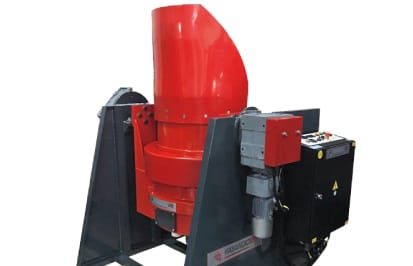
The KAYAKOCVIB KSM series centrifugal disc finishing machines operate on this principle and are designed for small high-precision parts in industries such as medical device manufacturing, aerospace component production, CNC machined parts, and automotive fasteners. The KSM machines provide adjustable disc speed, water and compound dosing control, and programmable cycle management to support repeatable production conditions.
Process Sequence Step by Step
Understanding the full process sequence is essential for consistent results. The following steps describe a standard centrifugal finishing production run for metallic parts.
- Part Inspection Before Loading: Parts should be inspected before loading to confirm that flash, gate stubs, or large casting irregularities have been mechanically removed where necessary. Centrifugal finishing handles light to medium burrs effectively, but large protrusions may require pre-trimming to avoid part damage or media damage during the run.
- Media and Part Loading: Media is loaded first, filling the tub to the recommended fill level, typically between 60 and 80 percent of the tub working volume. Parts are then added. The ratio of media volume to part volume is a key process variable. A higher media-to-part ratio generally protects parts from part-on-part contact and reduces the risk of surface damage on sensitive components.
- Water and Compound Dosing: Finishing compound is introduced with water before or at the start of the cycle. The compound serves multiple functions: it lubricates the media-part contact interface, provides chemical cleaning and degreasing action, prevents rust formation during wet processing, and helps carry away removed material. For steel and stainless steel parts, a deburring and polishing liquid such as a 943-type compound is commonly used. For aluminum and non-ferrous parts, a milder 085-type compound is generally preferred to avoid surface etching.
- Cycle Execution: The disc is started and the process runs for the programmed cycle time. During this phase, disc speed, water flow, and compound concentration should remain stable. Process intensity can be adjusted by changing disc speed. Some applications use a two-phase cycle, starting with a cut phase using aggressive ceramic or plastic media and finishing with a polish or burnish phase using finer media or porcelain media.
- Separation After Processing: At the end of the cycle, parts and media must be separated. In most centrifugal disc systems, the tub opens or tilts and the mass is discharged onto a separation screen or vibratory separator. Media passes through the screen openings while parts are retained and directed to the next stage. Correct screen sizing is essential to avoid media lodging in part features or part loss through the screen.
- Rinsing and Cleaning: After separation, parts typically require rinsing to remove compound residue, fine abrasive particles, and processing liquid. A pressure rinse or cascade rinse is commonly used. For parts with blind holes, recesses, or complex geometries, more thorough washing may be required.
- Drying: Wet parts must be dried promptly to prevent rust formation on ferrous materials. Thermal drying using a centrifugal dryer, trough dryer, or corncob drying media is suitable depending on part geometry and production volume. Parts with trapped water in cavities may require drying assistance.
- Surface Inspection: Final parts should be inspected against the target surface condition. Typical inspection criteria include edge condition, Ra surface roughness if specified, absence of pitting or part damage, and cleanliness. If results fall outside the specification, the process parameters, media selection, or cycle time should be reviewed and adjusted before the next production batch.
Media Selection for Centrifugal Disc Applications
Media selection directly controls the cutting rate, surface finish, and final Ra value achievable in centrifugal finishing. The correct media type depends on the base material, burr size, and required surface quality.
| Part Material | Recommended Media Type | Typical Application |
|---|---|---|
| Steel, Stainless Steel | Ceramic media | Deburring, edge rounding, surface smoothing |
| Aluminum, Zamak | Plastic media | Light deburring, polishing, scratch removal |
| Copper, Brass | Plastic or fine ceramic media | Polishing, surface brightening |
| Titanium, Medical Alloys | Fine ceramic or porcelain media | Surface smoothing, Ra improvement |
Media geometry also matters. Triangular, cylindrical, and spherical media shapes each produce different contact patterns on part surfaces. Angular shapes with flat faces are more effective at reaching flat surfaces and recesses, while spherical and cylindrical shapes are more effective on curved or tubular surfaces. Media size must be selected carefully to prevent lodging in holes, slots, or internal features of the part.
For polishing applications after initial deburring, a secondary cycle with finer media or burnishing media such as stainless steel pins or porcelain balls can improve surface brightness and reduce Ra significantly compared to a single-phase process.
Key Process Parameters and Their Effect on Results
Several process variables interact to determine the surface quality outcome in centrifugal finishing. Controlling these variables consistently is the foundation of a repeatable production process.
| Parameter | Effect on Process | Typical Adjustment Range |
|---|---|---|
| Disc speed (RPM) | Controls process intensity and cutting rate | 60 to 300 RPM depending on machine |
| Cycle time | Controls total material removal and surface refinement | 10 to 60 minutes typical, application dependent |
| Media-to-part ratio | Controls part protection and surface uniformity | 3:1 to 10:1 by volume, depending on part fragility |
| Compound concentration | Controls lubrication, cleaning, and rust inhibition | 1 to 5 percent dilution, compound specific |
| Water flow rate | Controls compound replenishment and slurry consistency | Continuous or intermittent, machine and compound dependent |
Higher disc speed increases cutting intensity and shortens the time needed to remove burrs, but also increases the risk of part damage for thin-walled or delicate components. For sensitive parts, a lower speed combined with a longer cycle time is often a safer approach. Actual parameter settings must be validated through sample testing before committing to full production runs.
Industrial Applications of Centrifugal Finishing
Centrifugal finishing is well suited for small to medium precision parts where short cycle time, consistent surface quality, and high production throughput are important. Common industrial applications include CNC turned and milled components, automotive fasteners, hydraulic valve components, medical implants and surgical instruments, aerospace precision parts, and small stamped or powdered metal parts.
For medical applications in particular, the ability to achieve low Ra surface roughness values on titanium or stainless steel implants without mechanical contact damage is an important advantage of this finishing method. However, medical surface requirements must be validated individually for each part design and material grade, and the finishing process must be qualified within the relevant quality management framework.
In automotive and fastener production, centrifugal disc finishing is often used to deburr and edge-round parts after CNC machining or thread rolling, preparing surfaces for subsequent coating, plating, or assembly operations. The high throughput capacity of centrifugal disc machines makes them practical for batch production environments.
Automation and Line Integration
In high-volume production environments, centrifugal finishing is often integrated into a semi-automated or fully automated finishing line. A typical automated line includes part loading and dosing, the centrifugal disc machine, an integrated or downstream separator, a washing or rinsing station, and a drying unit.
Automated compound dosing systems maintain consistent compound concentration throughout the production shift, reducing operator dependency and improving batch-to-batch repeatability. Water management systems can be integrated to recycle process water, reduce consumption, and handle wastewater in compliance with local environmental regulations.
For facilities processing multiple part types, programmable recipe management allows operators to recall validated process parameters for each part number, reducing setup time and process variation between production runs.
Production Risks and Validation Points
Several production risks are specific to centrifugal disc finishing and should be addressed during process development and validation.
- Part-on-part contact damage can occur if the media-to-part ratio is too low or if parts are loaded in excessive quantity. Increasing the media ratio or reducing the batch size typically resolves this.
- Media lodging in holes or slots is a known risk when media geometry is not properly matched to part features. Selecting slightly larger media or using a different media shape usually prevents lodging.
- Over-processing can cause excessive edge rounding, dimensional change on tight-tolerance features, or surface texture degradation. Cycle time must be carefully controlled and validated against the part drawing tolerances.
- Compound foaming at high disc speeds can disrupt process stability. Using a low-foam compound formulated for centrifugal applications prevents this issue.
- Rust formation on ferrous parts during or after wet processing can occur if compound concentration is too low or if drying is delayed. Monitoring compound concentration and drying parts promptly after separation are standard precautions.
Before releasing a centrifugal finishing process to full production, sample runs should be conducted with representative parts to confirm that the target surface condition, dimensional tolerances, and edge requirements are consistently met. Process validation documentation is especially important for regulated industries such as medical device manufacturing.
Frequently Asked Questions
What types of parts are best suited for centrifugal finishing?
Small to medium precision parts with light to medium burrs, complex geometries, or high surface finish requirements are generally well suited. Parts that are too large, too thin, or have very large protruding features may not be appropriate without pre-processing or an alternative finishing method.
How does centrifugal finishing compare to vibratory finishing in cycle time?
Centrifugal disc finishing typically operates at a higher process intensity than vibratory finishing, which usually results in shorter cycle times for equivalent material removal. The actual difference depends on part material, media selection, and target surface quality, and should be confirmed through sample testing rather than assumed.
Can centrifugal finishing be used for both deburring and polishing?
Yes. Many production processes use a two-phase approach: an initial deburring phase with cutting media followed by a polishing or burnishing phase with finer media. This allows the process to achieve both effective burr removal and improved surface finish in a single production sequence.
Is centrifugal finishing suitable for aluminum parts?
Yes, but plastic media rather than ceramic media is generally preferred for aluminum to avoid aggressive surface cutting. A mild compound formulated for non-ferrous metals should be used. Process parameters should be validated to confirm that the surface condition meets the part specification.
Related Machine and Process Resources
Related Video Demonstration
Conclusion
Centrifugal finishing offers a practical and efficient route to deburring, edge rounding, and surface smoothing for small to medium precision components across a wide range of industrial applications. The process delivers higher intensity than conventional vibratory methods, making it effective for applications where shorter cycle times and consistent surface quality are production requirements. Achieving reliable results depends on correctly selecting media type and geometry, controlling disc speed and cycle time, maintaining compound concentration, and validating the process against part-specific tolerances before full production release. For manufacturers evaluating centrifugal finishing for CNC machined parts, medical components, automotive fasteners, or aerospace precision parts, the process offers a scalable and automatable solution when correctly engineered and validated for the specific application.
Sorry, the comment form is closed at this time.