



02 Jul Centrifugal Disc Finishing Machine
The centrifugal disc finishing machine is one of the most energy-dense mass finishing technologies available in industrial production environments. Unlike vibratory finishing, which relies on low-frequency oscillation to move media against parts, centrifugal disc machines use a high-speed rotating disc at the base of a stationary bowl to generate intense relative motion between the finishing media and the workpiece. This mechanism produces significantly higher finishing forces than conventional vibratory systems, making it particularly suitable for applications where short cycle times, consistent edge rounding, and controlled surface improvement are required on small to medium precision parts.
In This Article
Operating Principle and Machine Architecture
The core of a centrifugal disc finishing machine is a flat disc mounted at the bottom of a fixed cylindrical bowl. When the disc rotates at high speed, friction between the disc surface and the media-part mixture causes the entire batch to rotate and climb up the stationary bowl wall. As the mass reaches the top of the wall, gravity pulls it back toward the center and down into the disc zone again. This creates a continuous toroidal flow pattern where parts and media recirculate rapidly through the active finishing zone.
The relative velocity between media and parts in this flow pattern is substantially higher than in vibratory machines operating at standard frequencies. This higher contact energy is what compresses cycle times and enables more aggressive deburring, edge rounding, and surface refinement within a shorter period. Depending on part geometry, material, burr characteristics, and media selection, processes that might require 60 to 120 minutes in a vibratory machine can often be completed in 10 to 30 minutes in a centrifugal disc machine, though actual results depend on application conditions and require process validation.
Process Sequence from Loading to Unloading
Understanding the full process sequence is essential for consistent production results. The following steps describe the typical operation of a centrifugal disc finishing machine in a production environment.
- Parts are loaded into the bowl along with the selected finishing media. The media-to-part volume ratio must be determined based on part size, geometry, and fragility. A typical starting ratio is approximately 3:1 to 5:1 media to parts by volume, though this requires validation per application.
- Process compound and water are added. Compound flow is typically set as a continuous drip or timed injection during the process cycle. Compound type depends on the base material and finishing objective.
- The disc motor is started. The disc speed is the primary intensity control parameter. Higher disc speed increases media pressure and cutting action. Lower disc speed reduces intensity and is used for fine polishing or fragile parts.
- The machine runs for the programmed cycle time. During the cycle, the operator or control system monitors compound flow, water level, and machine condition. In automated lines, cycle time and disc speed can be programmed via PLC.
- At the end of the cycle, the machine stops or transitions to a separation phase. In machines equipped with an unloading gate, the bowl opens and parts and media discharge together onto a separator.
- Parts are separated from media using a vibrating or rotary separator. Media returns to the machine or to a media storage system. Parts proceed to washing or drying depending on the downstream process requirement.
Disc Speed and Its Effect on Process Intensity
Disc speed is the most direct control parameter in centrifugal disc finishing. Speed determines how much kinetic energy is transferred to the media-part mixture. At higher speeds, media pressure against part surfaces increases, which accelerates material removal, deburring rate, and edge rounding. At lower speeds, the process becomes gentler and is more suitable for pre-polishing or final surface refinement stages.
Most industrial centrifugal disc machines allow variable speed control, which enables a single machine to handle both aggressive deburring in the first stage and fine polishing in a second stage by simply reducing disc speed and changing the compound. This programmable flexibility is one of the practical advantages of this machine type over fixed-intensity systems.
Media Selection for Common Part Materials
Media selection in centrifugal disc finishing follows the same base logic as in vibratory finishing, but the higher energy environment requires careful matching of media hardness, size, and shape to the part material and geometry.
For steel and stainless steel parts, ceramic media is the standard choice for deburring and edge rounding. Ceramic media provides sufficient hardness and cutting action to handle steel burrs and scale efficiently. Typical compound for steel applications is a deburring and polishing liquid such as 943 series compounds, combined with 028-S degreasing liquid when oil or coolant contamination is present on incoming parts.
For aluminum, zinc alloy, and other softer non-ferrous metals, plastic media is generally preferred. Plastic media is less aggressive, which prevents excessive material removal and surface damage on softer workpieces. For these materials, 085 series deburring and polishing compound is a common choice, with 028-S for degreasing when needed.
For copper and brass components, compound selection should account for the chemical sensitivity of yellow metals. 028 degreasing compound, which has more acidic characteristics, is typically appropriate for cleaning and finishing these materials.
Media shape also affects process behavior. Angular shapes produce faster cutting action. Round shapes produce burnishing and surface smoothing. Triangular or star-shaped media are commonly used for reaching complex geometries. Media size must be selected to avoid lodging in holes, slots, or recesses on the part. This risk is higher in centrifugal disc machines due to the elevated media pressure, and it should be evaluated during sample testing before production release.
| Part Material | Recommended Media | Primary Compound | Typical Application |
|---|---|---|---|
| Steel / Stainless Steel | Ceramic | 943 deburring liquid | Deburring, edge rounding, pre-plate |
| Aluminum / Zinc Alloy | Plastic | 085 deburring liquid | Deburring, surface refinement |
| Copper / Brass | Ceramic or Plastic | 028 degreasing liquid | Cleaning, light deburring, polishing |
| Mixed Metal Batch | Not recommended | Application-specific | Avoid mixing incompatible metals |
Process Parameters and Adjustment Logic
Beyond disc speed, several additional parameters influence finishing quality and consistency. Compound flow rate affects surface cleanliness, foam behavior, and the cutting efficiency of the media surface. Too little compound causes media glazing, where the media surface becomes smooth and loses cutting ability. Too much compound can create excess foam, reduce visibility, and dilute process chemistry below effective concentration.
Water level in the bowl must be maintained within the machine’s operating range. The compound-water mixture forms the process slurry that carries away removed material and keeps the media surface active. Process temperature also matters, particularly in high-throughput continuous cycles where friction can raise bowl temperature. Most machines are designed for ambient water input, and process heat is typically managed through compound flow and cycle timing.
Cycle time is determined through sample testing. There is no universal cycle time for centrifugal disc finishing because the required time depends on incoming part condition, burr size, material, media, compound, disc speed, and target surface quality. Initial sample runs at a defined parameter set establish the baseline, and cycle time is then adjusted based on inspection results.
Industrial Applications and Part Suitability
The centrifugal disc finishing machine is widely used across CNC machining, automotive component production, aerospace precision parts, fastener manufacturing, and medical device component finishing. Its compact footprint, short cycle times, and high surface quality output make it a practical choice for production environments where throughput and consistency must both be maintained.
CNC-machined parts such as turned components, milled housings, and precision fittings are typical workpieces. These parts often carry tool marks, sharp edges, and light burrs from machining operations. The high-intensity action of the centrifugal disc machine removes these efficiently while producing a uniform surface condition across the batch. Medical device components, which require consistent surface texture and cleanable geometries, are also well suited to this process, provided that media selection and compound chemistry are validated for biocompatibility and cleanliness requirements.
This machine type is less suitable for very large parts, very long components, or fragile thin-walled structures that could be damaged by the elevated media pressure. For long or large parts, trough vibratory machines are generally more appropriate. For delicate parts where surface marking must be minimized, drag finishing may be a more controlled alternative.
Washing, Separation, and Downstream Requirements
After the finishing cycle, parts and media are discharged and separated. A vibrating separator or rotary screen is typically used to return media to the machine while directing parts to the next stage. Incomplete separation can result in media contamination in the final part batch, which is a production defect that must be controlled.
Wet finishing leaves compound residue, metal fines, and slurry on part surfaces. Washing is typically required after centrifugal disc finishing when parts proceed to coating, plating, inspection, or assembly. Depending on contamination level and surface cleanliness requirement, pressure washing or ultrasonic cleaning may be used. For high-cleanliness applications such as medical or precision aerospace parts, ultrasonic cleaning is often the appropriate downstream step.
Drying is required when parts must be stored or packaged after finishing. Corrosion-prone steel parts must be dried promptly to prevent flash rust. Centrifugal dryers or vibrating hot-air dryers are the common choices depending on part size and geometry.
Wastewater from the process contains compound residue, metal fines, and dissolved materials. This wastewater must be treated before disposal or reuse. In facilities with continuous production, a wastewater treatment and recycling system is typically integrated into the finishing line to manage effluent volume and reduce fresh water consumption.
Automation and Line Integration
The centrifugal disc finishing machine is well suited to automated finishing line integration. In high-volume production environments, parts can be loaded automatically via conveyor or robotic handling, cycle parameters can be controlled by PLC, and unloading can be triggered automatically at cycle completion. Separator, washing, and drying units can be arranged in-line to form a continuous finishing process without manual intervention between stages.
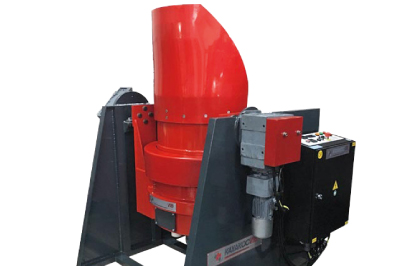
KAYAKOCVIB KSM series centrifugal disc finishing machines are designed for this type of industrial integration, with variable disc speed control, programmable cycle management, and compatibility with downstream separation, washing, and drying equipment. For facilities evaluating process automation, the ability to control disc speed, compound dosing, and cycle time through a centralized control system significantly improves process repeatability and reduces operator-dependent variation.
Production Risks and Validation Points
Several risks must be evaluated before releasing a centrifugal disc finishing process to production. Media lodging in part features is one of the most common issues and must be assessed during sample testing using the exact media size and shape planned for production. Part-on-part impingement can occur if the media-to-part ratio is too low or if part loading density is too high, resulting in surface damage on finished parts.
Insufficient compound flow causes media glazing, which reduces deburring efficiency and leads to inconsistent surface results across the batch. Overlong cycles at high disc speed can cause excessive edge breakdown or surface roughening beyond the target specification. All of these risks are manageable through controlled sample testing, parameter documentation, and periodic process auditing during production.
Before full production release, the following should be confirmed: media size is compatible with part geometry, compound type and flow rate are set for the part material and finishing objective, disc speed and cycle time are defined and documented, part loading quantity per batch is validated, and downstream washing and drying requirements are addressed.
Frequently Asked Questions
What is the main difference between a centrifugal disc finishing machine and a vibratory finishing machine?
A centrifugal disc finishing machine uses a high-speed rotating disc to generate intense media-to-part contact force, producing significantly shorter cycle times than vibratory finishing. Vibratory machines use low-frequency oscillation and are generally better suited for larger parts, longer cycles, or applications where lower process intensity is required.
Which part materials are suitable for centrifugal disc finishing?
Steel, stainless steel, aluminum, copper, brass, and zinc alloys are all commonly processed in centrifugal disc machines. Media and compound selection must be matched to the specific material. Soft metals such as aluminum require plastic media, while harder metals such as steel typically use ceramic media.
How is disc speed selected for a new application?
Disc speed is selected based on part material, burr size, geometry, and target surface quality. Higher speeds provide more aggressive action for heavy deburring. Lower speeds are used for surface refinement or fragile parts. The correct speed is determined through controlled sample testing and should be documented as part of the process specification.
Can centrifugal disc finishing machines be integrated into automated production lines?
Yes. These machines are compatible with automated loading, PLC cycle control, automatic unloading, in-line separation, and downstream washing and drying systems. Automation significantly improves repeatability and reduces manual labor in high-volume production environments.
Related Process Equipment
Related Video Demonstration
Conclusion
The centrifugal disc finishing machine delivers high-intensity finishing action within a compact cycle time, making it a technically effective choice for small to medium precision parts requiring consistent deburring, edge rounding, or surface refinement. Process quality depends on the correct combination of disc speed, media type and size, compound chemistry, cycle time, and batch loading parameters. None of these variables can be assumed from general guidelines alone; each application requires validation through sample testing before production release. When properly configured and integrated with downstream separation, washing, and drying equipment, the centrifugal disc finishing machine supports repeatable, high-throughput production across CNC machining, automotive, aerospace, fastener, and medical component manufacturing environments.
Sorry, the comment form is closed at this time.