



10 Aug Aerospace Surface Roughness
Aerospace surface roughness is one of the most demanding surface quality parameters in industrial manufacturing. Unlike general engineering components, aerospace parts must meet tight Ra tolerances that directly affect fatigue life, aerodynamic performance, fluid flow behavior, coating adhesion, and component reliability under cyclic loading. Achieving and maintaining consistent surface roughness on aluminum airframe parts, titanium structural components, and precision aerospace subassemblies requires a combination of correct machine selection, media and compound matching, and validated process parameters.
In This Article
Why Surface Roughness Matters in Aerospace Applications
In aerospace manufacturing, surface roughness is not a cosmetic attribute. It is an engineering specification that affects how parts behave in service. Rough surfaces on fatigue-critical parts such as turbine blades, landing gear components, structural brackets, and hydraulic system fittings act as stress concentration points that can initiate cracks under repeated loading cycles. This is why aerospace specifications often define maximum Ra values as part of the drawing requirement, not as optional finishing criteria.
Beyond fatigue performance, surface roughness influences coating adhesion quality on anodized or primer-coated parts, sealing performance at mating surfaces, fluid friction in hydraulic or pneumatic channels, and corrosion susceptibility on exposed aluminum and titanium surfaces. A machined aerospace part that leaves the CNC turning or milling center with a surface roughness of Ra 1.6 to Ra 3.2 micrometers may need to reach Ra 0.4 or lower depending on the functional requirement of the finished component.
Typical Aerospace Parts, Materials, and Surface Conditions
Aerospace surface finishing operations typically involve a relatively narrow group of materials. Aluminum alloys, particularly 2024, 6061, and 7075 series, are the most common structural materials encountered in airframe machining. Titanium alloys, primarily Ti-6Al-4V, appear in high-strength structural parts, fasteners, and engine-adjacent components where weight-to-strength ratio and temperature resistance are priorities. Both materials present distinct finishing challenges.
Aluminum is softer and more prone to smearing, scratching, and surface contamination from aggressive media. Titanium is significantly harder and more chemically reactive at elevated temperatures, which limits the use of high-temperature or strongly alkaline finishing compounds. Machined surfaces on both materials typically show tool marks, micro-burrs at drilled hole edges, and surface irregularities from fixturing contact that must be resolved before the part proceeds to anodizing, coating, or assembly.
Recommended Process Route for Aerospace Surface Finishing
The finishing process route for aerospace parts depends on the starting surface condition, the target Ra specification, the part geometry, and the batch volume. A typical route for CNC-machined aluminum aerospace components begins with deburring to remove micro-burrs and sharp edge conditions, followed by surface smoothing or pre-polish to reduce Ra toward the target range, and then a final polishing or brightening stage if a very fine surface finish is required.
For titanium parts, the process route follows similar logic but requires more careful compound selection. Strongly alkaline compounds can cause surface discoloration or micro-etching on titanium, so neutral or mildly alkaline compounds with low aggressiveness are generally preferred. In all aerospace finishing applications, the process must be validated through sample testing before production release because actual surface roughness results depend on part geometry, batch loading, media type, compound concentration, and machine operating parameters.
Machine Selection for Aerospace Precision Finishing
Two machine types are most relevant to aerospace surface roughness control: centrifugal disc finishing machines and drag finishing machines. Each addresses a different production scenario in terms of part complexity, batch size, and required surface quality level.
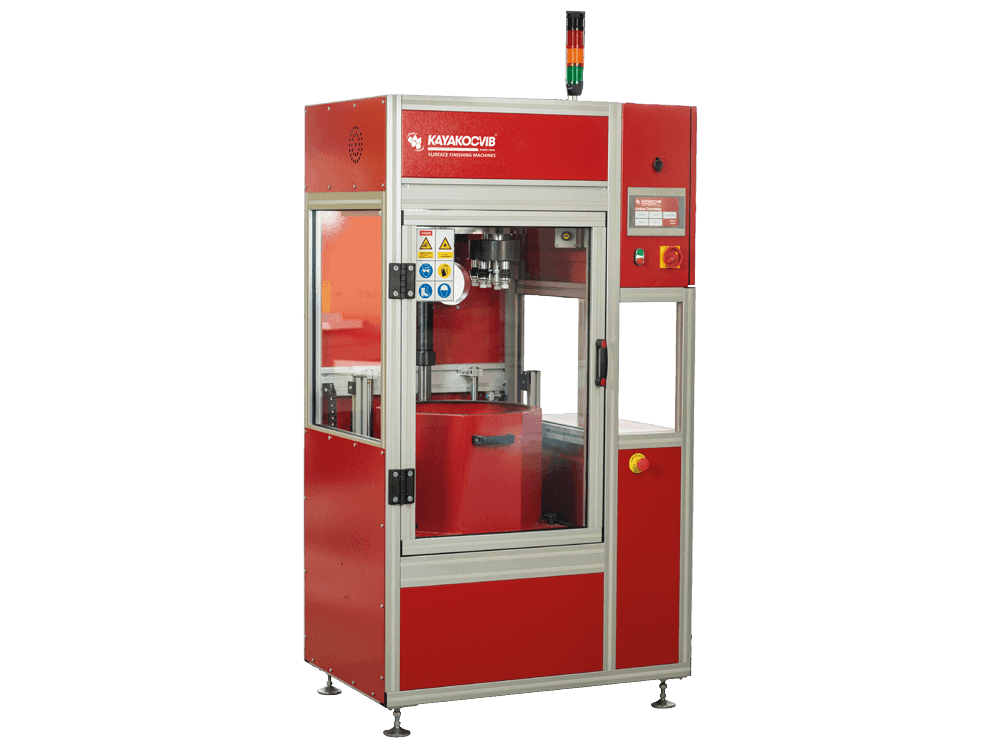
Centrifugal disc finishing machines, such as the KAYAKOCVIB KSM series, generate significantly higher finishing forces than conventional vibratory finishing machines. The rotating disc at the base of the processing bowl creates a toroidal flow of media and parts, producing finishing pressures that are typically several times higher than standard vibratory equipment. This results in shorter cycle times and the ability to reduce surface roughness efficiently on small to medium aerospace parts such as machined brackets, hydraulic fittings, precision shafts, and fastener heads. The KSM series is well suited for applications where consistent Ra reduction is required across high-volume batches of small components.
Drag finishing machines, such as the KAYAKOCVIB DRG series, operate on a fundamentally different principle. Individual parts are fixtured on spindles that rotate and drag the part through a stationary media bed. This controlled relative motion between the part surface and the media produces a highly consistent, isotropic surface finish. Drag finishing is particularly valuable for complex aerospace components such as impellers, structural brackets with critical mating surfaces, and parts where specific surfaces must be finished while other areas are protected from media contact. The controlled nature of drag finishing makes it easier to validate and document process repeatability, which is important for aerospace quality systems.
Media and Compound Selection for Aluminum and Titanium
Media selection has a direct and measurable effect on aerospace surface roughness outcomes. For aluminum aerospace parts, plastic media is the standard choice. Plastic media combines moderate cutting action with a lower density that reduces the risk of surface damage, edge over-rounding, or mechanical smearing on soft aluminum surfaces. The media shape should be selected based on part geometry: cylindrical and triangular shapes are commonly used for general machined surfaces, while smaller cones or pyramids may be selected when internal features, crossholes, or complex recesses must be reached.
For titanium aerospace parts, harder cutting media may be required in the deburring stage due to the material’s resistance to abrasion. However, the polishing stage typically uses finer plastic or resin-bonded media to avoid aggressive material removal. Media size must also be evaluated against part geometry to prevent lodging in drilled holes, slots, or undercuts, which is a significant risk on machined aerospace components with complex geometries.
Compound selection for aluminum aerospace finishing typically uses a mildly alkaline deburring and polishing liquid combined with a compatible degreasing compound to maintain part cleanliness during wet processing. For titanium, neutral pH or mildly alkaline compounds are preferred to avoid surface reaction. Compound concentration, water flow rate, and replenishment frequency must all be defined as process parameters and maintained consistently during production.
Process Parameters That Control Surface Roughness
Achieving a target Ra value in aerospace surface finishing is not simply a matter of running parts through a finishing machine. Several interdependent process parameters must be defined and controlled. The table below summarizes the key variables and their effect on surface roughness outcome.
| Process Parameter | Effect on Surface Roughness | Notes |
|---|---|---|
| Media type and hardness | Controls cutting rate and final Ra achievable | Plastic for aluminum, harder grades for titanium deburring |
| Media size | Affects contact area and penetration into features | Smaller media reaches recesses but increases lodging risk |
| Machine speed or intensity | Higher intensity reduces Ra faster but increases edge rounding risk | Must be balanced against part geometry sensitivity |
| Cycle time | Longer cycles reduce Ra further but with diminishing returns | Over-processing can cause geometry deviation on thin walls |
| Compound concentration | Controls lubrication, cutting suspension, and surface cleanliness | Low concentration causes smearing; excessive concentration reduces cutting |
| Water flow rate | Affects compound replenishment and swarf removal | Insufficient flow leaves debris embedded in surface |
| Batch load ratio | Part-to-media ratio affects finishing uniformity | Overloading reduces media contact; underloading risks part-on-part damage |
Quality Control and Inspection After Finishing
Aerospace surface roughness must be verified through measurement, not assumed from process settings alone. Surface profilometry using a contact or non-contact profilometer is the standard method for Ra measurement on aerospace components. Measurement points should be defined on engineering drawings or process instructions and must include any surfaces that carry fatigue, sealing, or coating adhesion requirements.
In addition to Ra measurement, visual inspection for surface damage, staining, media embedment, and residual compound is standard practice after finishing. Aluminum parts that proceed to anodizing or primer coating are particularly sensitive to compound residues that can cause coating adhesion failures. This makes post-finishing washing a required step rather than an optional one. Ultrasonic cleaning or pressure washing systems are commonly used after centrifugal disc or drag finishing to remove compound residue and fine abrasive particles from complex part geometries.
Process capability must be established through initial sample testing with representative parts before full production batches are released. Actual Ra results depend on part geometry, fixturing method in drag finishing, media condition, compound freshness, and machine maintenance status. All of these variables must be documented as part of a controlled production process.
Production Line Integration for Aerospace Finishing
In higher-volume aerospace subcontract manufacturing environments, surface finishing operations are increasingly integrated into automated lines that reduce manual handling and improve process consistency. An integrated line for aerospace surface roughness control may include a centrifugal disc finishing machine for high-volume small parts, an automated part-media separator, a washing or ultrasonic cleaning station, and a controlled drying unit to prevent water staining or corrosion on aluminum parts between finishing and coating.
For lower-volume, high-value aerospace components processed on drag finishing machines, automation typically focuses on controlled spindle motion, programmable cycle profiles, and part tracking rather than high-throughput conveyors. The ability to document cycle parameters for each part or batch is increasingly important in aerospace supply chain quality systems where traceability is a customer or regulatory requirement.
Practical Limitations and Validation Requirements
Mass finishing and drag finishing are effective tools for aerospace surface roughness control, but they are not universally applicable without validation. Very thin-walled aluminum aerospace structures may be susceptible to deformation under centrifugal disc finishing forces. Parts with very small internal channels, blind holes below a critical diameter, or delicate surface features may present media lodging or surface damage risks that require process modification or alternative methods.
It is also important to recognize that finishing processes reduce Ra by a mechanism of progressive micro-abrasion. They cannot correct gross geometric deviations, tool chatter marks deeper than the abrasive can reach in a practical cycle time, or surface defects introduced by poor machining setup. The starting surface condition from CNC machining directly determines what the finishing process can realistically achieve within a controlled cycle time. Parts with severe tool marks or deep machining defects may require intermediate operations before finishing can bring the surface within specification.
Frequently Asked Questions
What Ra values are typically achievable on aluminum aerospace parts through centrifugal disc finishing?
With appropriately selected plastic media, correct compound chemistry, and optimized cycle parameters, centrifugal disc finishing on aluminum parts can commonly reduce machined surfaces from Ra 1.6 to Ra 3.2 micrometers down toward Ra 0.4 to Ra 0.8 micrometer range in many industrial applications. However, actual results depend on part geometry, starting surface condition, media grade, and process settings, and must be confirmed through sample testing.
When should drag finishing be chosen over centrifugal disc finishing for aerospace parts?
Drag finishing is preferred when parts have complex geometries that require selective surface finishing, when individual part traceability is important, when very consistent and isotropic surface texture is required on critical mating or sealing surfaces, or when the part value justifies fixturing-based individual processing. Centrifugal disc finishing is better suited for smaller parts processed in higher batch volumes where individual fixturing is not practical.
Can titanium aerospace parts be finished in the same machine as aluminum parts?
Titanium and aluminum parts should not be processed together in the same finishing batch. The different material hardness values, cutting rates, and compound requirements make mixed-batch processing impractical and likely to produce inconsistent surface results. Separate media charges and compound settings are required for each material group.
What washing method is recommended after aerospace surface finishing?
Ultrasonic cleaning is commonly used for complex aerospace parts with internal channels, crossholes, and recesses where compound residue or fine abrasive particles can remain after wet mass finishing. Pressure washing is suitable for simpler geometries. The washing stage is a required process step before anodizing, primer coating, or assembly on aerospace components where surface cleanliness directly affects subsequent process quality.
Related Process Equipment
Related Video Demonstration
Conclusion
Controlling aerospace surface roughness requires an engineering approach that connects part material properties, starting surface condition, machine selection, media and compound chemistry, and measurable quality control at each stage. Centrifugal disc finishing machines are effective for high-volume small aerospace components where consistent Ra reduction and short cycle times are priorities. Drag finishing machines offer controlled, traceable individual part processing for complex or high-value aerospace components where surface uniformity and selective finishing are required. In both cases, the process must be validated through sample testing with representative parts before production release, because surface roughness outcomes in aerospace finishing are application-dependent and cannot be assumed from process settings alone. A well-engineered and documented finishing process is a foundational requirement for meeting the surface quality standards that aerospace structural and functional components demand.
Sorry, the comment form is closed at this time.