



03 Jul Aerospace Centrifugal Finishing
Aerospace centrifugal finishing is a high-energy mass finishing process used to deburr, edge-condition, and surface-smooth precision components made from aluminum alloys, titanium, and other aerospace-grade materials. Unlike standard vibratory finishing, centrifugal disc machines generate significantly higher process forces, allowing shorter cycle times and tighter surface quality control for parts that must meet strict dimensional and fatigue-life requirements.
In This Article
Finishing Requirements for Aerospace Components
Aerospace components carry surface quality requirements that go well beyond cosmetic appearance. Machined aluminum structural brackets, titanium fasteners, hydraulic valve bodies, and precision housings must meet edge condition specifications, surface roughness targets, and cleanliness standards before assembly or coating. Uncontrolled burrs on machined edges can cause stress concentration, fatigue crack initiation, or interference during assembly. Residual machining marks, tool paths, and micro-scratches on functional surfaces can affect sealing performance and fatigue resistance.
For most aerospace aluminum and titanium components produced by CNC machining, the finishing requirements typically include controlled edge rounding without excessive material removal, surface roughness reduction to support anodizing, hard anodizing, or conversion coating adhesion, and complete removal of chips, cutting oil residue, and machining burrs. These requirements must be met consistently across production batches, which makes process repeatability a primary engineering concern.
Why Centrifugal Disc Finishing Suits Aerospace Applications
Standard circular vibratory finishing machines operate at relatively low process intensity. They are suitable for general deburring and surface conditioning of many industrial parts, but for aerospace components with tight tolerances and demanding surface specifications, the energy level of vibratory finishing may require long cycle times or may not achieve the required surface quality consistently.
Centrifugal disc finishing machines generate process forces typically five to ten times higher than those produced in circular vibratory machines. This is achieved through a rotating disc mounted at the base of a fixed cylindrical bowl. The disc rotation drives the media-part mass in a toroidal flow pattern, creating high-pressure, high-frequency contact between media and part surfaces. The result is faster material removal, more uniform edge rounding, and superior surface smoothing within significantly shorter cycle times.
For aerospace production, the key engineering advantages of centrifugal disc finishing are consistent edge condition control, repeatable surface roughness results, and the ability to process small to medium precision parts without introducing dimensional distortion when media and process parameters are correctly selected.
Typical Aerospace Parts Processed by This Method
Aerospace centrifugal finishing is applied across a range of part families. The most common include CNC-machined aluminum structural components such as brackets, ribs, and frames; titanium and aluminum fasteners including bolts, nuts, and inserts; hydraulic and pneumatic valve bodies; precision housings and end caps; and small actuator components. Parts with complex geometries, internal channels, or multiple machined surfaces benefit from the all-around media contact that centrifugal disc machines provide.
Part size is a relevant selection factor. Centrifugal disc machines are generally most effective for small to medium components that fit comfortably within the bowl without risk of part-to-part impact damage. Larger or more delicate structural panels may require vibratory finishing or drag finishing instead, depending on geometry and fragility.
Media and Compound Selection for Aerospace Materials
Correct media and compound selection is one of the most important engineering decisions in any aerospace centrifugal finishing application. Incorrect media can cause excessive material removal, dimensional change, surface smearing, or media lodging in recesses.
For aerospace aluminum alloys, plastic media is the standard recommendation. Plastic media is a polymer-bonded abrasive available in various shapes including cones, triangles, cylinders, and wedges. Its lower density and softer cutting action make it suitable for aluminum without the risk of over-cutting or introducing surface stress. Plastic media in finer grit grades can also be used for polishing and pre-anodizing surface conditioning.
For titanium components, the media selection depends on the finishing objective. Light deburring of CNC-machined titanium can be performed with medium-density plastic media, while more aggressive edge conditioning may require ceramic media with appropriate compound selection. Ceramic media provides harder, faster cutting action and is better suited to the mechanical strength of titanium alloys. The choice between plastic and ceramic media for titanium requires application-specific testing and validation.
Finishing compounds used in wet centrifugal finishing serve as lubricants, surface activators, and cleaning agents during the process. For aluminum, a neutral to mildly alkaline deburring and polishing liquid is typically selected to support cutting action while protecting the part surface from chemical attack. For titanium, compound chemistry must be compatible with the alloy to avoid hydrogen embrittlement or surface contamination. Compound selection, concentration, and flow rate must be validated for each aerospace application before production release.
| Material | Recommended Media Type | Typical Finishing Objective | Key Compound Consideration |
|---|---|---|---|
| Aerospace Aluminum | Plastic media, various shapes | Deburring, edge rounding, pre-anodizing smoothing | Neutral to mildly alkaline compound, aluminum-safe |
| Titanium Alloys | Plastic or ceramic depending on burr size | Light deburring to controlled edge conditioning | Compound must be titanium-compatible, no hydrogen risk |
| Aluminum Fasteners | Fine plastic media | Burr removal, surface brightening | Low-foam compound, rinsing critical |
Process Parameters That Control Surface Quality
In aerospace centrifugal finishing, surface quality is controlled by a combination of machine settings, media type, compound chemistry, and cycle time. Each parameter interacts with the others, and changes to one variable typically require re-validation of the full parameter set.
Disc rotation speed is the primary energy control variable. Higher disc speed increases process intensity, accelerates material removal, and reduces cycle time, but also increases the risk of part damage if speed exceeds the safe threshold for the part geometry and material. Lower disc speed reduces cutting aggressiveness and is preferred for final polishing or surface brightening stages. For most aerospace aluminum components, disc speed is set conservatively to balance productivity and surface quality.
Media fill level and media-to-part ratio directly affect how parts move within the bowl and how uniformly media contacts all surfaces. Insufficient media volume reduces finishing consistency and increases part-to-part contact risk. Excessive media can reduce the energy transferred to parts. The correct media-to-part ratio must be established during process development and maintained consistently in production.
Cycle time determines the depth of edge rounding and surface roughness achieved. Short cycles typically produce burr removal with limited Ra reduction. Extended cycles achieve smoother surfaces but increase the risk of over-processing or rounding sharp features beyond tolerance. For aerospace applications, cycle time is typically validated during qualification testing and controlled with timers in production.
Compound flow rate controls surface cleanliness, lubrication during finishing, and chip flushing. An inadequate flow rate allows chips and media wear debris to accumulate on part surfaces, potentially causing scratching or redeposition. Correct compound flow must be established during process setup and checked periodically in production.
Process Route for CNC-Machined Aerospace Parts
A typical aerospace centrifugal finishing process route follows a structured sequence from pre-cleaning through finishing, separation, washing, and inspection.
- Pre-cleaning or degreasing to remove cutting oils, coolant residue, and chips before finishing. Residual oils can interfere with compound performance and contaminate media.
- Loading parts and media into the centrifugal disc machine bowl at the correct media-to-part ratio.
- Running the finishing cycle at validated disc speed, compound flow rate, and cycle time.
- Unloading the bowl and separating parts from media using a separator machine. Separation must be complete to prevent media fragments from entering finished assemblies.
- Rinsing or washing finished parts to remove compound residue, media dust, and chips. For aerospace applications, post-process washing is typically mandatory before inspection or coating.
- Drying parts completely before inspection, packaging, or coating. Residual moisture can cause oxidation on aluminum surfaces and must be eliminated.
- Surface inspection including visual check for remaining burrs, dimensional check on critical features, and surface roughness measurement where specified.
Machine Selection for Aerospace Production
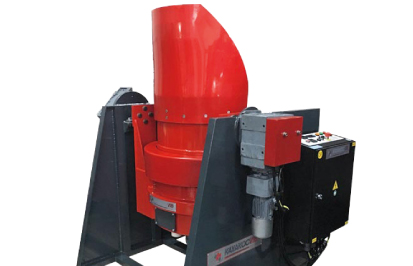
KAYAKOCVIB KSM centrifugal disc finishing machines are designed for high-energy finishing of small to medium precision parts. The KSM series is suitable for aerospace aluminum and titanium components where consistent surface quality and short cycle times are required. The fixed bowl and rotating disc design generates the high process intensity needed for aerospace centrifugal finishing while maintaining controlled part movement to reduce damage risk.
Machine selection within the centrifugal disc range depends on part size, production volume, and batch size requirements. For small aerospace fasteners and inserts, smaller bowl volumes allow precise media-to-part ratio control. For medium-sized machined components, larger bowl configurations support higher batch throughput. In both cases, disc speed adjustment, compound dosing control, and timer-controlled cycles are essential features for aerospace process repeatability.
When aerospace finishing lines include pre-washing, centrifugal finishing, separation, post-washing, and drying stages, integration of each unit into a controlled sequence is important for consistent quality. Automated part transfer between stages reduces handling contamination and supports production traceability requirements.
Limitations and Validation Requirements
Aerospace centrifugal finishing is a highly capable process, but it has defined limitations that must be acknowledged in any engineering application. Very large or flat structural components may not be suitable for centrifugal disc machines due to bowl geometry constraints and part damage risk. Parts with deep blind holes or very narrow internal channels may experience media lodging, which requires post-process inspection and, in some cases, redesign of the finishing process route.
Titanium parts with thin cross-sections or sharp functional features require careful process development to avoid over-processing. Aluminum castings with thin walls or fragile projections may require lower disc speeds or protective media separation strategies. No process parameter set should be transferred from one part family to another without validation, as geometry, alloy, and surface condition differences significantly affect finishing behavior.
All aerospace finishing processes require qualification testing before production release. This typically includes sample processing, dimensional measurement, surface roughness measurement, edge condition assessment, and in some cases fatigue testing to confirm that the finishing process does not introduce surface damage. Actual results depend on application conditions, material batch variation, media wear state, and machine condition, all of which must be monitored in production.
Frequently Asked Questions
What is aerospace centrifugal finishing used for?
Aerospace centrifugal finishing is used to deburr machined edges, reduce surface roughness, condition part surfaces before anodizing or coating, and remove chips and cutting residues from aluminum and titanium aerospace components.
Why is centrifugal disc finishing preferred over vibratory finishing for aerospace parts?
Centrifugal disc machines generate significantly higher process forces than vibratory machines, resulting in shorter cycle times, more consistent edge rounding, and better surface quality control for precision aerospace components.
What media should be used for aerospace aluminum parts?
Plastic media is generally recommended for aerospace aluminum alloys because of its lower density and gentler cutting action, which reduces the risk of dimensional distortion or surface damage on precision components.
Can centrifugal finishing be used for titanium aerospace parts?
Yes, but media selection, compound chemistry, and process parameters must be validated for titanium. Plastic or ceramic media may be used depending on the deburring requirement, and compound chemistry must be compatible with the alloy.
Is process validation required for aerospace finishing applications?
Yes. All aerospace centrifugal finishing processes must be qualified through sample testing, dimensional measurement, surface roughness verification, and edge condition assessment before production release. Actual results depend on part geometry, material, media, and machine settings.
Related Process Equipment
Related Video Demonstration
Conclusion
Aerospace centrifugal finishing provides a technically sound solution for the consistent deburring, edge conditioning, and surface preparation of machined aluminum and titanium components. The high-energy process environment of centrifugal disc machines delivers the surface quality levels and cycle time efficiency that aerospace production demands, provided that media selection, compound chemistry, disc speed, and cycle time are carefully validated for each application. Machines such as the KAYAKOCVIB KSM series offer the controlled process parameters necessary for repeatable aerospace finishing. As with all aerospace surface processes, qualification testing, in-process monitoring, and post-process inspection remain essential requirements before any process is approved for production release.
Sorry, the comment form is closed at this time.