



11 Aug Aerospace Edge Quality Deburring
Aerospace edge quality deburring is one of the most demanding surface finishing requirements in industrial manufacturing. Aerospace components made from aluminum alloys and titanium must meet strict edge condition specifications that directly affect fatigue life, aerodynamic performance, coating adhesion, and assembly integrity. Unlike general industrial deburring where burr removal alone is sufficient, aerospace finishing requires controlled edge geometry, consistent radius, and defined surface roughness achieved within validated process parameters.
In This Article
Why Edge Quality Matters in Aerospace Components
In aerospace structures and engine components, an uncontrolled edge is not simply a cosmetic issue. Sharp edges and micro-burrs act as stress concentration points. Under cyclic loading, these stress risers initiate fatigue cracks that propagate through the part. For flight-critical components, this represents a structural risk that must be engineered out during the manufacturing process.
Burrs and sharp edges also affect sealing surfaces, mating interfaces, and fluid flow behavior in hydraulic, fuel, and pneumatic systems. A burr that detaches during service can contaminate fluid circuits or jam precision mechanisms. Edge rounding requirements in aerospace specifications are therefore functional, not cosmetic.
Coating and anodizing processes also require controlled edge geometry. Thin anodic or conversion coating layers do not cover sharp edges uniformly. A controlled radius ensures coating continuity across all edge zones, which is particularly important for corrosion protection in aluminum structural parts.
Typical Aerospace Parts and Their Edge Conditions
Aerospace machined components present a wide range of edge conditions depending on the manufacturing process used. CNC milled aluminum brackets, frames, and structural ribs typically exit machining with burrs ranging from light feather burrs to heavier exit burrs at intersecting features. Titanium components from milling or drilling operations often carry harder, more tenacious burrs that resist removal by light mechanical action.
Intersecting hole edges, pocket corners, and slot exits are the most difficult zones to address consistently. Manual deburring methods cannot reliably produce the same edge radius at every feature across a batch of complex parts. This inconsistency is the primary driver for mechanized aerospace edge quality deburring using controlled finishing processes.
Common aerospace part families requiring edge finishing include:
- Structural brackets and mounting plates in aluminum 6061 and 7075
- Hydraulic manifold bodies in aluminum and titanium
- Engine turbine disc and blade root profiles in titanium alloys
- Control surface hinges and actuator brackets
- Precision housings for avionics and navigation equipment
Recommended Process Route for Aerospace Deburring
The standard process route for aerospace edge quality deburring follows a defined sequence from burr removal through edge rounding, surface conditioning, cleaning, and inspection. Each stage must be controlled and repeatable to meet aerospace documentation requirements.
- Pre-process inspection to classify burr height, edge sharpness, and surface condition before finishing
- Mechanical deburring in a centrifugal disc or drag finishing machine with appropriate media and compound
- Intermediate inspection to confirm burr removal and initial edge radius formation
- Edge rounding refinement if required, using finer media grade or extended cycle time
- Aqueous washing to remove residual compound, chips, and finishing residue from part surfaces and internal features
- Drying to prevent water staining or hydrogen embrittlement risk on titanium parts
- Final surface and edge inspection using optical or contact measurement methods
For titanium components, the washing and drying stages require particular attention. Titanium is sensitive to hydrogen uptake at elevated temperatures and from prolonged contact with acidic compounds. Compound selection and rinsing thoroughness must be validated as part of the process approval.
Machine Selection for Aerospace Edge Finishing
Machine selection is the most consequential engineering decision in setting up an aerospace deburring process. The choice between centrifugal disc finishing and drag finishing depends on part geometry, required edge radius, surface roughness target, and batch size.
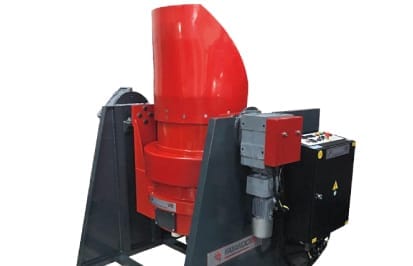
Centrifugal disc finishing machines are well suited for small to medium aerospace components where high process intensity and short cycle times are required. The centrifugal disc generates a toroidal flow that presses media forcefully against all exposed surfaces of the part. This action produces consistent burr removal and edge rounding across complex geometries in cycle times that are typically significantly shorter than conventional vibratory finishing. KAYAKOCVIB KSM series centrifugal disc finishing machines are used in aerospace applications for precision aluminum components where consistent edge condition and surface finish must be achieved within a controlled and repeatable process.
Drag finishing is the preferred method for high-value precision parts where part-to-part contact must be eliminated. In drag finishing, each part is fixtured individually and dragged through a stationary media bed at controlled speed and angle. The relative motion between the media and the part surface produces highly uniform material removal across the entire part surface, including complex contours and transition zones. KAYAKOCVIB DRG series drag finishing machines are suitable for aerospace components where zero part-to-part contact, controlled edge radius, and high surface finish quality are required simultaneously.
| Process Parameter | Centrifugal Disc Finishing | Drag Finishing |
|---|---|---|
| Cycle time | Short, typically minutes | Moderate, part dependent |
| Part-to-part contact | Possible in batch processing | None, individual fixturing |
| Edge rounding control | Good for complex geometries | High, programmable |
| Surface finish quality | Good to very good | Very good to excellent |
| Best fit | Small to medium batch parts | High-value precision parts |
| Automation potential | High, batch loading | Moderate, fixture-based |
Media and Compound Selection for Aluminum and Titanium
Media and compound selection must be matched to the base material and the target edge condition. Incorrect media selection is one of the most common causes of inconsistent edge quality or surface damage in aerospace finishing.
For aerospace aluminum alloys such as 6061 and 7075, plastic media is the standard choice. Plastic media is softer than ceramic and produces controlled cutting action without aggressive stock removal that could alter part geometry or create unwanted surface texture. For aerospace aluminum deburring, plastic media combined with a deburring and polishing liquid such as KAYAKOCVIB 085 compound delivers consistent burr removal and edge rounding without damaging thin walls or precision-machined features. A degreasing liquid such as 028-S is typically used in the washing stage to remove machining oil residue and compound carry-over.
For titanium aerospace components, the media and compound selection requires more careful engineering. Titanium is harder and more abrasion-resistant than aluminum, and light plastic media may produce insufficient cutting action on heavier burrs. In some titanium applications, a harder plastic media grade or a specially formulated cutting compound is required to achieve the target edge radius within a practical cycle time. Process validation testing is essential before committing to a media and compound combination for titanium parts.
Media shape also affects edge rounding behavior. Triangular or wedge-shaped media reaches into pocket corners and slot entries where cylindrical or spherical media cannot penetrate. For aerospace components with complex internal geometries, a mixed media charge that includes at least one angular shape should be considered to ensure consistent coverage across all edge zones.
Process Parameters That Control Edge Rounding
In aerospace edge quality deburring, several process parameters directly determine whether the target edge condition is achieved consistently across a production batch.
Machine speed or rotational frequency controls the contact force between media and part. Higher speeds increase material removal rate and shorten cycle time, but also increase the risk of surface damage on delicate features. Speed settings must be optimized through sample testing for each part type and material combination.
Cycle time determines how much material is removed and how much edge radius develops. Insufficient cycle time leaves residual burrs or insufficient radius. Excessive cycle time removes too much material from sharp corners, rounds functional geometry unintentionally, or degrades surface finish. Cycle time must be established through controlled sample runs with post-process dimensional and edge inspection.
Media-to-part ratio in the finishing chamber affects how uniformly the media acts on all part surfaces. An underfilled chamber produces non-uniform contact and inconsistent edge rounding. Manufacturer-recommended loading volumes should be used as the starting point, with adjustment based on sample results.
Compound concentration and flow rate affect cutting speed and surface cleanliness throughout the process. Compound dilution that is too low reduces lubrication and risks surface scratching. Compound dilution that is too high reduces cutting action and extends cycle time. Water hardness also affects compound performance and should be monitored in production environments.
Quality Control and Inspection Requirements
Aerospace edge quality deburring requires documented inspection at defined points in the process route. Visual inspection alone is not sufficient for aerospace applications where edge radius specifications are quantitative.
Edge radius measurement is commonly performed using optical profilometry, digital microscopy, or contact stylus instruments. Measurement points should be defined on the engineering drawing or process specification and include the most difficult edge zones such as intersecting holes, slot exits, and pocket transitions.
Surface roughness measurement confirms that the finishing process has achieved the required Ra value without introducing unwanted texture or directional scratch marks. For aerospace aluminum parts, typical post-finishing surface roughness targets depend on the part function and are specified on the engineering drawing. Process capability must be demonstrated across a statistically meaningful sample before production release.
Foreign object debris prevention is an additional quality requirement in aerospace finishing. Parts must be inspected for media particles or compound residue in recesses, blind holes, and threaded features after finishing and washing. This is particularly relevant when finishing parts with fine threaded inserts or small-diameter holes where media lodging is a risk. Media size selection should always consider minimum hole diameter to eliminate lodging probability.
Frequently Asked Questions
What edge radius is typically required for aerospace aluminum structural parts?
Edge radius requirements vary by part function and are defined on the engineering drawing or applicable process specification. Typical controlled edge rounding values for aerospace structural aluminum parts commonly range from 0.05 mm to 0.3 mm, but the exact value must be confirmed from the design authority document. Process validation testing is required to confirm that the finishing process consistently achieves the specified radius.
Can centrifugal disc finishing replace manual deburring for aerospace components?
For many small to medium aerospace aluminum components, centrifugal disc finishing can replace manual deburring and provide significantly better process consistency. However, parts with very tight internal passages, fragile features, or complex fixturing requirements may require drag finishing or supplementary manual deburring in specific zones. The decision must be based on part geometry analysis and validated sample testing.
Is drag finishing suitable for titanium aerospace parts?
Drag finishing is technically suitable for titanium parts when the correct media grade and compound are selected. Titanium requires higher cutting action than aluminum, and media and compound selection must be validated through sample testing. Cycle time, machine speed, and compound formulation all require application-specific optimization before production use.
What washing process is recommended after aerospace deburring?
Aqueous washing with a dedicated degreasing compound is standard after aerospace wet deburring. For components with blind holes or complex internal passages, pressure washing or ultrasonic cleaning may be required to ensure complete removal of finishing residue and loose particles. The washing process must be validated as part of the overall aerospace edge quality deburring process qualification.
Related Process Equipment
Related Video Demonstration
Conclusion
Aerospace edge quality deburring is a precision-controlled finishing discipline that goes well beyond simple burr removal. Achieving consistent edge radius, defined surface roughness, and foreign object debris cleanliness on aluminum and titanium components requires the correct combination of machine type, media grade, compound formulation, and validated process parameters. Centrifugal disc finishing suits high-volume small-part applications where short cycle times and good surface quality are required. Drag finishing is the engineering choice for high-value parts where individual fixturing, zero part-to-part contact, and maximum surface quality are priorities. In both cases, process qualification through sample testing, dimensional inspection, and documented parameter control is the foundation of a compliant aerospace finishing operation. Selecting the right process route for aerospace edge quality deburring early in the manufacturing planning phase prevents costly rework and supports downstream processes including coating, anodizing, and assembly.
Sorry, the comment form is closed at this time.