


10 Aug Automated Finishing Aerospace
Automated finishing aerospace applications demand a level of process consistency, traceability, and surface quality control that manual or semi-manual methods cannot reliably deliver at production scale. When aerospace suppliers process structural brackets, turbine housings, hydraulic valve bodies, landing gear components, or precision machined fittings, the finishing stage directly influences fatigue life, dimensional integrity, coating adhesion, and compliance with engineering drawings. This article examines how automated surface finishing is implemented for aerospace part families, which machine types are suited to specific geometries and materials, how media and compound selection is approached for aluminum and titanium, and where quality control and production integration require careful engineering decisions.
In This Article
Surface Finishing Requirements in Aerospace Supply Chains
Aerospace finishing requirements differ from general industrial applications because surface condition tolerances are tight, material removal must be controlled precisely, and process repeatability must be documented. Machined aluminum structural parts typically carry sharp machining burrs, tool marks, and residual chip contamination. Titanium components used in engine-adjacent applications present harder burrs and greater sensitivity to heat and chemical reactions. In both cases, the finishing process must achieve consistent edge rounding, defined surface roughness within drawing limits, and cleanliness suitable for subsequent coating, anodizing, or inspection steps.
For aerospace suppliers operating under quality management frameworks, process variability is a direct risk. If cycle parameters change between batches, or if operator loading practices differ, the surface output changes with them. Automated finishing systems remove these variables by fixing machine settings, media type, compound dosing, and cycle time within validated process parameters. The result is a repeatable, documented finishing route that supports both internal quality control and customer audits.
Typical Aerospace Parts, Materials, and Finishing Challenges
Aerospace surface finishing covers a wide range of part families. Structural aluminum brackets and housings machined from 6061-T6 or 7075-T6 alloys are among the most common candidates for mass finishing automation. These parts carry light to medium machining burrs, require controlled edge rounding without altering tight tolerances, and must be free of surface contamination before anodizing or chromate conversion coating. The soft nature of aerospace aluminum means that finishing intensity must be managed carefully to avoid micro-scratching, part-on-part impact marks, or geometry distortion on thin walls.
Titanium components such as brackets, fittings, and housings machined from Ti-6Al-4V are harder to finish. Titanium burrs are tougher, media cutting action must be stronger, and the process must avoid hydrogen embrittlement risk from aggressive acid-based compounds. Cycle time requirements for titanium are typically longer than for aluminum, and media selection must balance cutting efficiency with surface integrity.
Precision small parts such as hydraulic fittings, aerospace fastener components, and instrumentation housings require a different finishing approach. For these parts, the geometry is complex, dimensional tolerances are tight, and surface roughness targets may fall in the range where standard vibratory mass finishing alone may not be sufficient without careful parameter control. Short cycle times with high process intensity, as available in centrifugal disc machines, are often better suited to these requirements.
Recommended Process Route for Aerospace Parts
A typical automated finishing aerospace process route for machined aluminum parts follows a defined sequence. Parts enter the finishing system after machining and cleaning, pass through the mass finishing stage where burrs are removed and surface roughness is refined, then proceed through part-media separation, washing, rinsing, and drying before moving to inspection or coating. Each stage must be controlled and monitored to maintain consistency across batches.
- Pre-cleaning or chip removal if heavy contamination is present before finishing.
- Loading parts into the finishing machine at a validated fill level with the correct media type and volume.
- Compound dosing through an automated liquid dosing system at a set flow rate and concentration.
- Running the finishing cycle for the validated duration at the specified machine intensity setting.
- Discharging parts and media to a separator where parts and media are separated without manual handling.
- Parts pass through a washing or rinsing stage to remove finishing compound residue and loose particles.
- Parts are dried in a vibratory dryer or hot air drying unit before moving to inspection.
- Batch documentation is logged for traceability purposes.
This sequence can be fully automated using conveyors, part handling robots, and programmable control systems that maintain parameter records for each batch. For aerospace suppliers, the documentation output of an automated line is as important as the surface result itself.
Machine Selection for Aerospace Applications
Machine selection depends on part geometry, material, batch size, required surface quality, and cycle time targets. For small to medium precision aerospace parts, centrifugal disc finishing machines provide higher process intensity than vibratory machines and achieve faster cycle times with finer surface outputs. The KAYAKOCVIB KSM series centrifugal disc finishing machines generate strong centrifugal force that accelerates the sliding action between media and parts, producing consistent edge rounding and surface refinement in shorter cycles. This is particularly useful for aerospace components where throughput targets are combined with tight surface quality specifications.
For larger aluminum structural parts, housings, or complex geometries that require gentler finishing action to avoid part-on-part contact damage, circular vibratory machines are a practical choice. These machines process larger batch volumes with lower impact energy, suitable for parts with thin walls or complex features where aggressive media action could cause distortion or localized over-cutting.
For high-precision aerospace components where surface finish targets are demanding and part-to-part contact must be eliminated entirely, drag finishing systems such as the KAYAKOCVIB DRG series offer individually fixtured processing. Each part is mounted on a spindle and dragged through a media container, allowing precise control of the cutting action on specific surfaces. This approach is used for turbine blades, precision valve components, and cutting tools where the finishing result must meet strict surface texture requirements without any risk of contact damage between parts.
| Part Type | Material | Recommended Machine | Finishing Mode |
|---|---|---|---|
| Small precision fittings, fasteners | Aluminum, titanium | Centrifugal disc (KSM) | Wet finishing with plastic media |
| Structural brackets, housings | Aerospace aluminum | Circular vibratory (KVM) | Wet finishing with plastic media |
| Large or long structural parts | Aluminum | Trough vibratory (TVM) | Wet finishing with plastic media |
| Precision blades, valve components | Titanium, steel | Drag finishing (DRG) | Individually fixtured wet finishing |
Media and Compound Selection for Aluminum and Titanium
For aerospace aluminum parts, plastic media is the standard choice. Plastic media provides sufficient cutting action for light to medium machining burrs while minimizing the risk of surface micro-damage, scratching, or aluminum transfer marks that ceramic media can cause on softer alloys. Plastic media is available in multiple geometric shapes including cones, cylinders, triangles, and spheres, each providing different degrees of accessibility to internal features, holes, and undercuts. Shape selection depends on part geometry and the specific surfaces targeted for finishing.
For titanium aerospace components, the appropriate media type depends on burr severity. Light burrs and surface refinement on titanium can be approached with dense plastic media or low-aggression ceramic media depending on the application, with final selection validated through sample testing. Heavy titanium burrs may require ceramic media with higher cutting ability, but process parameters must be controlled carefully to avoid surface damage.
Compound selection for aluminum aerospace parts typically involves alkaline or neutral deburring and polishing compounds that support the cutting action of the media while maintaining a stable processing environment and protecting the aluminum surface. Acidic compounds should generally be avoided on aluminum unless specifically tested and validated for the application. For titanium, compound selection must account for chemical compatibility with the alloy, avoiding formulations that could cause hydrogen absorption or surface staining.
Automated compound dosing systems feed liquid compound at a controlled flow rate throughout the finishing cycle, maintaining consistent media activity and preventing compound depletion that would reduce cutting performance over time. This dosing automation is a requirement in repeatable aerospace finishing processes rather than an optional improvement.
Production Line Integration and Automation Architecture
Automated finishing aerospace production lines are typically integrated with upstream machining cells and downstream inspection or coating stations. The degree of automation varies from semi-automated lines where parts are loaded manually into conveyors but all processing stages are controlled automatically, to fully automated lines with robotic loading, vision-based inspection, and automated process documentation.
A typical integrated line for aerospace bracket production might include a loading conveyor feeding the centrifugal disc or vibratory machine, an automated separator discharging parts onto a washing conveyor, an inline pressure washing and rinsing unit removing compound residue, a vibratory dryer delivering dry parts to an inspection station, and a control system logging machine parameters and batch data automatically. This configuration eliminates operator-dependent variability and supports traceability documentation for aerospace quality requirements.
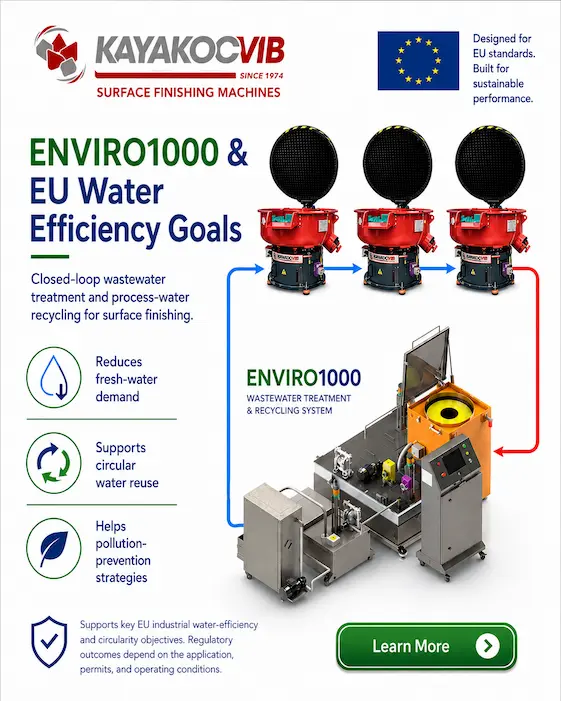
Wastewater from the finishing and washing stages must be managed. Finishing compounds, metallic fines from deburring, and media wear particles all enter the process water. Aerospace suppliers operating under environmental management systems require wastewater treatment before discharge. Automated wastewater treatment and recycling systems can reduce water consumption and manage sludge output, which is relevant for suppliers processing aluminum where metallic fines accumulate in the water circuit quickly.
Process Parameters That Control Surface Output
In automated finishing aerospace applications, the surface result depends on a combination of interdependent parameters. Each parameter must be validated during process development and held within tolerance during production runs.
- Media type and geometry: determines cutting action, accessibility to part features, and surface texture achieved.
- Media-to-part fill ratio: affects part movement, media pressure on surfaces, and risk of part-on-part contact.
- Machine speed or vibration amplitude: controls the energy of the finishing action and the rate of material removal.
- Cycle time: determines the degree of deburring, edge rounding, and surface refinement achieved.
- Compound type and dosing rate: affects media activity, surface protection, and cleanliness of the finished part.
- Water flow rate: controls compound concentration and temperature in wet finishing processes.
Changes to any of these parameters alter the surface output. This is why automated parameter control and recipe-based machine operation are necessary for aerospace supplier finishing lines. Process validation should be performed on representative sample parts before releasing a new parameter set for production, and any parameter change should trigger a re-validation step within the quality management system.
Quality Control and Inspection Points
Surface quality inspection after automated finishing typically includes visual examination for burr removal completeness, surface roughness measurement at designated drawing callout locations, dimensional verification at critical features where material removal must remain within tolerance, and cleanliness testing before coating operations. For anodizing or chromate conversion coating on aluminum parts, the surface must be free of finishing compound residue, metallic contamination, and oxidation products that would interfere with coating adhesion.
Measuring surface roughness after finishing requires using calibrated contact or optical profilometers. Typical aluminum aerospace machined parts after vibratory finishing with plastic media may achieve surface roughness in ranges suitable for anodizing preparation, but specific Ra targets depend on part material, media type, cycle time, and starting surface condition. Actual values must be confirmed through sample testing and process validation. Do not assume a fixed Ra result without process-specific measurement.
Edge rounding consistency should be evaluated at multiple points on the part because finishing action intensity varies depending on part geometry, media accessibility, and part position in the machine. Parts with deep pockets, small holes, or recessed features may require specific media shapes or extended cycle times to achieve uniform edge condition across all surfaces.
Frequently Asked Questions
What is automated finishing in aerospace manufacturing?
Automated finishing in aerospace manufacturing refers to the use of controlled mass finishing or precision finishing machines with automated loading, parameter control, separation, washing, and drying stages to process aerospace parts without operator-dependent variability. The goal is consistent surface quality, documented process repeatability, and reduced manual handling of precision components.
Which machine type is best suited for small precision aerospace components?
Centrifugal disc finishing machines are generally well suited for small precision aerospace parts because they provide higher process intensity and faster cycle times than conventional vibratory machines. For parts where contact between components must be eliminated entirely, drag finishing systems offer individually fixtured processing with precise surface control.
Is plastic media always used for aerospace aluminum finishing?
Plastic media is the standard starting point for aerospace aluminum because it provides sufficient cutting action for machining burrs while protecting soft alloy surfaces from damage. However, final media selection must be validated for each specific part, burr condition, and surface requirement. In some cases, specific ceramic media grades may be considered for harder aluminum alloys with heavy burrs, but this requires process testing.
How is wastewater managed in aerospace finishing lines?
Wastewater from wet mass finishing contains finishing compound, metallic fines, and media particles. Aerospace suppliers typically require automated wastewater treatment to separate solids, neutralize chemical content, and either discharge treated water within environmental limits or recycle it back into the process. The specific treatment approach depends on the compounds used, local regulations, and production volume.
Related Process Equipment
Related Video Demonstration
Conclusion
Automated finishing aerospace applications require more than simply selecting a machine and running parts. The process must be engineered around part material, geometry, burr characteristics, surface quality targets, and downstream process requirements. Centrifugal disc machines suit small precision components where cycle time and surface quality targets are demanding. Vibratory machines handle medium to large aluminum structural parts in batch production. Drag finishing is reserved for high-precision components where part contact must be eliminated. Across all machine types, media selection, compound dosing, and parameter control must be validated and held consistently through automated systems. For aerospace suppliers building or upgrading their surface finishing capabilities, the engineering investment in process validation and line automation directly translates into measurable quality consistency and traceability that modern aerospace supply chain requirements demand.
Sorry, the comment form is closed at this time.