


08 Aug Automated Finishing Automotive Suppliers
Automated finishing automotive suppliers require is fundamentally different from batch-mode workshop finishing. Automotive production volumes, dimensional consistency requirements, and multi-shift production schedules make manual or semi-automated finishing impractical for most component families. A properly designed automated finishing line handles deburring, edge rounding, surface preparation, washing, and drying in a continuous or semi-continuous sequence without manual part handling between stations. This article covers the finishing requirements typical to automotive supplier operations, how automated lines are structured, machine and media selection logic for common automotive materials, and the quality control and integration factors that determine whether a line delivers consistent results in production.
In This Article
Finishing Requirements in Automotive Supplier Production
Automotive suppliers produce a wide range of components including transmission housings, valve bodies, brackets, fasteners, stamped structural parts, aluminum die castings, and CNC-machined steel or stainless steel parts. Each component family carries specific finishing requirements depending on function, downstream assembly, coating, or cleanliness specification.
Edge rounding is required on CNC-machined aluminum and steel components to prevent stress concentration, improve coating adhesion, and meet dimensional callouts. Deburring is required after stamping, machining, and casting operations to remove sharp edges, flash, or burrs that would interfere with assembly or cause handling injuries. Surface preparation for painting, powder coating, or anodizing requires a consistent surface texture free of oxide layers, machining marks, or contamination. Cleanliness requirements on hydraulic components such as valve bodies often specify maximum particulate contamination by weight or particle size, which means the finishing and washing sequence must be validated against cleanliness targets.
Managing all of these requirements across multiple part families at production volume is not achievable with manual bench finishing. Automated finishing lines address volume, repeatability, and integration requirements simultaneously.
Typical Parts, Materials, and Surface Defects
Automotive supplier components span a broad material range. Steel and stainless steel parts from machining or stamping typically carry medium to heavy burrs, sharp edges, and machining residue. Aluminum die castings carry flash, parting line remnants, and oxidized surface layers. Mixed-metal production environments where aluminum brackets and steel fasteners are processed on the same line require careful process segmentation to avoid cross-contamination and media incompatibility.
Common surface defects entering the finishing line include: machined burrs on bores and faces, stamped edge burrs, casting flash and gate remnants, oxide films on aluminum, coolant and chip contamination from machining, and tool marks requiring surface texture improvement before coating.
Not all of these defects are resolved by the same process. Heavy casting gate stubs typically require trimming or grinding before vibratory finishing. Very fine machining burrs on precision valve body passages can be removed by vibratory or centrifugal disc finishing. Understanding the defect profile of each part family is necessary before specifying the automated line configuration.
Recommended Process Route for Automotive Finishing Lines
A typical automated finishing line for automotive suppliers follows a defined sequence of stations. The exact configuration depends on part type, material, volume, and quality specification, but the general logic follows a deburring or edge rounding stage, a separation stage, a washing stage, and a drying stage.
- Pre-cleaning or chip removal if heavy coolant or machining residue is present on incoming parts.
- Vibratory or centrifugal disc finishing for deburring, edge rounding, and surface preparation.
- Part-media separation using a vibratory separator to remove media from finished parts.
- Washing to remove finishing compound residue, fine abrasive particles, and surface contamination.
- Drying to prevent surface oxidation and prepare parts for downstream operations such as coating or assembly.
- Optional post-process inspection station integrated into the conveyor or handling system.
Each station must be matched to production rate. A finishing machine operating at a cycle time that does not match the downstream washing or drying capacity creates buffer problems and defeats the purpose of automation. Line balancing is a practical engineering requirement, not just a layout consideration.
Machine Selection for Automotive Finishing Applications
Machine selection for automated finishing automotive suppliers operate depends on part geometry, material, required edge condition, burr characteristics, and production volume. Two machine families cover most automotive supplier applications: circular vibratory finishing machines and centrifugal disc finishing machines.
Circular vibratory finishing machines such as the KAYAKOCVIB KVM series are well suited for medium-volume processing of CNC-machined components, stamped brackets, and die cast parts where deburring and edge rounding are the primary objectives. These machines process parts in a bed of media and compound, with the vibratory motion creating a continuous sliding and rolling action between media and part surfaces. The gentle action makes them suitable for parts with fine features, threaded areas, and mixed geometries. Typical cycle times for automotive CNC parts in circular vibratory machines range from 20 to 60 minutes depending on burr size, required edge radius, and media aggressiveness, but actual cycle time must be confirmed through sample testing for each part.
Centrifugal disc finishing machines are suited to smaller, high-precision automotive parts where short cycle times and aggressive surface improvement are required. The high-energy action of centrifugal disc machines can achieve in 5 to 15 minutes what a vibratory machine achieves in 45 to 90 minutes for certain part-media combinations, but this depends entirely on part material, geometry, and target surface condition.
For long structural components that do not fit well in circular machines, trough-type vibratory finishing machines may be preferred. These machines handle elongated parts with less risk of part-to-part impingement and are better suited to parts with aspect ratios above approximately 4:1.
Media and Compound Selection for Automotive Materials
Media and compound selection is one of the most important decisions in configuring an automated finishing line for automotive suppliers. Incorrect media selection leads to dimensional damage, media lodging, insufficient burr removal, or surface scratching that fails downstream coating inspection.
For aluminum die castings, brackets, and housings, plastic media is generally preferred. Aluminum is a softer material and ceramic media can cause micro-indentation, dimensional damage on thin walls, or aggressive material removal that exceeds the allowable edge radius tolerance. Plastic media provides controlled cutting action with lower impact force. A typical process chemistry for aluminum in vibratory finishing uses an 085-type deburring and polishing liquid combined with water at controlled concentration and flow rate.
For steel and stainless steel machined parts, stamped components, and fasteners, ceramic media is the standard choice. Steel parts require stronger cutting action to remove medium to heavy burrs, and ceramic media provides the hardness and abrasive content needed for efficient deburring and edge rounding. A 943-type deburring and polishing liquid is commonly used for steel and stainless steel applications. A 028-S degreasing liquid is used in both aluminum and steel processes when parts arrive with machining oils, coolant residue, or surface contamination that must be removed during the finishing cycle.
Media shape selection affects access to part geometry. Triangular, cylindrical, and wedge-shaped media reach different feature types. Parts with deep bores, cross-drilled holes, or complex internal passages require media geometry that minimizes lodging risk. Very small holes relative to media size always carry a media lodging risk that must be evaluated during sample testing before production release.
| Material | Recommended Media | Process Chemistry | Notes |
|---|---|---|---|
| Aluminum die casting | Plastic media | 085 + 028-S | Low-impact action, avoid aggressive cutting |
| Steel machined parts | Ceramic media | 943 + 028-S | Strong cutting for medium to heavy burrs |
| Stainless steel | Ceramic media | 943 + 028-S | Validate Ra target through sample testing |
| Brass and copper | Plastic or fine ceramic | 028 | 028 suitable for oxide and scale removal |
| Mixed-metal batches | Process separately | Per material | Do not mix aluminum and steel in same batch |
Production Line Integration and Automation Architecture
The value of automated finishing lines for automotive suppliers is realized through consistent part handling, controlled process parameters, and eliminating manual intervention between process stations. The automation architecture typically includes parts loading and unloading systems, conveyor or belt transfer between stations, automated compound dosing systems, water flow control, machine cycle time control, and part-media separation at the exit of the finishing machine.
Parts loading into finishing machines can be handled by belt conveyors, vibratory feed systems, or robotic loading depending on part weight, fragility, and production rate. For small stamped parts and fasteners, vibratory feeders provide continuous loading with minimal handling marks. For larger CNC-machined components, belt conveyor or robotic loading is more appropriate to prevent part damage during transfer.
Compound dosing systems must deliver consistent chemistry concentration throughout the production shift. Manual compound addition creates process variation between batches and is a common root cause of inconsistent surface results in high-volume automotive production. Automated dosing pumps controlled by flow rate and timer or conductivity feedback maintain process stability across shifts.
Separation between finishing media and finished parts is handled by vibratory separator machines. The separator must be sized to handle the throughput of the upstream finishing machine without creating a bottleneck. After separation, parts move to the washing station. For hydraulic components and parts with cleanliness specifications, pressure washing or ultrasonic cleaning systems provide the level of surface cleaning required to meet particulate contamination targets.
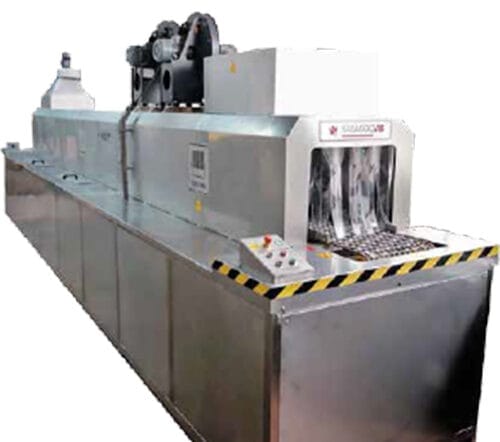
Drying after washing is essential for automotive parts destined for painting, powder coating, or long-term storage. Residual moisture causes flash rusting on steel parts and surface staining on aluminum. Vibratory dryers using dry corn cob or hardwood granulate media are commonly used for batch drying. For continuous-flow lines, hot air conveyorized drying tunnels provide throughput-matched drying without manual handling.
Quality Control and Inspection Points
Automated finishing lines for automotive suppliers must include defined quality control points to validate that the process is delivering the required surface condition consistently. Process validation before production release and periodic in-process checks during production are both necessary.
Key inspection and control points in an automotive finishing line include:
- Incoming part inspection for burr size and surface condition to confirm the line is within its validated input range.
- Post-finishing edge condition check using edge radius measurement or tactile inspection against the part drawing callout.
- Surface roughness measurement after finishing where Ra or Rz targets are specified by the customer or coating process.
- Cleanliness verification for hydraulic components using gravimetric analysis or particle counting methods.
- Media condition monitoring to ensure media is not worn beyond the point where it loses cutting efficiency or starts generating media fragments.
- Compound concentration monitoring to confirm process chemistry is within the specified window.
Surface roughness values achievable in vibratory finishing depend on part material, media type and grade, compound, machine amplitude, and cycle time. Actual Ra or Rz values must be established through sample testing for each part, as no universal value can be guaranteed across different part geometries and materials.
Process Parameters That Affect Line Performance
Several process parameters directly affect the consistency and quality output of an automated finishing line. Understanding these parameters allows process engineers to adjust the line when surface results deviate from target.
Vibratory machine amplitude controls the energy intensity of media-part contact. Higher amplitude increases cutting rate and reduces cycle time but increases the risk of part impingement on heavier, harder parts. Lower amplitude is preferred for delicate aluminum parts or parts with thin-wall sections. Most industrial vibratory finishing machines allow amplitude adjustment within a defined range.
Media-to-part volume ratio affects both surface quality and the risk of part-to-part contact damage. A typical starting ratio for CNC-machined parts is approximately 3:1 to 5:1 media to part volume, but this depends on part geometry and mass. Heavier parts require more media cushioning to prevent impingement.
Compound flow rate and concentration determine the chemical contribution to deburring, polishing, and cleaning. Too little compound slows the finishing action and may cause media glazing. Too much compound can produce excessive foam, which reduces media-part contact efficiency and may interfere with separation.
Cycle time must be matched to the burr removal requirement. Processing parts beyond the optimum cycle time does not improve surface quality linearly and may cause dimensional over-cutting on soft materials. Optimum cycle time for each part must be established through sample testing and should not be extrapolated from similar but different parts.
Frequently Asked Questions
What types of parts are best suited for automated vibratory finishing in automotive production?
Small to medium CNC-machined components, stamped brackets, fasteners, and aluminum die castings are well suited to automated vibratory finishing lines. Parts with complex geometry, multiple faces, and threaded features benefit from the all-surface coverage of vibratory media action. Very large structural parts or parts with heavy gate stubs may require pre-treatment before vibratory finishing.
Can aluminum and steel parts be processed in the same automated finishing line?
Aluminum and steel parts should be processed in separate batches. Mixing aluminum and steel in the same finishing batch causes aluminum surface damage from hard ceramic media intended for steel, and cross-contamination of aluminum particles on steel surfaces. A single automated line can handle both materials if it is programmed for separate product recipes with different media loads and process chemistry.
How is compound dosing managed in a high-volume automotive finishing line?
Automated dosing pumps controlled by timer, flow rate, or conductivity sensors maintain compound concentration consistently across production shifts. Manual dosing is not recommended for automotive-volume production because it introduces batch-to-batch variation in surface results.
What washing method is suitable after vibratory finishing for hydraulic valve bodies?
Hydraulic valve bodies with cleanliness specifications typically require pressure washing or ultrasonic cleaning after vibratory finishing to remove fine abrasive particles and compound residue from internal passages. The washing process and rinse sequence must be validated against the cleanliness specification using gravimetric or particle counting methods before production release.
Related Process Equipment
Related Video Demonstration
Conclusion
Automated finishing automotive suppliers implement at production scale requires careful matching of machine type, media, compound, washing, and drying systems to the specific part families, materials, and surface quality targets on the production program. Circular vibratory finishing machines are the core of most automotive supplier finishing lines for small to medium components, while centrifugal disc machines offer a higher-energy alternative for precision parts with short cycle time requirements. Media and compound selection must follow material logic, with plastic media for aluminum and ceramic media for steel. Compound dosing, separation, washing, and drying must all be integrated at matched throughput rates to deliver consistent results across multi-shift production. Actual surface quality and cycle time performance must be validated through sample testing before production release, as results depend on application conditions and cannot be guaranteed by machine or media specification alone.
Sorry, the comment form is closed at this time.