




03 Aug ERP Integration Surface Finishing
ERP integration surface finishing is an increasingly relevant topic for manufacturers who operate high-volume deburring, polishing, and mass finishing lines alongside CNC machining, stamping, or casting cells. As production volumes grow and quality documentation requirements tighten, the manual handoff of job orders and process results between the factory floor and enterprise planning systems becomes a significant operational bottleneck. This article explains how ERP systems connect with surface finishing production lines, what data flows are involved, and what engineering decisions determine whether the integration delivers reliable production control.
In This Article
What ERP Integration Means in a Finishing Context
Enterprise Resource Planning systems manage production orders, material flow, scheduling, inventory, and quality records at the plant or enterprise level. In a surface finishing context, ERP integration means that the finishing line receives production orders directly from the ERP system and returns confirmed process results, part counts, cycle completions, and quality status back to the same system without manual data entry.
This bidirectional data exchange requires a defined communication architecture between the ERP layer, often an MES or SCADA middleware layer, and the machine-level control systems on the finishing line. Without this structure, finishing operations typically run on paper-based or verbal job instructions, and production confirmations are entered retroactively, which introduces timing errors, traceability gaps, and scheduling conflicts.
ERP integration does not change the surface finishing process itself. It changes how production information reaches the machine and how process results are reported back into the planning system. The finishing chemistry, media selection, machine settings, and cycle parameters remain governed by process engineering requirements.
Data Architecture for Surface Finishing Line Integration
A practical ERP integration for a finishing line typically involves three layers of data communication.
The first layer is the ERP system itself, which holds the production order, part number, material specification, required surface condition, quantity, and scheduling priority. Systems such as SAP, Oracle, Microsoft Dynamics, or Infor are common in industrial environments. The ERP system issues a job order to the finishing line and expects a confirmation with actual quantities and process status upon completion.
The second layer is the MES or SCADA middleware. This layer translates ERP job orders into machine-readable instructions and collects machine signals, sensor data, and process confirmations for reporting back to the ERP. This layer also handles exception management, such as process faults, short counts, or quality holds, before they propagate into the ERP record. Not all finishing lines require a full MES deployment. In many mid-scale operations, a PLC-based line controller or an HMI with OPC-UA connectivity serves this middleware function adequately.
The third layer is the machine control level, which includes the PLCs, variable frequency drives, process timers, water dosing controllers, compound dosing pumps, and sensor inputs on each finishing machine. At this level, data such as bowl load weight, vibration amplitude, process temperature, cycle time, compound dosing volume, and separation status are available for transmission upward into the integration architecture.
Key Integration Points on a Surface Finishing Line
Not every sensor or parameter on a finishing line needs to feed into the ERP system. ERP integration is most valuable when it covers the control points that affect production scheduling, quality confirmation, and material traceability.
The following table summarizes the most relevant integration points on a typical automated surface finishing line.
| Integration Point | Data Provided | ERP Relevance |
|---|---|---|
| Loading station | Part count, batch weight, job order scan | Order confirmation start, material consumption |
| Vibratory or centrifugal finishing machine | Cycle time, amplitude setting, compound dosing, fault status | Process confirmation, cycle compliance, deviation alert |
| Separation station | Part count after separation, reject signal if available | Confirmed output quantity |
| Washing station | Wash cycle status, water temperature, chemical dosing | Cleaning confirmation for quality records |
| Drying station | Drying cycle status, temperature, exit confirmation | Final part readiness for downstream operations |
| Inspection or gauge station | Surface roughness result, dimensional pass/fail, visual result | Quality hold or release decision to ERP |
| Unloading station | Final confirmed part count, pallet or tray ID | Order completion confirmation, inventory update |
Not all finishing lines will have all of these stations. A compact automated line for small CNC parts might include only a vibratory machine, a separator, and a dryer. A high-specification line for aerospace or medical components might include washing, ultrasonic cleaning, inline inspection, and serialized part tracking at each station.
Communication Protocols and Machine Connectivity
Modern surface finishing machines with PLC-based controls typically support standard industrial communication protocols. OPC-UA has become the most widely adopted protocol for connecting machine-level data to MES or SCADA systems in manufacturing environments. Older machines may require Modbus TCP or Profibus interfaces. Some machines expose only digital I/O signals, which can be captured through remote I/O modules and mapped into the integration layer.
Before specifying an ERP integration for a finishing line, the control architecture of each machine must be audited. Key questions include whether the machine PLC supports OPC-UA or another standard protocol natively, whether the control system has accessible memory registers for process parameters, and whether the machine vendor provides documentation of the data map. Machines without accessible digital controls will require hardware-level retrofitting before integration is feasible.
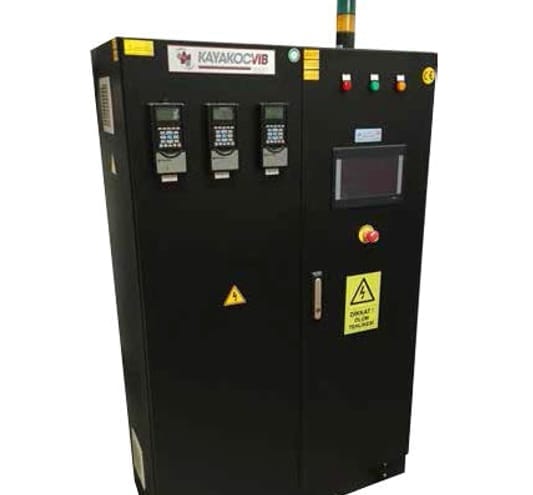
KAYAKOCVIB automation systems are designed with PLC-based controls that support integration into broader factory automation and data communication architectures, making them compatible with MES and ERP connectivity requirements when properly specified.
Production Order Management and Scheduling Logic
One of the primary benefits of ERP integration surface finishing is the ability to push production orders directly to the finishing line without paper travelers or manual entry at the machine HMI. When a batch of CNC-machined parts completes upstream operations and is ready for finishing, the ERP system can automatically release a finishing job order with the correct part number, process recipe, quantity, and priority.
The finishing line controller receives this order, loads the corresponding process recipe, and queues the job in the correct sequence. If multiple orders are waiting, the scheduler in the MES or line controller manages the queue based on priority, machine availability, and media compatibility. This scheduling logic is particularly important in mixed-production environments where steel fasteners, aluminum die castings, and stainless steel CNC parts may be processed on the same finishing line at different times with different media and compound requirements.
Media and compound management is a process constraint that the ERP integration must respect. Ceramic media used for steel deburring should not be followed immediately by an aluminum polishing run without a media change or at minimum a thorough compound flush. The integration layer must carry this process constraint logic, either embedded in the recipe management system or as a compatibility check during order scheduling.
Process Recipe Management and Traceability
Process recipe management is a foundational element of any technically sound ERP integration for surface finishing. A process recipe defines the machine settings, cycle time, compound dosing rate, water flow rate, amplitude, and separation parameters for a specific part number and surface finishing requirement. Recipes are typically stored in the MES or line controller and linked to part numbers in the ERP system.
When a production order arrives at the finishing line, the correct recipe is called automatically. The machine applies the specified settings, runs for the defined cycle time, and confirms completion. This confirmation, along with the actual process parameters recorded during the cycle, is returned to the ERP or quality management module as a production record.
Traceability requirements in automotive, aerospace, fastener, and medical manufacturing often require that the process parameters applied to each batch are documented and retrievable. ERP integration enables this documentation to be generated automatically rather than recorded manually, reducing transcription errors and audit preparation time.
Automation Line Layout and Integration Readiness
The physical layout of the finishing line affects how integration is implemented. In a linear automated line where parts move on conveyors from loading through finishing, separation, washing, drying, and unloading, integration is straightforward because the process sequence is fixed and the data flow mirrors the physical flow.
In flexible finishing cells where a single finishing machine handles multiple part families in different sequences, the integration logic is more complex. The line controller must track which recipe is active, confirm that the correct media and compound are loaded, and manage the scheduling of different orders through the same machine without cross-contamination.
For high-volume production of steel or iron parts, circular vibratory machines with ceramic media are commonly integrated into automated lines with direct conveyor loading, automated separation, and continuous compound dosing controlled by the line PLC. For precision aluminum or mixed-metal parts requiring tighter surface quality control, centrifugal disc finishing machines or drag finishing systems with shorter cycle times and more controlled process conditions may be preferred, and their integration requirements differ accordingly.
Quality Data Feedback and Closed-Loop Control
A more advanced form of ERP integration surface finishing involves closed-loop quality feedback. In this approach, inline measurement data such as surface roughness readings from a profilometer, part cleanliness data from a wash station sensor, or dimensional data from a gauge station is fed back into the process control layer and used to adjust finishing parameters in real time or across subsequent batches.
For example, if surface roughness measurements after a vibratory finishing cycle consistently show values near the upper specification limit, the control system can automatically extend the cycle time for the next batch within a defined tolerance band, or flag the result for process engineer review before confirming the order as complete in the ERP system.
This level of closed-loop integration requires calibrated measurement devices, a defined control response logic, and clear specification limits stored in the ERP or quality management system. It is most justified in applications where the finishing result directly affects downstream function, such as sealing surfaces, bearing interfaces, or implant contact surfaces.
Implementation Considerations
Implementing ERP integration on a surface finishing line requires preparation across several areas. The machine control architecture must be documented and assessed for connectivity. Process recipes must be formally defined, validated, and stored in a recipe management system before integration is attempted. Part numbers and surface finishing specifications must be clean and consistently structured in the ERP system.
Common implementation mistakes include attempting integration before process recipes are validated, assuming that all machines on the line have compatible control systems, and underestimating the engineering effort required to define the data map between machine registers and ERP fields. It is also important to define how process exceptions and deviations are handled before the integration goes live. A finishing machine fault or a short count at the separation station must trigger a defined response in the ERP system, not simply create an unresolved exception in the production record.
Pilot integration on a single finishing machine or a single part family is generally more reliable than a full-line cutover. This approach allows the data map, recipe management logic, and exception handling to be validated before being extended to the full production line.
Frequently Asked Questions
What is the minimum control requirement for integrating a finishing machine into an ERP system?
At minimum, the finishing machine requires a PLC-based control system with accessible process data registers and a supported communication interface such as OPC-UA, Modbus TCP, or digital I/O. Machines with only manual controls or analog timers require hardware retrofitting before integration is feasible.
Does ERP integration change the surface finishing process parameters?
No. ERP integration manages production order flow, recipe selection, and data reporting. The physical process parameters such as amplitude, cycle time, compound dosing, and media type are defined by process engineering requirements and stored in validated recipes. Integration delivers and records these parameters but does not alter the underlying finishing chemistry or mechanics.
How is media compatibility managed in an ERP-integrated finishing line?
Media compatibility is managed through recipe management logic. Each recipe is linked to a specific media type and compound combination. The scheduling layer must include compatibility rules that prevent conflicting media or compound combinations from being queued consecutively without a media change or flush cycle between them.
Is MES software required for ERP integration on a finishing line?
A full MES deployment is not always required. In many finishing line applications, a PLC-based line controller with OPC-UA connectivity and recipe management capability serves the middleware function adequately. Full MES deployment is more justified when multiple finishing lines, multiple part families, and complex scheduling or quality traceability requirements are involved.
Related Process Equipment
Related Video Demonstration
Conclusion
ERP integration surface finishing is an engineering integration task that spans machine control architecture, process recipe management, data communication protocols, and production scheduling logic. It does not simplify the surface finishing process itself, but it enables the finishing operation to function as a visible and controllable step within the broader production system. The practical value of integration depends directly on the quality of the process recipes, the accuracy of the machine data, and the reliability of the exception handling logic. For manufacturers operating automated finishing lines across CNC machining, automotive, aerospace, fastener, and medical production environments, a well-implemented ERP integration reduces manual reporting effort, improves scheduling accuracy, and provides the process documentation required for quality audits and traceability records.
Sorry, the comment form is closed at this time.