


30 Jul Reduce Water Consumption Mass Finishing
To reduce water consumption in mass finishing, manufacturers must look beyond simply lowering flow rates. Water is consumed at multiple stages of the finishing cycle, including compound dosing, rinsing, media washing, and equipment cleaning. Without a structured approach to water reuse and treatment, industrial finishing lines can consume several thousand liters per shift, generating significant wastewater volumes that must be managed, treated, and disposed of at cost. This guide provides a selection-oriented framework for engineers and production managers who need to decide which water-saving measures and treatment technologies are appropriate for their specific finishing operation.
In This Article
Why Water Consumption Is High in Mass Finishing
Mass finishing processes, including vibratory finishing, centrifugal disc finishing, and trough finishing, operate as wet processes in most industrial applications. Water carries the finishing compound through the media bed, controls the surface chemistry of the finishing action, flushes away removed material and contamination, and prevents media glazing. Each of these functions requires a steady water input.
In continuous flow configurations, fresh water enters the machine throughout the cycle and exits as wastewater carrying suspended solids, oils, metal fines, abrasive particles, and spent compound. Without intervention, this wastewater is discharged to drain after each cycle, meaning the full water volume is consumed and replaced each time. In high-volume production environments processing steel, stainless steel, aluminum, or mixed metal components, this pattern creates large daily water volumes with direct cost implications.
Secondary water consumption points include the separation stage, where parts and media are separated on a vibrating separator and often rinsed, and the post-finishing washing stage, where parts may be pressure washed or rinsed before drying. Each stage adds to total water demand if not managed with a recycling approach.
Main Selection Criteria for Water Reduction Strategies
Choosing the right combination of water-saving measures depends on several production factors. Not every operation requires the same approach, and over-engineering a water treatment system for a low-volume operation may not deliver a practical return. The following criteria should guide the selection decision.
- Daily water volume consumed by the finishing process
- Number of shifts and machines in operation
- Type of workpiece material and contamination level (oils, cutting fluids, metal fines)
- Compound type and concentration requirements
- Local wastewater discharge regulations and costs
- Available floor space for treatment equipment
- Existing automation level of the finishing line
For operations running one or two machines on a single shift with relatively clean parts, simple batch water reuse with a sedimentation tank may be sufficient. For high-volume lines processing oily CNC machined parts or running multiple machines continuously, a full closed-loop system with flocculation treatment becomes justified.
Closed-Loop Water Reuse Logic
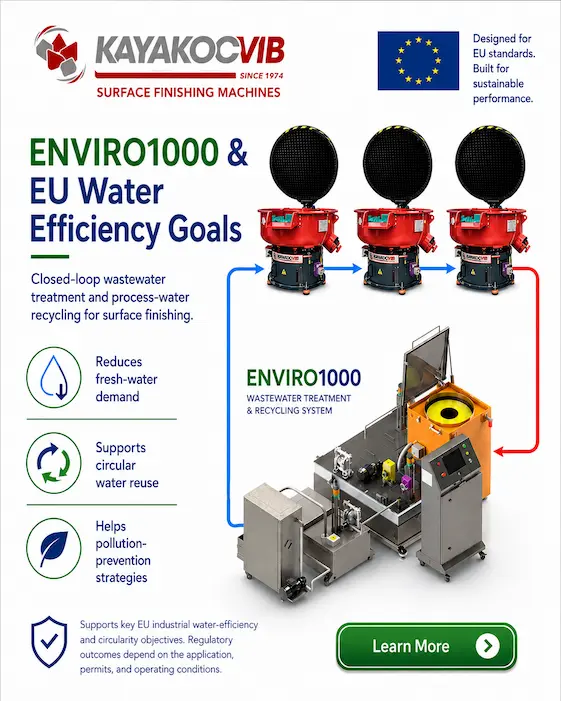
The most effective method to reduce water consumption in mass finishing at an engineering level is to implement a closed-loop water reuse system. In this configuration, wastewater from the finishing machine and separator is collected, treated to remove solids, oils, and suspended contamination, and then returned to the finishing machine as process water. Fresh water makeup is added only to compensate for evaporation and drag-out losses, which are typically small compared to total process water volume.
A well-designed closed-loop system can reduce water consumption in mass finishing by a substantial factor compared to open-drain operation, though actual savings depend on machine size, production rate, compound type, and part contamination level. Process validation with sample testing is required before committing to a specific water reduction target.
The key technical challenge in closed-loop reuse is ensuring that recycled water does not accumulate metal fines, oils, or spent compound residues above concentrations that would interfere with the finishing action or cause staining on parts. This requires sufficient treatment capacity relative to the wastewater generation rate of the finishing line.
Solids Separation and Sedimentation
The first treatment stage in most water reuse systems is solids separation. Wastewater from vibratory or centrifugal finishing machines contains suspended metal fines, abrasive particles from media wear, and compound residues. If these solids are returned to the machine without removal, they accumulate in the water circuit and can affect surface quality and media performance.
Sedimentation tanks allow solids to settle by gravity over time. A sedimentation tank sized appropriately for the production volume will separate the majority of coarser suspended solids from the liquid phase. The clarified water from the upper zone is then suitable for reuse, while settled sludge is periodically removed for disposal.
The KAYAKOCVIB SDM-T sedimentation tank is designed for integration with industrial mass finishing lines. It provides a controlled settling environment with sufficient residence time to achieve effective solids separation before water is recycled. SDM-T units are sized based on the wastewater flow rate of the connected finishing machines, and the sludge compartment allows periodic removal without interrupting the water circuit.
For operations with high solids loading, such as heavy deburring of steel or stainless steel parts, sedimentation alone may not achieve sufficient water quality for reuse. In these cases, a second treatment stage is necessary.
Flocculation and Chemical Treatment
Flocculation is a chemical treatment method used to aggregate fine suspended particles that would otherwise remain in suspension and not settle by gravity within a practical residence time. A flocculant agent is dosed into the wastewater, causing fine particles and emulsified oils to bind into larger floc structures that settle more rapidly.
Flocculation treatment is appropriate for wastewater containing very fine metal particles, emulsified cutting oils, or compound residues that produce stable colloidal suspensions. In mass finishing of aluminum or mixed metal parts where cutting fluids may be present on incoming parts, flocculation can significantly improve the clarity and reusability of treated water.
The KAYAKOCVIB FLOG flocculation dosing system is designed to integrate with the wastewater treatment circuit, adding controlled doses of flocculant to condition wastewater before sedimentation or filtration. Correct flocculant dosing requires adjustment based on wastewater chemistry, contamination type, and volume. Over-dosing can reduce separation efficiency, so dosing rates should be calibrated during process setup.
Integrated Wastewater Treatment Systems
For finishing lines generating consistent wastewater volumes across multiple shifts, an integrated wastewater treatment system provides a more automated and controlled approach than standalone sedimentation alone. These systems combine sedimentation, chemical conditioning, filtration, and water storage in a single process unit, and can be connected directly to multiple finishing machines through a centralized water circuit.
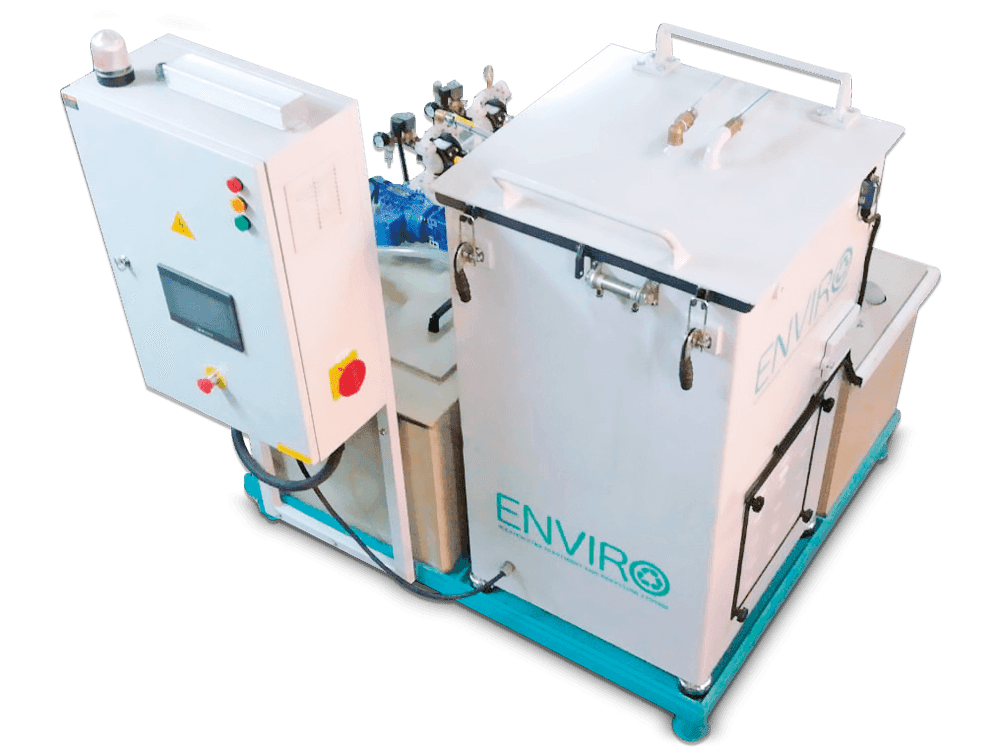
The KAYAKOCVIB ENVIRO1000 wastewater treatment system is designed for this integration purpose. It processes wastewater from vibratory or centrifugal finishing machines, treats it through sedimentation and chemical conditioning stages, and returns clarified water to the finishing machines for reuse. The system is intended for industrial environments where continuous or high-volume finishing generates wastewater volumes that justify automated closed-loop treatment.
In practical terms, integrating an ENVIRO1000 or equivalent system converts the finishing line from an open-drain, high-water-consumption configuration to a closed-loop operation with substantially lower fresh water intake and reduced wastewater discharge volume. Actual performance depends on part contamination, compound selection, and machine loading, and should be confirmed through a commissioning validation process.
Compound Selection and Dosing as a Water-Saving Factor
Finishing compound type and concentration directly affect water consumption and wastewater quality. Over-dosing of compound increases the organic load in wastewater, complicates treatment, and can create foam in closed-loop systems. Under-dosing reduces finishing effectiveness and may require longer cycle times, indirectly increasing water usage per part.
For steel and stainless steel parts, a compound such as a deburring and polishing liquid used at the correct concentration maintains effective cutting and deburring action while generating wastewater with a manageable treatment profile. For aluminum parts, a milder formulation is generally preferred to avoid surface attack and to reduce chemical load in the water circuit.
Precise compound dosing through an automated dosing pump reduces variability and prevents over-consumption. When targeting closed-loop water reuse, using compounds with a documented treatment compatibility profile simplifies the treatment chemistry design. Compound suppliers should be consulted for guidance on flocculant compatibility and wastewater treatment behavior of specific formulations.
Water Consumption Reduction Selection Matrix
| Production Profile | Recommended Approach | Treatment Equipment | Expected Water Reduction |
|---|---|---|---|
| Low volume, single machine, clean parts | Batch water reuse with sedimentation | SDM-T sedimentation tank | Moderate, application-dependent |
| Medium volume, multiple machines, light contamination | Semi-closed loop with sedimentation and decant reuse | SDM-T plus dosing system | Significant, requires validation |
| High volume, continuous operation, oily or mixed metal parts | Full closed-loop with flocculation and integrated treatment | ENVIRO1000 plus FLOG | Highest achievable, application-dependent |
| High contamination, cutting oils, fine metal particles | Closed-loop with chemical treatment and filtration | ENVIRO1000 plus FLOG plus filtration stage | High, requires process commissioning |
The values in this matrix are indicative and depend on part geometry, material, contamination type, compound selection, and machine operating parameters. All water reduction targets require process validation before production implementation.
Common Mistakes That Increase Water Consumption
Several operational patterns consistently increase water consumption beyond what the process technically requires. Identifying and correcting these patterns often delivers meaningful savings before any investment in treatment equipment is made.
- Running continuous water flow through the finishing machine at higher rates than the compound dosing system requires
- Using manual water control without flow meters or timers, leading to inconsistent and often excessive water use
- Not recovering rinse water from the separation stage, which is typically low in contamination and reusable
- Disposing of batch water after short cycles when the water quality is still acceptable for reuse in a subsequent batch
- Over-dosing compound, which increases wastewater organic load and makes reuse more difficult
- Running the finishing machine with the drain open during dry or pre-dry phases, wasting residual water
Addressing these operational inefficiencies through flow controls, timers, and consistent compound dosing often reduces water consumption in mass finishing measurably without requiring capital investment in treatment systems.
Automation and Line Integration Considerations
In automated finishing lines where parts flow continuously from loading through finishing, separation, washing, and drying, the water circuit should be designed at the line planning stage rather than retrofitted. Centralized water collection, treatment, and distribution pipework is simpler and more cost-effective to install during line construction than to add after commissioning.
Automated compound dosing systems connected to the water circuit maintain consistent compound concentration in the reused water, compensating for consumption and dilution as fresh makeup water is added. Flow monitoring on both the supply and return circuits allows the water balance to be tracked and optimized over time.
For lines combining vibratory finishing machines with pressure washing or ultrasonic cleaning stations, the rinse water from washing stages may be partially recovered and fed into the finishing machine water circuit if its contamination level is compatible. This further reduces total fresh water intake across the line.
Frequently Asked Questions
What is the most effective way to reduce water consumption in mass finishing?
Implementing a closed-loop water reuse system with adequate solids separation and chemical treatment is the most effective approach. This converts the process from open-drain to recycled water operation, reducing fresh water intake to makeup levels only. The right level of treatment complexity depends on production volume and contamination profile.
Can sedimentation alone be sufficient for water reuse in mass finishing?
For operations with relatively clean parts and moderate production volumes, a sedimentation tank such as the SDM-T may provide sufficient water clarification for batch reuse. For high contamination or fine particle loads, additional flocculation treatment is generally needed to achieve acceptable water quality for continuous reuse.
Does compound selection affect water treatment performance in closed-loop systems?
Yes. Compound type and dosing rate directly affect the organic load and foam potential in recirculated water. Using compounds with compatible treatment profiles and precise automated dosing reduces treatment complexity and improves closed-loop system stability.
Is wastewater from aluminum finishing treated differently than from steel finishing?
The contamination profile differs. Aluminum finishing typically produces softer metal fines and may carry cutting fluid residues from machining, which can emulsify. Steel finishing generates harder, denser particles that settle more readily. Flocculant selection and dosing rates should be matched to the specific metal type and contamination level present in the wastewater.
Related Process Equipment
Conclusion
Selecting the right strategy to reduce water consumption in mass finishing requires a systematic evaluation of production volume, part contamination level, finishing process type, and available floor space for treatment equipment. Low-volume operations can benefit significantly from simple sedimentation-based batch reuse with operational discipline improvements. High-volume or multi-machine lines producing oily or contaminated parts typically justify integrated closed-loop treatment combining sedimentation, flocculation, and automated water management. The KAYAKOCVIB SDM-T, FLOG, and ENVIRO1000 systems represent equipment options suited to different points on this spectrum. In all cases, the specific water reduction achievable depends on application conditions and requires process validation rather than generic estimates. Treating water reduction as an engineering decision rather than a procurement choice leads to more reliable and sustainable outcomes.
Sorry, the comment form is closed at this time.