


30 Jul Sedimentation Tank Surface Finishing
Sedimentation tank surface finishing is a wastewater and process water management stage that is integral to any wet vibratory finishing line. Without effective solids separation and water recycling, process water quickly becomes contaminated with fine abrasive particles, metal fines, and spent compound, degrading surface quality and increasing operating costs. This article explains how sedimentation tanks work within a finishing line, describes the full process sequence, and covers the engineering decisions that affect system performance in automotive, CNC machining, and general metal processing applications.
In This Article
What Sedimentation Means in a Vibratory Finishing Line
In wet vibratory finishing, water is continuously fed into the machine together with liquid compound. During the finishing cycle, the water carries away material removed from the workpiece, including metal fines, abrasive particles released from worn media, and contamination from part surfaces such as cutting oils and machining fluids. This slurry exits the machine and must be processed before the water can be reused or discharged.
Sedimentation is the process by which suspended solid particles settle out of the liquid under gravity. In industrial finishing, a sedimentation tank provides a controlled residence volume where flow velocity is reduced, allowing particles to settle to the tank floor as sludge while clarified water rises and overflows into a clean water reservoir for reuse. The settled solids are then collected and disposed of separately.
This distinction matters because process water that is not properly treated will carry abrasive fines back into the vibratory machine, increase machine wear, contaminate part surfaces, and reduce compound effectiveness. In high-volume production environments, this translates directly into inconsistent surface quality and higher compound consumption per part.
Process Sequence: From Machine Discharge to Clean Water Return
The following numbered sequence describes how sedimentation tank surface finishing operates within a typical vibratory finishing line.
- The vibratory finishing machine discharges used process water continuously or in batch intervals. This effluent carries suspended metal fines, abrasive particles, compound residue, and tramp oils from part surfaces.
- The effluent flows by gravity or pump into a collection sump or pre-settling chamber. In some configurations, a coarse screen or mechanical filter removes large fragments before the flow enters the main sedimentation tank.
- The slurry enters the sedimentation tank at low velocity. Tank geometry is designed to extend hydraulic residence time, typically by using baffles or inlet diffusers that reduce turbulence. Reduced velocity allows gravity settlement to occur efficiently.
- Solid particles settle progressively to the tank floor as sludge. Particle settlement rate depends on particle density, particle size, and water viscosity. Fine metal particles from aluminum or stainless steel may settle more slowly than coarse ceramic abrasive fragments.
- If flocculation agents are added, they cause fine suspended particles to aggregate into larger, heavier flocs that settle faster. This step is particularly useful when processing aluminum, where fine metallic particles are extremely small and slow to settle unaided.
- Clarified overflow water accumulates in a secondary clean water compartment or buffer tank. This water is recirculated to the vibratory machine as make-up water, reducing fresh water consumption and compound dosing requirements significantly.
- Accumulated sludge at the tank floor is periodically removed by scraper mechanisms, sludge pumps, or manual cleaning cycles depending on the system design. The dewatered sludge is collected for off-site disposal in compliance with local waste regulations.
- Oil and foam accumulation at the water surface can be managed with surface skimmers integrated into the tank design. This is particularly relevant when processing parts that carry tramp machining oils into the finishing process.
Key Process Parameters and Their Effect on Separation Quality
The efficiency of a sedimentation system depends on several physical and operational variables. Understanding these parameters allows process engineers to adjust system performance to match the specific finishing application.
| Parameter | Effect on Sedimentation | Typical Adjustment |
|---|---|---|
| Hydraulic residence time | Longer residence allows finer particles to settle | Increase tank volume or reduce flow rate |
| Inlet flow velocity | High velocity causes turbulence and resuspends settled solids | Use inlet baffles or diffusers |
| Flocculation agent dosing | Aggregates fine particles into settleable flocs | Adjust dose based on particle load and water turbidity |
| Tank geometry and depth | Deeper tanks improve settlement distance and sludge capacity | Select based on flow rate and particle type |
| Water temperature | Higher temperature reduces viscosity, improving particle settling | Usually a fixed ambient variable, not adjusted |
| Sludge removal frequency | Infrequent removal reduces effective tank volume | Schedule based on production volume and particle load |
In production environments where part materials change, for example switching between steel batches and aluminum batches, the particle characteristics of the slurry change accordingly. Steel fines are denser and settle more readily. Aluminum fines are lighter and may require flocculation support or longer residence time to achieve acceptable water clarity before reuse.
Closed-Loop Water Reuse and Compound Management
One of the primary engineering benefits of integrating a sedimentation tank into a vibratory finishing line is the ability to operate on a closed-loop or semi-closed-loop water system. In a fully closed-loop configuration, clarified water from the sedimentation tank is returned directly to the machine without any discharge to drain. Make-up water is added only to compensate for evaporation and sludge moisture content.
This approach reduces fresh water consumption considerably in high-volume production lines. It also reduces the quantity of liquid compound required per shift, because residual compound chemistry is partially retained in the recirculated water. Process engineers should monitor recirculated water for compound concentration, pH, and contamination levels to maintain stable finishing conditions. Excessive accumulation of metal ions or contamination in recirculated water can affect surface quality and require partial water replacement or chemical treatment.
In lines processing mixed metals, closed-loop reuse requires more careful management because metal ion contamination from one material can affect the surface condition of a different material processed in the same line. Stainless steel parts, for example, can be sensitive to iron ion contamination in the process water, which may cause surface discoloration if not controlled.
Oil Separation and Surface Skimming
Parts arriving at the vibratory finishing machine frequently carry residual machining oils, cutting fluids, or stamping lubricants. These oils enter the process water and float to the surface of the sedimentation tank. If not removed, they accumulate and can cause foaming, interfere with compound performance, and contaminate the clarified water returned to the machine.
Surface skimmers integrated into the sedimentation tank continuously remove floating oil layers. In more demanding applications, oil-water separators or coalescence separators can be added downstream of the sedimentation tank to achieve higher oil removal efficiency before water is recirculated. The 028-S degreasing compound used in KAYAKOCVIB finishing lines assists in emulsifying and mobilizing surface oils during the finishing cycle, making them easier to manage in the downstream sedimentation stage.
Flocculation and Chemical Treatment Options
Gravity sedimentation alone may not achieve sufficient water clarity when the slurry contains very fine particles below approximately 10 to 20 micrometers in diameter. In these cases, flocculation chemicals are dosed into the incoming slurry to promote particle aggregation. Flocculation is particularly relevant for aluminum and mixed-metal applications, where fine metallic particles remain in suspension for extended periods without chemical assistance.
The KAYAKOCVIB FLOG flocculation system provides controlled chemical dosing integrated with the sedimentation process. Flocculant dosing rate is adjusted based on incoming water turbidity and particle load. Proper flocculation significantly reduces the sludge settling time and improves the quality of clarified water returned to the finishing line, allowing the system to operate at higher recirculation rates without compromising surface finishing results.
In some high-throughput applications, centrifugal separation is used as an alternative or supplement to gravity sedimentation. A centrifuge applies centrifugal force to accelerate particle separation, processing higher slurry volumes in a smaller footprint and with faster separation times. However, centrifugal separation involves higher capital and maintenance cost compared to gravity sedimentation, and is generally justified only when particle load is very high or when floor space is severely limited.
Integration with the KAYAKOCVIB SDM-T Sedimentation Tank
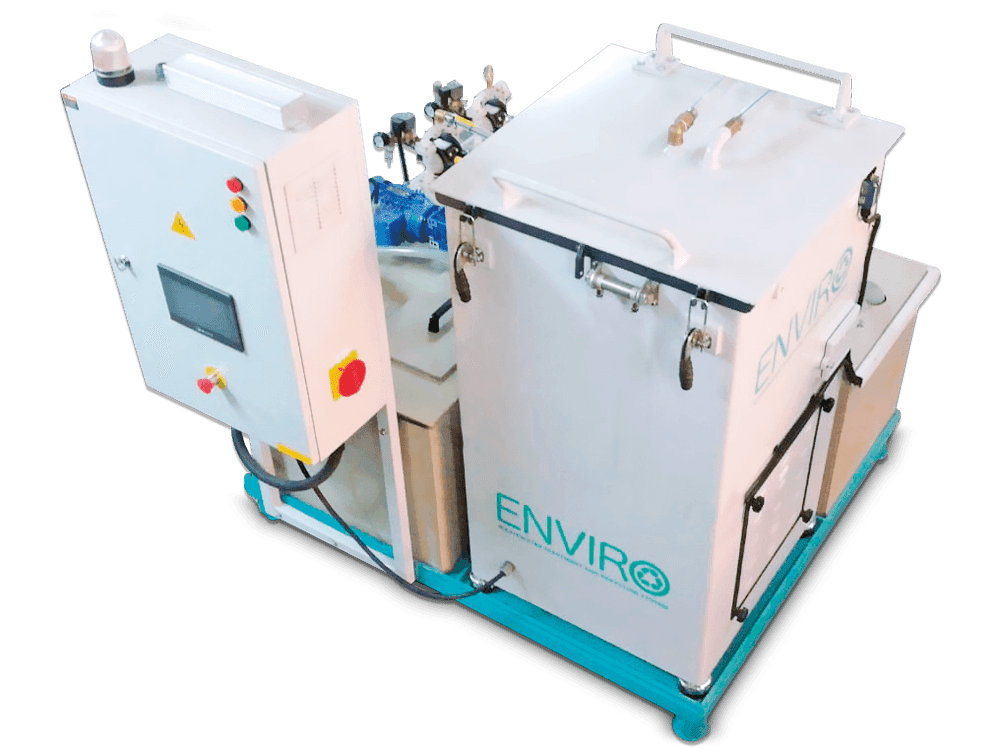
The KAYAKOCVIB SDM-T sedimentation tank is designed specifically for integration into vibratory finishing lines. The system includes a multi-compartment tank body with inlet baffling, a clarified water reservoir, sludge collection geometry, and provisions for optional flocculation dosing and surface skimming. The SDM-T is sized to match the flow rate and particle load generated by one or more vibratory machines operating in a production line.
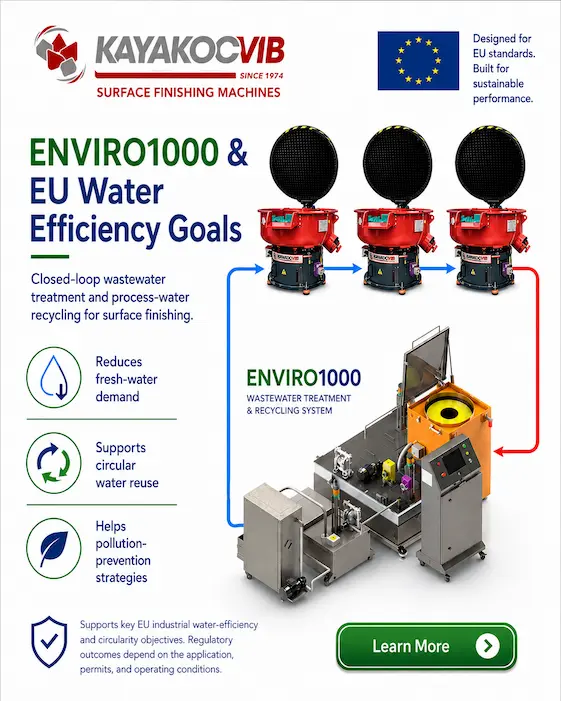
The KAYAKOCVIB ENVIRO1000 wastewater treatment system extends this capability further by combining sedimentation, flocculation, and pH adjustment into a single integrated unit suitable for production environments where local wastewater discharge regulations impose strict limits on suspended solids and chemical oxygen demand. For many automotive and CNC machining facilities, the ENVIRO1000 allows the line to achieve near-zero liquid discharge conditions through effective closed-loop water reuse combined with controlled sludge disposal.
Practical Line Integration Considerations
When integrating a sedimentation tank into an existing or new vibratory finishing line, several layout and operational factors affect system performance. Tank sizing must be matched to the total slurry flow rate from all connected finishing machines. Undersized tanks result in insufficient residence time, poor separation, and contaminated recirculated water.
The elevation relationship between the vibratory machine discharge, the sedimentation tank, and the clean water return pump must allow gravity flow wherever possible. Pump selection for slurry transfer must account for abrasive particle content to avoid excessive pump wear. Sludge removal access must be planned in the facility layout to allow periodic cleaning without interrupting production unnecessarily.
In automated finishing lines where the vibratory machine, separator, dryer, and wastewater system are integrated under a central control system, the sedimentation tank operation including pump cycles, dosing, and level monitoring can be coordinated with machine run cycles to minimize water consumption and maintain consistent process water quality across multiple production shifts.
Frequently Asked Questions
What types of particles does a sedimentation tank remove from finishing process water?
A sedimentation tank removes suspended solids including metal fines abraded from workpieces, ceramic or plastic abrasive particles released from worn media, and coarse contamination from part surfaces. Floating oils can be removed by integrated surface skimmers. Very fine particles may require flocculation to settle effectively.
Can a sedimentation tank handle process water from both steel and aluminum finishing lines?
Yes, but mixed-metal process water requires careful management. Steel and aluminum fines have different densities and settling characteristics. If water is recirculated across both material types, iron ion contamination can affect aluminum surface quality. In sensitive applications, separate water circuits are preferred for different base materials.
When is flocculation necessary in a sedimentation tank system?
Flocculation is necessary when gravity settlement alone does not produce sufficiently clarified water within the available residence time. This typically occurs when the slurry contains fine particles below 10 to 20 micrometers, which is common in aluminum finishing or when processing very smooth precision parts that generate minimal coarse debris.
How frequently does sedimentation tank sludge need to be removed?
Sludge removal frequency depends on production volume, part material, media wear rate, and tank capacity. In high-volume lines, sludge may accumulate within days. In lower-volume lines, weekly or monthly cleaning may be sufficient. Allowing sludge to overfill reduces effective tank volume and degrades separation performance, so scheduled cleaning intervals should be established based on observed accumulation rates.
Related Process Equipment
Conclusion
Sedimentation tank surface finishing is not an optional peripheral stage but a functional engineering component of any well-designed wet vibratory finishing line. The quality of process water directly affects deburring consistency, compound performance, machine wear, and the surface condition of finished parts. Proper tank sizing, residence time management, flocculation where needed, oil removal, and closed-loop water reuse together determine whether the wastewater system supports or limits overall finishing line performance. For production environments in automotive, CNC machining, and metal processing industries, integrating a correctly specified sedimentation system such as the KAYAKOCVIB SDM-T into the finishing line is an engineering decision with measurable impact on operating cost, regulatory compliance, and surface quality consistency. Actual system performance depends on slurry characteristics, production volume, and local regulatory requirements, and should be validated through line testing before full production release.
Sorry, the comment form is closed at this time.