



27 Jul Vibratory Drying Problems
Vibratory drying problems are among the most common sources of quality failure at the end of a mass finishing line. After deburring, polishing, or surface preparation in a vibratory or centrifugal machine, parts must be dried completely and without contamination before inspection or packaging. When the drying stage fails, the entire finishing investment is at risk. Staining, water marks, corrosion, surface contamination, and incomplete drying are recurring issues in production environments processing steel, stainless steel, aluminum, and mixed metal batches. Understanding why these problems occur and how to correct them is essential for any process engineer managing a finishing line.
In This Article
How Vibratory Drying Works
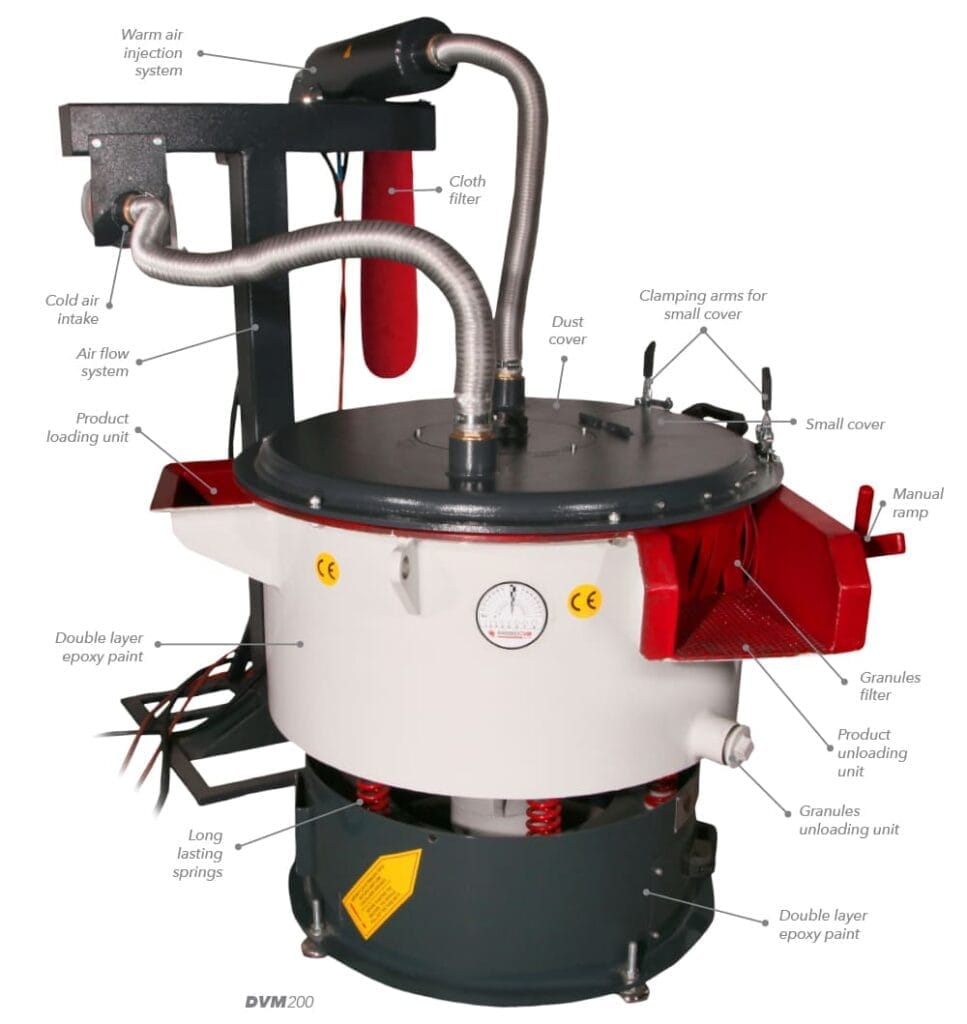
Vibratory drying uses mechanical vibration combined with a drying medium, typically dry corn cob granules or wooden chips, to absorb moisture from wet parts. The vibrating motion creates continuous contact between the parts and the drying media, transferring surface moisture into the absorbent granules while heat from an integrated heater accelerates evaporation. In circular vibratory dryers such as the KAYAKOCVIB DVM series, parts and drying media move together in a helical spiral pattern inside a tub. In trough vibratory dryers such as the D-TVM series, this motion occurs along the linear length of the trough, which is better suited for longer components.
The drying result depends on several interacting variables: media condition, media-to-part ratio, vibration amplitude, bowl temperature, loading volume, and the initial moisture level of the parts entering the dryer. When any of these variables falls outside its effective range, the drying process produces substandard results.
Root Cause Categories for Drying Failures
Vibratory drying problems can be grouped into four root cause categories: media-related causes, machine-related causes, process parameter causes, and upstream process causes. Most production failures involve more than one category simultaneously, which is why single-variable corrections often produce incomplete results.
Media-related causes include saturated or degraded corn cob granules, incorrect granule size for the part geometry, insufficient media volume, or contaminated media carrying residual compound or oil. Machine-related causes include insufficient bowl temperature, worn vibration motor mounts reducing amplitude, incorrect motor settings for the part weight, or a damaged tub lining causing parts to contact metal directly. Process parameter causes include overcrowded loading, insufficient cycle time, and incorrect amplitude for the media-part combination. Upstream process causes include excessive compound residue on parts entering the dryer, parts arriving too wet because the separation stage was poorly timed, or oil contamination from prior machining that was not removed in a washing stage before finishing.
Diagnosing Staining and Water Marks
Staining and water marks on dried parts are the most frequently reported vibratory drying problems in CNC machining, automotive, and fastener production environments. These defects appear as white residue rings, brown discoloration, or uneven surface patches that cannot be removed by re-drying alone.
White residue rings are typically caused by compound or mineral deposits drying on the surface before the media can absorb the moisture. This happens when parts carry excessive compound residue from the finishing stage or when the water used in the finishing process has high mineral hardness. The solution involves improving the rinse stage before drying, using deionized or softened water in the final rinse, and ensuring that finishing compound concentration is controlled within the recommended range.
Brown or yellow staining on steel parts is usually oxidation that begins when parts are left wet for too long between the finishing machine and the dryer. In mixed-metal batches, contact staining can also occur when aluminum and steel parts are dried together, as galvanic reactions accelerate surface discoloration in the presence of moisture. Aluminum and steel parts should always be dried separately.
Uneven surface marks on aluminum parts are often caused by corn cob media that is too coarse for the part geometry, creating uneven contact pressure during the drying cycle. For precision aluminum components, finer corn cob granules provide more uniform surface contact and reduce the risk of localized drying defects.
Incomplete Drying and Residual Moisture
Residual moisture after the drying cycle is a direct cause of corrosion on steel parts and surface spotting on stainless steel and aluminum. Incomplete drying is one of the most persistent vibratory drying problems because it is not always visible immediately after unloading and may only become apparent hours later during inspection or packaging.
The most common causes of incomplete drying are saturated drying media, insufficient bowl temperature, overcrowded loading, and inadequate cycle time. Corn cob granules have a finite moisture absorption capacity. When they reach saturation, they no longer remove moisture from parts regardless of how long the cycle runs. Saturated media must be replaced or periodically dried in a separate oven if the media specification allows regeneration.
Bowl temperature is a critical parameter. Most vibratory dryers operate with heater temperatures between 60°C and 90°C depending on part material and media type. Temperatures below this range reduce evaporation efficiency significantly. For aluminum parts, which are sensitive to surface oxidation at elevated temperatures, the lower end of this range is typically preferred. For steel parts requiring fast drying, higher temperatures within the safe range improve cycle performance.
Overcrowded loading reduces the ratio of absorbent media to parts and restricts the free movement needed for effective media-part contact. A general guideline is that the drying media should make up at least 60 to 70 percent of the total bowl volume, with parts filling the remaining fraction. Exact ratios depend on part geometry, part size, and media granule size, and should be validated through process testing.
Machine Loading and Motion-Related Causes
Vibratory dryer performance depends on proper part motion inside the bowl or trough. If the parts are not moving freely and continuously, certain surfaces receive disproportionate drying media contact while others remain damp. This is particularly common with flat parts, thin-walled components, or parts with recessed features such as blind holes, threaded bores, or undercuts.
Flat parts tend to stack or nest on each other during the drying cycle, preventing media from reaching the contact surfaces. Increasing vibration amplitude, reducing load volume, or using a lighter media granule can improve separation and reduce nesting. For parts with deep blind holes, the drying process should be preceded by a compressed air blow-off step to remove trapped water before loading into the dryer.
Amplitude setting directly affects how aggressively the media contacts the parts. Too low an amplitude creates gentle motion that is insufficient for good moisture transfer. Too high an amplitude on delicate parts such as thin aluminum brackets or medical components may cause surface marking or dimensional damage. Amplitude must be set as a balance between drying efficiency and part protection.
Common Vibratory Drying Problems and Corrective Actions
| Problem | Likely Cause | Corrective Action |
|---|---|---|
| White residue rings | Compound residue or hard water minerals | Improve rinse stage, use softened water, reduce compound concentration |
| Brown staining on steel | Oxidation from delayed drying or mixed metals | Reduce transfer time, separate steel and aluminum batches |
| Residual moisture after cycle | Saturated media, low temperature, overloading | Replace media, increase bowl temperature, reduce load volume |
| Uneven surface marks on aluminum | Coarse media, nesting of flat parts | Use finer corn cob, increase amplitude, reduce batch size |
| Parts not drying in recessed areas | Trapped water in holes or cavities | Add blow-off step before dryer loading |
| Surface scratches from drying | Contaminated media or excessive amplitude | Replace media, reduce amplitude, check for metal fragments in media |
Upstream Process Factors That Create Drying Problems
Many vibratory drying problems originate in the stages before the dryer. The finishing compound concentration, the quality of the rinse stage, and the transfer time between finishing and drying all influence the condition of parts entering the dryer.
Excessive compound concentration in the finishing machine leaves a thick chemical film on parts that the drying media cannot fully absorb. The compound residue reacts with heat and drying air to form a dried deposit that bonds to the surface. Compound dosing should be controlled accurately using a metered dosing system rather than manual addition.
Parts that are not rinsed adequately after vibratory finishing arrive at the dryer still carrying dissolved compound and finishing residue. A clean water rinse stage between the finishing machine and the dryer significantly reduces the contamination load on the drying media and improves drying consistency. For high-specification parts in automotive or aerospace applications, a pressure rinse step may be required before drying.
Transfer time between the separator and the dryer is a practical factor that is often overlooked. If parts sit wet in a bin for several minutes before loading into the dryer, early oxidation on steel parts begins before drying even starts. On high-volume lines, direct conveyor transfer from the separator to the dryer minimizes this risk. KAYAKOCVIB DVM and D-TVM vibratory drying machines can be integrated directly into automated finishing lines to eliminate manual handling delays.
Parameter Tuning for Consistent Drying Results
Achieving consistent drying across production batches requires establishing and documenting the correct process parameters for each part type and material. Key parameters to define include bowl temperature, cycle time, media-to-part ratio, vibration amplitude, and media replacement interval.
Cycle time should be validated by measuring residual moisture on parts removed at different time points during the drying cycle. The minimum cycle time is the point at which all part surfaces consistently test dry without visible moisture or condensation. Adding a safety margin of 10 to 15 percent to the validated minimum cycle time provides a buffer for batch-to-batch variation.
Media replacement interval should be based on media saturation rate rather than calendar time. In high-volume operations, corn cob media may saturate after a few shifts. In lower-volume operations, the same media may remain effective for several days. Operators should check media condition regularly by observing whether parts are drying consistently and whether the media feels damp or clumps together during use.
Prevention Checklist for Drying Process Stability
- Verify corn cob media condition before each production run and replace saturated media immediately.
- Confirm bowl or trough heater temperature is within the target range before loading parts.
- Check that the media-to-part ratio meets the validated specification for each part type.
- Ensure the rinse stage before drying is functioning correctly and using clean water.
- Measure compound concentration in the finishing machine and adjust dosing if out of range.
- Verify that steel and aluminum parts are not mixed in the same drying batch.
- Apply compressed air blow-off before drying when parts have blind holes, threaded bores, or deep cavities.
- Record drying cycle time, temperature, and media replacement date for each batch.
- Inspect dried parts for residual moisture, staining, and surface marks before approving for packaging.
Frequently Asked Questions
Why do steel parts show rust spots after vibratory drying?
Rust spots on steel after drying are typically caused by delayed transfer to the dryer, insufficient drying temperature, or inadequate compound rinsing. Parts must be moved from the separator to the dryer quickly, the bowl temperature must be within the validated range, and the rinse stage must remove compound residue before drying begins.
How often should corn cob drying media be replaced?
Replacement interval depends on production volume and part moisture load. In high-volume lines, media may need replacement after each shift or every few hours. The practical indicator is whether parts are still drying consistently. Clumping, reduced drying speed, or visible surface moisture after the full cycle are signs that media is saturated and must be replaced.
Can aluminum and steel parts be dried together?
Aluminum and steel parts should not be dried together in the same batch. Galvanic contact between dissimilar metals in the presence of residual moisture can cause contact staining and accelerated surface oxidation. Each material group should have a dedicated drying batch.
What causes scratches or marks appearing only after drying, not after finishing?
Scratches appearing after drying are usually caused by metal fragments or hard contamination that has accumulated in the drying media over time, or by excessive vibration amplitude for delicate parts. The drying media should be inspected for contamination and replaced if contaminated. Amplitude should be reduced for sensitive part geometries.
Related Process Equipment
Related Video Demonstration
Conclusion
Vibratory drying problems are rarely caused by a single variable. Most drying failures result from a combination of media condition, machine settings, loading practices, and upstream process quality. Diagnosing and correcting these problems requires a systematic approach that examines each factor independently before drawing conclusions. For production engineers managing finishing lines across CNC machining, automotive, fastener, aerospace, or medical part production, establishing documented process parameters, enforcing rinse stage quality, and monitoring media condition are the most effective strategies for eliminating recurring vibratory drying problems. When drying is integrated directly into an automated finishing line with controlled transfer timing and consistent loading, the risk of batch-to-batch variation decreases significantly and drying output quality becomes more predictable.
Sorry, the comment form is closed at this time.