



27 Jul Drying Small Metal Parts
Drying small metal parts after wet vibratory finishing is a process step that is frequently underestimated in industrial surface finishing lines. When parts exit a wet finishing or washing cycle, residual moisture on metal surfaces can cause flash rusting on steel, surface staining on aluminum, and contamination of downstream coating or inspection operations. Selecting the correct drying method, machine type, and drying media is essential to maintaining the surface quality achieved in the finishing stage.
In This Article
Why Drying Matters After Wet Finishing
In mass finishing operations, wet vibratory finishing is the standard process for deburring, edge rounding, and surface polishing of metal parts. Water and liquid compound are continuously fed into the machine during the process cycle. When the cycle ends and parts are separated from the finishing media, they carry surface moisture that must be removed quickly and completely.
For steel and stainless steel parts, even brief exposure to atmospheric moisture after a wet cycle can produce visible oxidation or flash rust within minutes under humid conditions. For aluminum parts, residual moisture combined with certain compound chemistries can cause surface staining or discoloration. In applications where parts proceed directly to electroplating, anodizing, powder coating, or assembly, uncontrolled moisture is a production risk.
Effective drying is therefore not simply a convenience step. It is a process control requirement that directly affects surface quality, corrosion performance, and coating adhesion.
How Vibratory Drying Works
Vibratory drying uses dry, preheated wooden chips or natural drying media combined with mechanical vibratory motion to absorb and remove surface moisture from parts. The drying machine generates a controlled vibratory action that keeps parts in continuous relative motion with the drying media. This motion creates constant surface contact between the absorbent media and all external surfaces of the part, drawing moisture away from the metal surface.
Heat is introduced either through an external media heater that warms the wooden chips before loading, or through a heated drying chamber built into the machine. Warm media absorbs moisture more effectively than ambient-temperature media because it accelerates surface evaporation and increases the capillary absorption rate of the wood chips. In most industrial dryers, a warm air circulation or exhaust system removes the humid air from the drying chamber during the cycle.
The combination of warm media contact, continuous mechanical motion, and air circulation produces dry parts within a cycle time that is typically short enough for integration into a continuous production line. Actual cycle times depend on part geometry, surface area, part load density, media condition, and the amount of residual moisture entering the dryer.
Machine Types for Drying Small Metal Parts
Two primary machine configurations are used for drying small metal parts in industrial finishing environments: circular vibratory dryers and trough vibratory dryers.
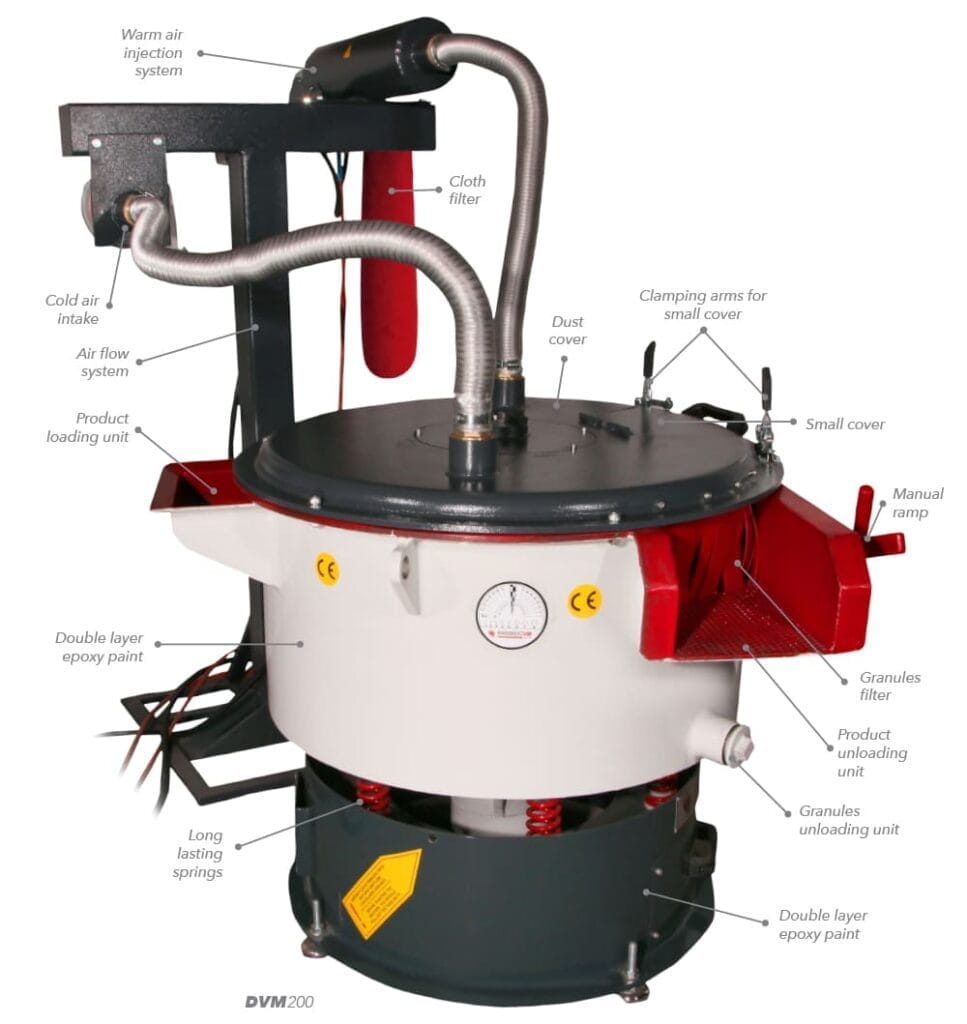
Circular vibratory dryers, such as the KAYAKOCVIB DVM series, use a bowl-shaped processing chamber. The vibratory motion causes the part-and-media mix to flow in a helical spiral around the bowl. This continuous circulation ensures that all part surfaces make repeated contact with the drying media. Circular dryers are well suited for small to medium parts in batch volumes, including fasteners, CNC-machined components, stamped parts, and die cast parts.
Trough vibratory dryers, such as the KAYAKOCVIB D-TVM series, use an elongated U-shaped processing channel. The vibratory motion moves the part and media mix from one end of the trough to the other in a controlled flow pattern. Trough dryers are better suited for parts that are too long or too large for circular bowl geometry, or for applications where a continuous in-line flow from a finishing machine to a dryer is required.
Machine selection between circular and trough configurations depends primarily on part geometry, production flow layout, and whether batch or continuous drying is required.
Drying Media Selection
The choice of drying media has a direct effect on drying efficiency, surface condition, and cycle time. The most widely used drying media for metal parts are natural wooden chips, typically made from absorbent hardwood species that have been dried and conditioned to a controlled moisture content before use.
Wooden chip size and geometry influence how well the media contacts and covers complex part surfaces. Smaller chips reach internal pockets and recessed areas more effectively than large chips, but very fine media can lodge in blind holes or threads if part geometry creates entrapment risk. Standard chip sizes suitable for small metal parts are typically in the range of 10 to 30 millimeters, though actual selection requires validation based on part geometry.
Drying media must be regularly replaced or refreshed because wooden chips absorb moisture progressively during use and lose drying effectiveness over time. Saturated or over-used media will not dry parts effectively regardless of machine settings. In high-volume production lines, media condition monitoring and scheduled replacement are standard maintenance practices.
For parts that require a light surface conditioning or mild brightening effect during drying, specialty drying media with additive content may be used. These products combine moisture absorption with a surface-active compound that leaves a light protective film or mild luster on the metal surface. Application of this approach must be validated against downstream process requirements to confirm compatibility with coating or inspection steps.
Process Parameters That Control Drying Quality
Several process variables control the drying result for small metal parts. Understanding these variables allows process engineers to optimize cycle performance and prevent surface quality problems.
| Parameter | Effect on Drying Result | Typical Control Range |
|---|---|---|
| Media temperature | Higher temperature accelerates moisture absorption and evaporation | 40 to 70 degrees Celsius depending on part material and media type |
| Cycle time | Longer cycles ensure complete drying of complex geometries | Typically 10 to 30 minutes depending on part load and moisture level |
| Part-to-media ratio | Insufficient media reduces surface contact and slows drying | Media volume should substantially exceed part volume |
| Vibratory amplitude | Controls media and part circulation intensity | Set to maintain active but non-damaging part motion |
| Air exhaust or ventilation | Removes humid air from the chamber during drying | Continuous exhaust recommended during operation |
Part temperature at the point of entry into the dryer also affects cycle performance. Parts that enter the dryer already at elevated temperature from a preceding washing stage dry faster than cold parts. In integrated production lines, this thermal carryover effect can be used to reduce drying cycle time.
Application Context Across Industries
Drying small metal parts is a requirement across a wide range of manufacturing sectors. The process specifications and tolerance for surface condition after drying vary significantly between industries.
In the fastener industry, high-volume production of bolts, nuts, and washers requires fast and consistent drying after wet deburring or barrel finishing. Parts must exit the dryer free of surface moisture before proceeding to zinc plating, mechanical plating, or heat treatment. Any moisture carryover creates immediate plating quality risk.
In CNC machining operations, precision turned and milled parts often proceed through wet vibratory finishing for edge rounding and surface improvement. These parts typically have complex geometries with internal bores, threads, and cross-holes that retain moisture. Effective drying media selection and cycle time are critical to ensuring all internal surfaces are dry before inspection or packaging.
In the automotive supply chain, stamped and die cast components require drying as part of a controlled pre-coating process. Parts destined for electrophoretic coating or powder coating must be free of surface moisture and finishing compound residue. The drying stage in these lines is often integrated with washing and separation in a continuous automated sequence.
In medical device manufacturing, surface finish and cleanliness specifications are stringent. Small implants, surgical instruments, and device components in stainless steel or titanium require controlled drying without any risk of surface contamination from media particles or residue. Drying process validation is typically required as part of the broader process validation program for medical components.
Integration Into an Automated Finishing Line
In high-volume manufacturing, drying small metal parts is rarely performed as a standalone manual operation. Modern finishing lines integrate the dryer as a downstream stage following the finishing machine and separator.
A typical automated line for small metal parts includes a circular vibratory finishing machine, a separator to remove parts from finishing media, an optional washing station, and a vibratory dryer. Parts flow automatically from one stage to the next using conveyor systems, vibratory transfer channels, or elevators. The dryer discharge can be connected directly to a packaging station, inspection conveyor, or storage bin.
Automation reduces manual handling, improves process consistency, and allows continuous production without operator intervention at each stage. In fully automated lines, part loading into the finishing machine, media replenishment, compound dosing, washing, separation, and drying are all controlled from a central process controller. This level of integration is particularly relevant for high-volume fastener, automotive, and CNC production environments.
Media heating systems, exhaust fans, and cycle timers in the dryer are integrated into the line control system so that the dryer is ready at the correct operating temperature when parts arrive from the upstream stage.
Surface Quality Considerations After Drying
Properly executed vibratory drying should leave parts completely dry, free of visible moisture, and without surface marks from the drying media. However, several conditions can produce surface quality problems if the drying process is not correctly set up.
Media contamination from finishing compound residue, metal fines, or oil introduced by parts can cause surface staining or redeposition of contaminants during drying. Regular media replacement and periodic machine cleaning prevent this problem.
Parts with sharp edges or thin sections may receive minor surface marks from mechanical contact with wooden chips at high vibratory amplitude. Reducing amplitude or increasing media-to-part ratio typically resolves this.
Parts with deep blind holes or narrow internal passages may retain moisture even after a standard drying cycle. For these geometries, extended drying time, finer media, or a secondary air blow-off station after the dryer may be required.
Aluminum parts are sensitive to surface staining from incompatible drying media or media with elevated moisture content. Using fresh, conditioned wooden chips and maintaining correct media temperature prevents staining on aluminum surfaces.
Frequently Asked Questions
Can vibratory drying be used immediately after ultrasonic cleaning?
Yes, parts cleaned in an ultrasonic or pressure washing system and then rinsed can proceed directly to a vibratory dryer. The dryer must handle the moisture load from the cleaning rinse, so media condition and cycle time should be validated for the specific part and cleaning process combination.
How often should drying media be replaced?
Replacement frequency depends on production volume, part moisture content at dryer entry, and chip size. In high-volume production, media is typically inspected and partially refreshed on a regular maintenance schedule. Saturated chips that no longer absorb moisture effectively must be replaced to maintain drying performance.
Is vibratory drying suitable for delicate or thin-walled parts?
Vibratory drying can be used for delicate parts when amplitude and part-to-media ratio are correctly adjusted to minimize mechanical contact intensity. For very sensitive parts, drying cycle parameters require validation to confirm that no surface marking or deformation occurs during drying.
What is the difference between circular and trough vibratory dryers?
Circular dryers use a bowl geometry with helical part circulation and are suited for small to medium batch parts. Trough dryers use an elongated channel and are better suited for long parts or continuous in-line flow layouts. Machine selection depends on part geometry and production line configuration.
Related Process Equipment
Related Video Demonstration
Conclusion
Drying small metal parts is an integral process step in industrial mass finishing lines, not an afterthought. The vibratory drying method provides effective, scalable, and automatable moisture removal for a wide range of steel, stainless steel, and aluminum components. Key variables including media temperature, media condition, cycle time, part-to-media ratio, and machine type must be correctly specified for the application. Circular dryers are the standard choice for batch processing of small parts, while trough dryers serve applications requiring in-line continuous flow or long part handling. Process engineers should validate drying cycle parameters through sample testing before production release, particularly for parts with complex internal geometry, sensitive surface finishes, or tight downstream process requirements.
Sorry, the comment form is closed at this time.