


26 Jul Water Stains After Vibratory Finishing
Water stains after vibratory finishing are one of the most common surface quality defects encountered in mass finishing production. These stains appear as dull spots, mineral deposits, or streaky discoloration on finished parts and are caused by water or compound residue drying on the metal surface without being properly removed. Understanding the root causes and applying the correct drying method, media rinsing sequence, and process configuration is essential to producing clean, stain-free parts consistently.
In This Article
Why Water Stains Form After Vibratory Finishing
Vibratory finishing is a wet process in most industrial applications. Parts run in contact with water, finishing compound, and media throughout the cycle. At the end of the cycle, parts carry residual moisture and compound film on their surface. If this moisture is not removed rapidly and completely, dissolved minerals, compound chemicals, and metal fines deposit on the part surface as the water evaporates. The result is visible staining, particularly on polished or bright surfaces.
The severity of staining depends on several factors: water hardness, compound concentration, rinsing effectiveness, part geometry, part material, and drying speed. Hard water with high mineral content leaves heavier deposits than soft water. High compound concentrations leave more residue if rinsing is inadequate. Parts with recessed areas, blind holes, or complex geometry trap water and dry unevenly, producing localized staining.
Main Causes Grouped by Category
Identifying the correct root cause is necessary before selecting a corrective action. Water staining in vibratory finishing typically falls into one of four categories.
The first category is insufficient rinsing. If parts are not rinsed adequately after the finishing cycle, compound residue remains on the surface and stains during drying. A clean water rinse stage at the end of the process removes the majority of compound film before drying begins.
The second category is hard water or water chemistry. High mineral content in process water leaves calcium and magnesium deposits on part surfaces during evaporation. Softened or deionized water significantly reduces this risk, particularly for bright polished stainless steel and aluminum parts.
The third category is slow or incomplete drying. Parts that remain wet for extended periods after the finishing cycle are more likely to develop stains. Ambient drying, open tray drying, or drying in a static oven without airflow does not remove moisture fast enough from complex part geometries.
The fourth category is compound selection or concentration errors. Using excessive compound concentration, the wrong compound type for the material, or a compound not designed for clean rinsing can leave a residue that is difficult to remove with standard rinsing and promotes staining during drying.
Selecting the Right Drying Method
Drying method selection is the most direct way to prevent water stains after vibratory finishing. The table below summarizes the main drying approaches used in industrial mass finishing and their suitability for stain prevention.
| Drying Method | Stain Prevention Effectiveness | Suitable For | Limitations |
|---|---|---|---|
| Vibratory dryer with corn cob or walnut shell media | High | Small to medium parts, mixed metals, steel, aluminum | Requires media maintenance and periodic replacement |
| Centrifugal drying | Medium to High | Small parts with simple geometry | Not suitable for delicate or large parts |
| Hot air oven drying | Medium | Parts with open geometry | Poor airflow reaches recessed areas; slow on complex parts |
| Ambient air drying | Low | Non-critical parts only | Inconsistent results; high stain risk on polished surfaces |
| Compressed air blow-off | Medium | Supplement to other methods | Not a standalone solution for complex geometry |
For industrial mass finishing applications where consistent surface quality is required, vibratory drying using absorbent organic media is the most reliable and widely used method. Corn cob granules and walnut shell granules absorb surface moisture from parts rapidly as the vibratory motion brings the dry media into continuous contact with wet part surfaces. This process simultaneously removes residual compound film and prevents water stains from forming.
Vibratory Dryer Machine Selection
Choosing the correct vibratory drying machine depends on part geometry, part size, and production volume. Two main machine types are used for vibratory drying in industrial finishing lines.
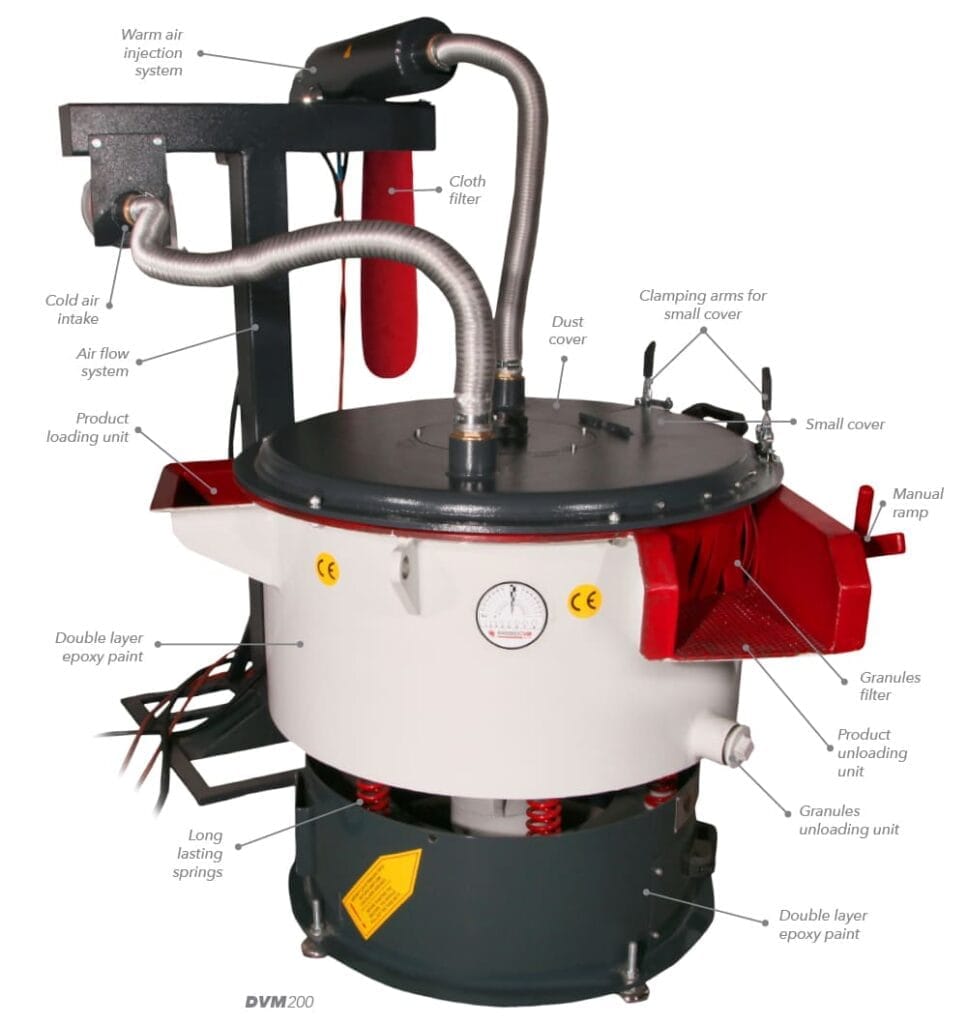
Circular vibratory dryers are suitable for small to medium parts with compact geometry. The circular bowl design produces three-dimensional vibratory motion that keeps parts and drying media in continuous relative movement. This motion distributes heat and absorbent media contact uniformly across the part batch. The KAYAKOCVIB DVM series circular vibratory dryers are designed for integration directly after a vibratory finishing machine and separator, allowing parts to move through rinsing, separation, and drying as a continuous process sequence.
Trough vibratory dryers are preferred for longer parts, larger workpieces, or parts that would be at risk of damage in a circular bowl due to part-on-part impact. The linear motion in a trough dryer keeps parts oriented and reduces collision energy. The KAYAKOCVIB D-TVM series trough dryers follow the same design logic as the D-TVM finishing machines, making them suitable for integration in lines processing shafts, rails, profiles, or other elongated components.
Both dryer types can be equipped with heating elements to warm the drying media and accelerate moisture absorption. Heated media significantly reduces drying cycle time and improves stain prevention on parts with complex internal geometry.
Compound and Rinsing Selection to Prevent Staining
Compound selection directly affects staining risk. Compounds that do not rinse cleanly or that leave a high-residue film after the finishing cycle increase the probability of water stains even when drying conditions are correct.
For steel and iron parts processed in ceramic media, compounds such as 943 deburring and polishing liquid provide effective process chemistry while rinsing cleanly from the part surface when a fresh water rinse stage is applied. For aluminum and non-ferrous parts processed in plastic media, 085 deburring and polishing liquid is commonly used and is formulated to rinse effectively from softer metal surfaces.
028-S degreasing liquid is used as a rinsing or degreasing compound to remove oil, metal fines, and compound residue from parts before the drying stage. Applying a final rinse with diluted 028-S, followed by a clean water flush, reduces residual compound load and significantly lowers staining risk in the subsequent drying stage.
Compound concentration must be controlled. Excessive compound in the process water increases residue on parts. Most mass finishing compounds are used at low dilution ratios, and overfeeding through dosing pumps is a common process error that leads to surface residue and staining problems.
Process Sequence for Stain-Free Results
A reliable process sequence for preventing water stains after vibratory finishing follows a structured order. The steps below represent a validated industrial approach for parts requiring clean, stain-free surfaces.
- Run the vibratory finishing cycle with the appropriate media, compound, and water at the correct dosing rate and flow.
- At the end of the finishing cycle, flush the machine with clean water for two to five minutes to dilute and remove compound residue from the media and part surfaces.
- Separate parts from media using an inline separator. Keep parts moving and avoid leaving wet parts stationary in a tray or bin.
- Pass parts through a rinsing stage using clean water, optionally with a low concentration of 028-S to remove remaining compound film.
- Transfer parts immediately to the vibratory dryer loaded with dry corn cob or walnut shell media. Run the drying cycle until parts are fully dry, typically ten to thirty minutes depending on part geometry, material, and media condition.
- Inspect parts for surface stains after drying. If staining persists, review water hardness, compound concentration, rinsing effectiveness, and drying media condition.
Drying Media Condition and Replacement
Drying media performance degrades over time. Corn cob and walnut shell granules absorb moisture from parts effectively when they are dry and in good condition. As media ages and absorbs accumulated moisture, oil, and compound residue, its drying effectiveness decreases and it may begin to deposit contamination on part surfaces instead of removing it.
The condition of drying media should be checked regularly. Saturated or contaminated media should be replaced or refreshed with dry media additions. In high-volume production lines, drying media is often refreshed on a scheduled basis rather than waiting for visible performance loss. Polishing wax or burnishing compound added to the drying media at low concentration can improve the surface appearance of parts during drying, particularly for bright polished steel or aluminum components.
Material-Specific Staining Risks
Different materials show different sensitivity to water staining. Understanding material behavior helps in configuring the correct drying approach.
Polished stainless steel is the most sensitive material for water stain visibility. Even low mineral deposits are clearly visible on bright stainless surfaces. Stainless steel parts should always be processed with softened or deionized water, rinsed thoroughly, and dried immediately in a vibratory dryer. Allowing stainless steel parts to air dry will almost always produce visible staining.
Aluminum surfaces are also sensitive to staining, particularly after bright polishing. Aluminum can develop a white oxide film if residual alkaline compound is not removed before drying. Using a mildly acidic rinse compound or adjusting the finishing compound pH can prevent this type of staining on aluminum.
Steel and iron parts are less sensitive to cosmetic staining but can develop rust spots rapidly if moisture is not removed promptly after the finishing cycle. Vibratory drying immediately after rinsing and separation is important for carbon steel parts to prevent flash rust, which may be mistaken for mineral staining but is actually early stage oxidation.
Automation and Line Integration
In automated finishing lines, preventing water stains after vibratory finishing requires that the rinsing, separation, and drying stages are integrated into a continuous flow without wet parts waiting in static trays between stages. Part transfer time between the separator and dryer should be minimized. Inline conveyors or chutes that move parts directly from the separator into the dryer inlet reduce the exposure time during which parts remain wet.
Automated compound dosing systems help maintain consistent compound concentration throughout the shift, preventing the overfeeding errors that lead to residue buildup. Water recycling systems with filtration and hardness control support consistent rinse quality across long production runs. In high-volume automotive or fastener lines, all these elements are typically integrated and controlled by a central sequence controller to ensure repeatable, stain-free results across the full production volume.
Troubleshooting Persistent Staining
When water stains after vibratory finishing persist despite applying the standard corrective actions, a systematic diagnosis approach is needed.
Check water hardness first. If process water or rinse water has high mineral content, install a water softener or deionized water supply for the rinse stage. Measure compound concentration in the process water and reduce dosing if the concentration is above the supplier recommendation. Inspect drying media condition and replace if the media is saturated, clumped, or contaminated. Verify that the drying cycle time is sufficient for the part geometry and material. Complex parts with deep recesses may require extended drying time or supplemental compressed air blow-off before entering the dryer. If staining is localized to specific areas of the part, this usually indicates water pooling in a recessed feature that requires attention to part orientation during drying or a targeted blow-off step.
Frequently Asked Questions
What causes water stains after vibratory finishing?
Water stains form when residual moisture, mineral deposits, or compound residue remains on the part surface and dries without being removed. The main causes are insufficient rinsing, hard process water, slow drying, and excessive compound concentration.
How do I choose between a circular dryer and a trough dryer?
Use a circular vibratory dryer for small to medium parts with compact geometry. Use a trough vibratory dryer for long parts, large components, or parts sensitive to part-on-part impact in a circular bowl. Machine selection depends on part size, geometry, and production volume.
Does water hardness affect staining after vibratory finishing?
Yes. Hard water with high mineral content leaves calcium and magnesium deposits on part surfaces during drying. Using softened or deionized water for rinsing significantly reduces staining risk, especially on polished stainless steel and aluminum parts.
Can polishing compound in the dryer prevent water stains?
Adding a small amount of polishing wax or burnishing compound to the drying media can improve surface appearance and provide a light protective film during drying. This is commonly used for bright polished parts but does not replace proper rinsing and drying.
Related Process Equipment
Related Video Demonstration
Conclusion
Preventing water stains after vibratory finishing requires a coordinated approach across rinsing, compound selection, water quality, and drying method. The most reliable industrial solution is vibratory drying with dry organic media immediately after part separation and rinsing, with water softening applied to the rinse stage when mineral content is elevated. Machine selection between circular and trough dryer formats should follow part geometry and size logic. Compound concentration control, drying media maintenance, and automated line integration complete a process configuration that consistently delivers clean, stain-free surfaces across steel, stainless steel, aluminum, and mixed metal production batches. Actual cycle times and drying effectiveness depend on part geometry and material and should be confirmed through production trials before committing to a final line configuration.
Sorry, the comment form is closed at this time.