


26 Jul Drying Corrosion Prevention
Drying corrosion prevention is one of the most underestimated process variables in industrial surface finishing. Parts that leave a vibratory finishing machine in perfect condition can develop staining, rust, or early-stage corrosion within minutes if the drying stage is not properly controlled. For steel, stainless steel, aluminum, and mixed-metal batches, the transition from wet finishing to dry storage or downstream processing represents a high-risk window where surface chemistry, moisture retention, and thermal conditions interact directly with corrosion susceptibility.
In This Article
Why the Drying Stage Creates Corrosion Risk
After wet vibratory finishing, parts carry residual process water, compound chemistry, and fine media debris on their surfaces. The finishing compound used during the process typically contains surfactants, rust inhibitors, and pH-adjusting agents that protect the surface during the wet cycle. Once the wet cycle ends and parts begin separating from media, the protective chemistry becomes diluted and unstable. If drying does not remove this moisture layer quickly and completely, the combination of surface water, dissolved salts, and exposed metal creates the electrochemical conditions needed for corrosion initiation.
For carbon steel and low-alloy steel parts, the risk window between water contact and visible rust formation can be very short, particularly at ambient temperatures above 20 degrees Celsius and in humid production environments. Stainless steel is more resistant but is not immune, especially when chloride contamination is present in process water or compounds. Aluminum is vulnerable to pitting and staining if alkaline compound residues are left on the surface during drying. Mixed-metal batches introduce additional variables because different materials have different corrosion potentials and different sensitivity to residual chemistry.
Process Sequence: Where Drying Fits in the Finishing Line
In a standard wet vibratory finishing line, the drying stage follows media separation and, when required, a rinsing step. The correct sequence matters significantly for drying corrosion prevention. Parts should move from the separator output into the dryer as quickly as the line layout allows. Any accumulation or manual handling step between separation and drying creates exposure time where moisture and compound residues remain active on part surfaces.
- Wet vibratory finishing in a KVM circular or TVM trough machine with appropriate media and compound
- Separation of parts from finishing media using a separator unit
- Rinsing stage if required by compound type, part material, or surface cleanliness specification
- Transfer to vibratory dryer with corn cob or walnut shell drying media
- Timed drying cycle with temperature control at or above the recommended threshold
- Output inspection and transfer to storage or downstream process
Each step in this sequence has a parameter that affects corrosion outcome. The most common mistakes are skipping the rinse when compound residues are corrosive, delaying transfer to the dryer, running the dryer at insufficient temperature, and using degraded or contaminated drying media.
Drying Machine Types and Their Effect on Corrosion Risk
The two primary vibratory dryer types used in industrial mass finishing are circular vibratory dryers and trough vibratory dryers. The choice between them affects both the drying efficiency and the risk of incomplete drying, which directly connects to corrosion outcomes.
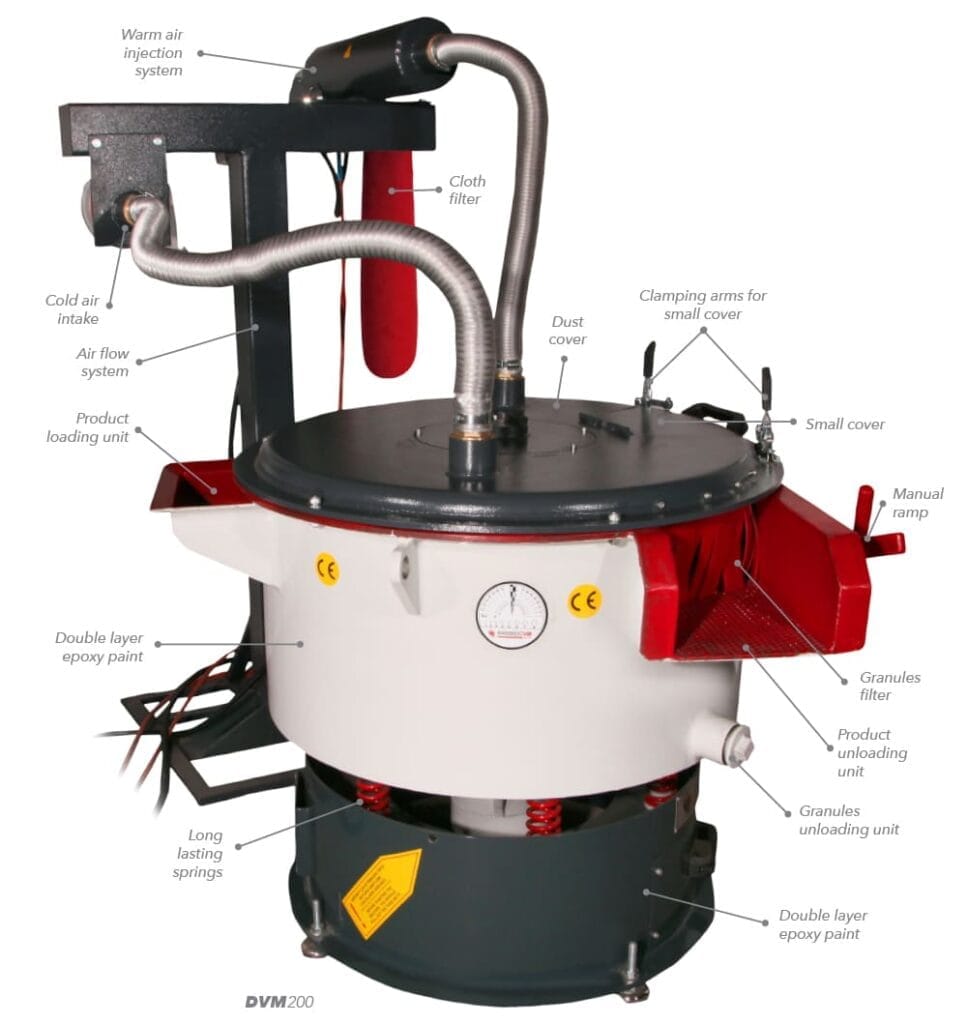
Circular vibratory dryers, such as the KAYAKOCVIB DVM series, use a circular bowl with vibration and heated airflow to tumble parts through drying media. The circular motion creates continuous part-to-media contact, which is effective for small to medium parts with moderate geometry complexity. The spiral flow pattern ensures that parts cycle through the heated zone repeatedly during the drying process, reducing the risk of cold spots or moisture pockets.
Trough vibratory dryers, such as the KAYAKOCVIB D-TVM series, are preferred for long components, larger parts, or geometries that would be damaged or poorly processed in a circular bowl. The trough format allows parts to move through the drying media in a more controlled linear path. For elongated steel or aluminum components used in automotive or aerospace applications, the D-TVM configuration provides better protection against part-to-part impact while still achieving thorough moisture removal.
Both machine types rely on the same physical drying principle: mechanical abrasion and absorption by organic drying media combined with warm or hot airflow to accelerate evaporation. The key process variables that determine drying effectiveness and corrosion risk are cycle time, temperature, media condition, air volume, and load factor.
Critical Process Parameters for Drying Corrosion Prevention
The following parameters must be controlled and validated for each application to achieve reliable drying corrosion prevention results. Actual values depend on part material, part geometry, surface area, batch weight, and ambient conditions, and must be established through process trials.
| Parameter | Effect on Corrosion Risk | Typical Adjustment Range |
|---|---|---|
| Drying temperature | Low temperature leaves residual moisture on surface, accelerating corrosion initiation | 60 to 120 degrees Celsius depending on material and media type |
| Cycle time | Insufficient time causes incomplete moisture removal, especially in complex geometries | 15 to 60 minutes depending on batch size and part geometry |
| Drying media fill level | Underfilling reduces contact surface; overfilling reduces part mobility and drying efficiency | Typically 60 to 80 percent of usable bowl volume |
| Media moisture content | Saturated or degraded media cannot absorb moisture from parts, leaving surfaces wet | Media must be periodically dried out or replaced based on production volume |
| Airflow volume | Insufficient airflow slows evaporation and allows humid air to remain inside the machine | Must match machine specification; verify air outlet is unobstructed |
| Load factor | Overloading reduces part mobility and creates areas where moisture is trapped between parts | Follow machine manufacturer loading guidelines for each batch weight |
Temperature is the most consistently critical variable. Many production lines run dryers at lower temperatures to save energy or because the setting was never validated after installation. For carbon steel parts, running the dryer below 80 degrees Celsius in a humid production environment can result in flash rusting within the dryer or immediately after output. For aluminum, temperatures above 100 degrees Celsius may cause surface discoloration if residual alkaline compounds are not fully rinsed before drying. The correct temperature must be selected per material and process chemistry, not set arbitrarily.
Drying Media Selection and Its Role in Corrosion Control
The drying media carries most of the moisture absorption function in a vibratory dryer. The two most common organic drying media types are corn cob granules and walnut shell granules. Both are natural cellulosic materials with high moisture absorption capacity, but they differ in hardness, surface texture, and suitability for different part types.
Corn cob media is softer and lighter, making it suitable for parts where surface marking must be avoided. It absorbs moisture efficiently but can degrade faster in high-humidity or high-temperature conditions. Walnut shell media is harder and more durable, offering better abrasive cleaning action alongside drying, which can help remove final compound residues during the drying cycle. For steel parts that require a mild additional burnishing effect, walnut shell media is commonly preferred. For aluminum or soft-metal parts, corn cob is generally the safer choice.
Regardless of media type, the moisture saturation state of the drying media must be monitored. Saturated media loses its absorption capacity and will no longer dry parts effectively. Media should be periodically cycled through a drying-out phase without parts loaded, or replaced at regular intervals based on production volume and observed drying quality. Using wet or contaminated drying media is one of the most frequent root causes of unexpected corrosion failures in finished batches.
Rinse Stage Control and Its Impact on Post-Drying Corrosion
The rinse step before drying is often treated as optional, but for many applications it is a necessary stage for drying corrosion prevention. Vibratory finishing compounds leave a chemical film on part surfaces. If this film has a high pH, contains chloride-based additives, or leaves soluble salts on the surface, the drying process may not fully neutralize the corrosion risk. In these cases, rinsing removes the compound residue before the thermal drying cycle begins.
Rinse water quality also matters. Using tap water with high chloride content or high conductivity for rinsing steel parts can introduce corrosive ions that the dryer cannot remove. For corrosion-sensitive applications, deionized water or a rust-inhibitor rinse is preferred. A rust-inhibitor rinse leaves a thin passivating film on the metal surface that protects the part after drying and during storage. This is particularly relevant for steel and iron parts that will be stored in ambient conditions for extended periods before coating, packaging, or further processing.
Material-Specific Considerations
Different base materials require different approaches to drying corrosion prevention. A single dryer setting or drying sequence does not apply uniformly across all materials.
For carbon steel and low-alloy steel, the highest corrosion risk exists and the process must prioritize fast transfer to the dryer, adequate temperature, complete moisture removal, and a rust-inhibitor rinse stage when storage time before coating is longer than a few hours.
For stainless steel, the passivation layer provides better inherent corrosion resistance, but contamination from mixed-media batches containing iron particles, or from process water with elevated chloride levels, can compromise this layer. Drying stainless steel parts thoroughly and avoiding contact with carbon steel parts or tools during the post-drying stage is important.
For aluminum, the primary risks are alkaline staining and pitting from residual compound chemistry. Rinsing is more critical for aluminum than for steel in most cases. The drying temperature should be set to avoid thermally activating any alkaline residues remaining on the surface. Plastic finishing media and pH-neutral or mildly acidic compounds are typically recommended for aluminum before the drying stage.
Mixed-metal batches, where steel and aluminum parts are processed together, are generally not recommended in vibratory finishing because the different material requirements for media, compound, and drying conditions cannot be optimized for both simultaneously. If mixed batches cannot be avoided, the process parameters must be validated carefully and the corrosion risk managed through conservative settings and frequent monitoring.
Automation and Line Integration for Consistent Drying Results
In high-volume production environments, manual transfer between the separator and dryer introduces timing variability that directly affects drying corrosion prevention outcomes. Automated finishing lines connect the separator output to the dryer input through conveyor systems or direct chute transfers, eliminating accumulation time and standardizing the wet-to-dry transition.
Automated dryers with programmable cycle controllers allow temperature, time, and airflow settings to be stored as recipes for each part family. This ensures that a validated drying process is repeated consistently across shifts and operators without relying on manual judgment. When integrated with washing or rinsing modules upstream, the complete sequence from wet finishing through rinse and dry can be managed as a single controlled process line, reducing the corrosion risk that arises from process gaps between stages.
Frequently Asked Questions
What is the most common cause of flash rust after vibratory finishing?
The most common cause is insufficient or delayed drying after the wet finishing cycle. If parts are held in the separator or in air for more than a few minutes before entering the dryer, surface moisture combined with residual compound chemistry initiates oxidation on exposed steel surfaces. Low dryer temperature and saturated drying media are secondary causes.
Does drying media type affect corrosion outcomes?
Yes. Degraded, wet, or contaminated drying media cannot absorb surface moisture effectively, leaving parts incompletely dried and at higher corrosion risk. The media type selection, corn cob or walnut shell, also affects whether final compound residues are buffed from the surface during the drying cycle.
Is a rust-inhibitor rinse always necessary before drying?
Not always, but it is recommended for carbon steel and iron parts that will be stored before coating or packaging. For parts that move directly to a coating or plating line immediately after finishing, a rinse with clean water may be sufficient. The specific requirement depends on part material, compound chemistry, storage conditions, and downstream process timing.
Can aluminum and steel parts be dried in the same batch?
It is generally not recommended. The optimal drying temperature and compound residue management differ between these materials, and mixed batches increase the risk of galvanic interaction and cross-contamination during the drying process. Separate drying cycles are preferred when both materials are processed on the same line.
Related Process Equipment
Related Video Demonstration
Conclusion
Drying corrosion prevention is not a passive outcome of running parts through a dryer. It requires deliberate control of temperature, cycle time, media condition, rinse stage quality, load factor, and transfer timing between process stages. Each variable interacts with part material, surface chemistry, and ambient conditions to determine whether a finished part exits the drying stage in stable condition or with active corrosion initiation already under way. For production engineers managing finishing lines that include steel, stainless steel, aluminum, or mixed-metal parts, the drying stage deserves the same systematic process validation applied to the finishing cycle itself. Machine selection between circular dryers and trough dryers, media type, and line integration all contribute to a drying process that reliably protects surface quality from the finishing machine to the end of the production line.
Sorry, the comment form is closed at this time.