



22 Jul Precision Metal Finishing
Precision metal finishing by centrifugal disc process is one of the most effective methods for achieving controlled deburring, edge rounding, and surface smoothing on small and medium metal components where both cycle time and surface quality are engineering constraints. Unlike general-purpose vibratory finishing, centrifugal disc technology applies significantly higher mechanical energy to the part-media mass, making it suitable for applications where production speed, consistency, and surface outcome must all be controlled simultaneously. This article covers the engineering requirements, machine selection logic, media and compound choices, and quality control considerations specific to centrifugal disc finishing in CNC machining, aerospace, automotive, fastener, and medical manufacturing environments.
In This Article
Why Precision Parts Require a Different Finishing Approach
Standard vibratory finishing works well for many general deburring and surface smoothing applications. However, for precision metal parts with tight dimensional tolerances, complex geometries, or demanding surface roughness targets, the relatively low G-force of vibratory machines may produce insufficient or inconsistent results. Precision components often have small burrs from turning, milling, or grinding that must be removed without altering edge geometry or part dimensions beyond acceptable limits.
Precision parts also tend to be produced in smaller batch sizes where cycle time per batch is commercially significant. In these cases, a high-intensity process that completes in minutes rather than hours creates a meaningful production advantage. Centrifugal disc finishing addresses these requirements by generating significantly higher media pressure and relative motion between parts and media compared to circular or trough vibratory machines.
How Centrifugal Disc Finishing Works
A centrifugal disc finishing machine consists of a stationary cylindrical tub with a high-speed rotating disc at the base. As the disc rotates, centrifugal force drives the media and parts outward and upward along the tub wall, creating a continuous toroidal flow. This motion produces intensive relative movement between media and part surfaces at forces typically several times greater than vibratory finishing.
The higher contact pressure between media and part surfaces accelerates cutting, smoothing, and polishing action. Because the media mass moves continuously and uniformly, part-to-part contact is generally low, which is important for finishing precision components where impact damage between parts must be avoided. Process intensity can be adjusted by controlling disc speed, which changes the G-force applied to the media mass and directly influences material removal rate, surface finish level, and edge geometry change.
Compound and water flow into the process continuously, maintaining lubrication, controlling temperature, suspending swarf, and influencing surface chemistry. The combination of mechanical action and process chemistry determines the final surface outcome.
Typical Parts and Materials in Centrifugal Disc Applications
Centrifugal disc finishing is commonly applied to small turned parts, milled components, precision fasteners, medical implant components, hydraulic valve bodies, aerospace structural parts, and electronic connector housings. These parts are typically manufactured from steel, stainless steel, aluminum, titanium, or mixed metal families depending on the application sector.
Part geometry matters for media selection and loading density. Blind holes, internal threads, undercuts, and thin walls all influence how media interacts with part surfaces and create potential media lodging or part damage risks that must be evaluated before production release. Very small holes may require undersize media or alternative process configurations to prevent lodging.
Media Selection for Precision Metal Finishing
Media selection is one of the most critical engineering decisions in centrifugal disc finishing because the wrong media can produce insufficient material removal, surface scratching, dimensional deviation, or part damage within the short cycle times typical of this process.
For steel and stainless steel components, ceramic media is generally preferred because the harder base material requires stronger cutting and edge break action. Ceramic media provides effective deburring and surface refinement at the higher intensity levels typical of centrifugal disc processes. Cycle time and surface outcome depend on media shape, cut grade, and size relative to part geometry.
For aluminum components, plastic media is generally more appropriate because aluminum is a softer material more sensitive to aggressive cutting. Plastic media provides controlled deburring and surface smoothing without excessive material removal or surface embedding of abrasive particles. Using ceramic media on aluminum requires careful process validation to confirm that material removal and surface quality are within acceptable limits.
Media shape selection depends on part geometry. Cylindrical and triangular shapes provide general surface coverage. Cone and wedge shapes improve access to corners and recesses. Spherical shapes are used for burnishing and surface brightening rather than material removal. Mixing media shapes is a common strategy when parts have varied surface features that require different finishing actions simultaneously.
| Material | Recommended Media Type | Typical Compound | Process Note |
|---|---|---|---|
| Steel, Stainless Steel | Ceramic | 943 deburring and polishing liquid | Higher cutting action for harder metals |
| Aluminum | Plastic | 085 deburring and polishing liquid | Softer action to prevent surface damage |
| Copper, Brass | Plastic or fine ceramic | 028 degreasing liquid | Acidic compound suitable for yellow metals |
| Mixed metals in one batch | Generally not recommended | Depends on dominant material | Requires process validation; galvanic risk |
Process Parameters That Control Surface Quality
In centrifugal disc finishing, the primary parameters that control surface quality are disc speed, media type and size, compound concentration, water flow rate, media fill level, and cycle time. These parameters interact and must be set as a system rather than optimized individually.
Disc speed determines the G-force applied to the media mass. Higher disc speed increases media pressure and accelerates material removal and surface refinement, but also increases the risk of part-to-part impact damage and dimensional deviation if not controlled appropriately. For precision metal finishing applications with tight tolerance requirements, disc speed is typically set conservatively and validated through sample testing before production release.
Compound concentration influences surface chemistry, lubrication, and swarf suspension. Insufficient compound concentration can cause surface staining, increased friction, or poor surface brightness. Excessive concentration may reduce cutting efficiency or create foam management issues. Compound type must be matched to base material and target surface condition.
Cycle time in centrifugal disc finishing is significantly shorter than in vibratory finishing for equivalent material removal. Typical cycles range from a few minutes to approximately thirty minutes depending on part material, burr size, media selection, and target surface condition. Actual cycle time must be confirmed through sample testing because it is application-specific and cannot be reliably estimated without process trials.
Machine Selection: KSM Centrifugal Disc Finishing
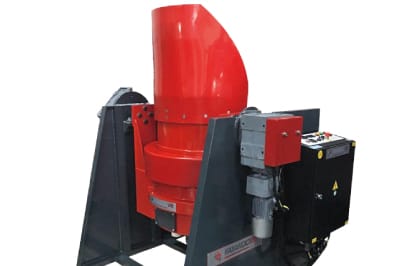
KAYAKOCVIB KSM series centrifugal disc finishing machines are designed for applications where high surface quality, short cycle times, and controlled finishing intensity are required. These machines are applicable to small and medium precision parts in CNC machining, aerospace, medical, fastener, and automotive component sectors where precision metal finishing requirements exceed the capability of standard vibratory equipment.
The KSM series provides adjustable disc speed, continuous compound dosing, and a process chamber geometry that promotes uniform toroidal media flow. When integrated with a downstream separator, washing system, and drying unit, the KSM centrifugal disc machine forms a complete finishing line capable of supporting automated or semi-automated production sequences.
Production Line Integration and Automation
For high-volume or continuous production environments, centrifugal disc finishing can be integrated into automated lines that include parts loading, process execution, media separation, washing, and drying in sequence. Automation eliminates manual handling between stations, reduces cycle variation, and supports repeatable process control across multiple production shifts.
Separation of finished parts from media typically uses a vibrating separator. After separation, parts pass through a washing station to remove compound residue, swarf, and surface contamination before inspection or downstream operations. Where compound residue must be removed from complex geometries or blind features, pressure washing or ultrasonic cleaning may be required as an additional stage.
Drying after wet finishing is necessary to prevent surface oxidation, especially on steel and stainless steel components. Centrifugal disc finished parts are commonly dried using corn cob or walnut shell media in a vibratory dryer, or by hot air drying systems depending on part geometry and production throughput requirements.
Quality Control and Inspection Points
Surface quality after centrifugal disc finishing should be evaluated against engineering specifications for the specific application. Relevant inspection points include surface roughness Ra measurement, edge condition under optical or scanning electron microscopy for critical aerospace or medical parts, dimensional check for tight tolerance features, and visual inspection for staining, scratching, or incomplete burr removal.
For medical and aerospace applications, additional validation steps such as cleanliness testing, passivation confirmation on stainless steel, or biocompatibility assessment may be required depending on the part function and regulatory environment. These requirements are application-specific and must be defined by the engineering team responsible for the part.
Process validation through sample testing before production release is essential for precision metal finishing applications. A process that is not validated on representative parts from the actual production material and condition cannot reliably predict surface outcome, dimensional impact, or cycle time requirements.
Practical Limitations and Engineering Boundaries
Centrifugal disc finishing is effective for small and medium parts but is not suitable for large or very long components that exceed the machine tub diameter. Parts with very deep blind holes, extremely thin walls, or fragile projections require careful evaluation before centrifugal disc processing, as the higher media pressure compared to vibratory finishing increases the risk of part damage in these geometries.
Mixed-material batches, such as aluminum and steel parts processed together, are generally not recommended because different material hardness and chemistry create uneven finishing results and potential galvanic contamination between dissimilar metals. Batch composition should be consistent by material type for reliable surface quality control.
Parts with heavy casting flash, large gate stubs, or weld spatter may require pre-processing operations before centrifugal disc finishing because the disc process is optimized for light-to-medium burrs rather than structural material removal. In these cases, a two-stage process combining initial deburring with subsequent surface finishing may be more appropriate.
Frequently Asked Questions
What is the main advantage of centrifugal disc finishing over vibratory finishing for precision parts?
Centrifugal disc finishing generates significantly higher G-force than vibratory finishing, producing faster material removal, shorter cycle times, and more consistent surface quality for small precision components where vibratory intensity is insufficient.
Can centrifugal disc finishing be used for medical implant components?
Yes, centrifugal disc finishing is used in medical component manufacturing for deburring, surface smoothing, and preparation of implant-grade stainless steel and titanium parts. However, final surface quality, cleanliness, and biocompatibility must be validated against application-specific regulatory and engineering requirements before production release.
How is disc speed selected for a new precision metal finishing application?
Disc speed is typically selected based on part material, part geometry, media type, and required surface outcome. Higher speeds increase media pressure and material removal rate but increase the risk of dimensional deviation and part damage. Initial disc speed settings should be validated through sample trials before committing to production parameters.
Is compound selection different for centrifugal disc finishing compared to vibratory finishing?
The same compound families are used in both processes, but concentration and dosing rate may differ because centrifugal disc finishing operates at higher intensity and typically shorter cycle times. Compound selection must still match the base material, and dosing must be optimized for the specific machine volume and flow configuration.
Related Process Equipment
Related Video Demonstration
Conclusion
Centrifugal disc finishing is an engineering solution for precision metal finishing applications where surface quality, edge condition, and production efficiency must be controlled simultaneously. The process is well-suited to small and medium precision parts in steel, stainless steel, and aluminum across CNC machining, aerospace, medical, fastener, and automotive sectors. Effective implementation requires media selection matched to part material, compound selection appropriate for surface chemistry requirements, disc speed validation through sample testing, and integration with separation, washing, and drying stages to complete the finishing route. For applications where vibratory finishing is too slow or produces insufficient surface quality, centrifugal disc technology provides a technically justified alternative with a well-defined set of process parameters that can be engineered and controlled to meet demanding surface finishing specifications.
Sorry, the comment form is closed at this time.