



21 Jul Centrifugal Finishing Medical Parts
Centrifugal finishing medical parts is a high-intensity mass finishing process used to deburr, edge round, and surface-condition precision components made from titanium, medical grade stainless steel, and similar materials. In medical manufacturing, surface quality requirements are tighter than in most other industries. Burr-free edges, controlled surface roughness, and clean surfaces free of contamination are not optional tolerances but functional requirements that directly affect implant performance, sterilization compatibility, and regulatory acceptance.
In This Article
Why Medical Components Require a Dedicated Finishing Approach
Medical parts typically arrive from CNC machining, turning, or milling operations with sharp edges, micro-burrs, and machined surface textures that are unsuitable for clinical or surgical use. Titanium alloys such as Ti-6Al-4V and medical grade stainless steel grades such as 316L and 17-4 PH are the most common materials. Both materials require controlled finishing to achieve the surface condition needed for implants, surgical instruments, bone screws, and related components.
Standard vibratory finishing can produce acceptable surface results for many industrial applications, but the process intensity is lower and cycle times are longer. For medical components where batch consistency, tight surface roughness targets, and full edge treatment are required, centrifugal disc finishing is typically the preferred solution because it delivers significantly higher process forces and more consistent results across each batch.
How Centrifugal Disc Finishing Works
Centrifugal disc finishing uses a rotating disc at the bottom of a stationary work bowl. As the disc spins, it accelerates the media and part mixture radially outward toward the bowl wall, then upward along the wall and back into the center. This creates a toroidal flow pattern that is more intense and more uniform than the flow produced in standard circular vibratory machines.
The high centrifugal acceleration generates finishing forces that are typically several times greater than standard vibratory finishing under the same media and compound conditions. This translates to shorter cycle times for a given surface quality target, which is important in medical production environments where batch traceability and consistency must be maintained. The enclosed bowl design also keeps parts and media contained, reducing the risk of part damage from impact during processing.
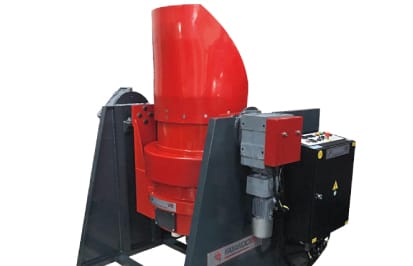
KAYAKOCVIB KSM series centrifugal disc finishing machines are designed for this type of application. The KSM series is suited for small to medium precision parts where high surface quality, short cycle times, and controlled process intensity are required. The machine can be configured for wet finishing with liquid compound dosing, which is the standard mode for medical components.
Typical Medical Parts and Surface Defect Profile
Medical components that are commonly processed by centrifugal finishing include bone screws, orthopedic implant components, surgical instrument blanks, dental implant bodies, and small CNC-machined housings used in medical devices. These parts typically present the following surface conditions after machining:
- Micro-burrs on threaded features, drilled holes, and milled edges
- Machined surface roughness in the range typical of CNC turning and milling
- Tool marks and directional surface texture from machining operations
- Occasionally, light contamination from cutting fluid residue
The finishing objective depends on the component function. For implant surfaces in contact with bone or tissue, a controlled smooth surface texture may be required. For instrument components, burr removal and edge rounding are the primary targets. For some implant types, the surface texture specification may require validation against a defined Ra range, which means the finishing process parameters must be locked and validated before production release.
Media and Compound Selection for Titanium and Medical Grade Stainless Steel
Media and compound selection is one of the most important variables in centrifugal finishing medical parts. The wrong media can damage part surfaces, cause dimensional issues on tight-tolerance features, or leave contamination that cannot be removed by standard cleaning.
For medical grade stainless steel, ceramic media with appropriate cutting characteristics is the standard choice. Ceramic media provides the cutting action needed to remove micro-burrs and produce a smooth surface on harder steel alloys. The geometry of the media should be selected based on part geometry, particularly the access requirements of threads, grooves, and internal features. Cylindrical, triangular, and spherical ceramic shapes are common for medical instrument and implant work.
For titanium components, media selection requires more care. Titanium is reactive and can be contaminated by iron particles transferred from aggressive ceramic media during finishing. In applications where contamination risk is a concern, high-purity ceramic media or plastic media with aluminum oxide abrasive content may be evaluated depending on the required surface condition and the sensitivity of the application. The media choice should always be validated through sample testing before production use.
For stainless steel medical parts, a neutral or slightly alkaline liquid compound compatible with 085-type deburring and polishing chemistry is typical. The compound controls the cutting rate, lubricates the process, and keeps the media and part surfaces clean during the cycle. For titanium parts, compound selection should be validated for chemical compatibility with the alloy and for post-process rinsing effectiveness. Compound dosing must be controlled to maintain consistent process conditions across batches.
Process Parameters for Medical Component Finishing
Centrifugal disc finishing process parameters must be controlled and documented for medical manufacturing. The following parameters directly affect the finishing result:
| Parameter | Typical Range | Effect on Result |
|---|---|---|
| Disc speed | Medium to high depending on machine model | Controls process intensity and surface cutting rate |
| Cycle time | Application-dependent; typically shorter than vibratory | Determines final surface roughness and burr removal level |
| Media fill level | As specified per machine and batch size | Affects part coverage and process uniformity |
| Compound concentration | Controlled by dosing system | Influences cutting rate, lubrication, and surface cleanliness |
| Water flow rate | Set per compound and process requirement | Maintains compound concentration and removes swarf |
| Batch load weight | Within machine rated capacity | Affects part-to-media ratio and finishing uniformity |
Actual parameter values must be established through sample testing and process validation. Recommended ranges from media and machine suppliers provide a starting point, but the final validated parameters must be confirmed against the part-specific surface quality requirements before production release.
Washing and Drying After Centrifugal Finishing
After centrifugal finishing, medical components require thorough washing to remove compound residue, abrasive fines, and metallic swarf from part surfaces. This step is not optional in medical manufacturing. Residual compound or media dust on implant or instrument surfaces can affect biocompatibility assessment, surface analysis, and coating or passivation processes that follow.
Pressure washing or ultrasonic cleaning is commonly used for post-finishing cleaning of medical parts. Ultrasonic cleaning is particularly effective for parts with threads, small holes, or complex geometries where residue can accumulate in recesses. The washing stage should use a cleaning solution compatible with the part material and with the regulatory requirements of the manufacturing environment.
After washing, parts must be dried before inspection or further processing. A DVM circular vibratory dryer using dry corncob media or similar drying media removes surface moisture without introducing contamination. Drying is especially important for stainless steel parts to prevent water staining, and for titanium parts to prevent any moisture-related surface effects ahead of passivation or further surface treatment steps.
Part-Media Separation and Batch Control
Separation of finished parts from media after the centrifugal finishing cycle requires careful handling for medical components. Parts that are small, light, or have features that can interlock with media must be separated using a separator machine with an appropriate screen size and vibration setting. Damage during separation is a production risk that must be controlled, particularly for thin-walled or delicate components.
Batch traceability is a manufacturing requirement for most medical components. This means the batch load, cycle parameters, media type, compound type, and cycle time must be recorded for each production batch. In automated finishing lines, these records can be captured by the machine control system. In manual operations, a documented process log must be maintained.
Integration into Medical Manufacturing Lines
Centrifugal finishing medical parts is rarely a standalone operation in high-volume medical manufacturing. The process is typically integrated into a production sequence that includes pre-cleaning after machining, centrifugal finishing, post-process washing, drying, visual or dimensional inspection, and further surface treatment such as passivation or electropolishing depending on the application.
Automation of the finishing stage reduces operator variability, which is an important factor in medical manufacturing where process consistency directly affects product conformance. Automated compound dosing, timed cycle control, and integration with part handling conveyors are standard features in modern centrifugal finishing systems for medical applications. The level of automation required depends on production volume, cleanroom requirements, and the complexity of the part handling task.
Quality Control and Validation Points
For medical component finishing, quality control must be built into the process rather than relying solely on post-process inspection. The following control points are relevant for centrifugal finishing operations in medical manufacturing:
- Visual inspection for complete burr removal across all edge features
- Surface roughness measurement using profilometry to confirm Ra targets are met consistently
- Dimensional check on critical features to confirm media has not removed material beyond tolerance
- Contamination check to confirm no media fragments, compound residue, or foreign material remain on the part
- Periodic media condition assessment to detect media degradation that could affect process consistency
- Compound concentration monitoring to verify dosing consistency across batches
Process validation should be performed before production release, ideally using a statistically meaningful sample size. If any process parameter changes after validation, revalidation may be required depending on the magnitude of the change and the applicable quality system requirements.
Limitations and Practical Considerations
Centrifugal finishing is highly effective for small to medium precision medical parts, but it has limitations that must be acknowledged. Very large implant components or long instruments may not fit within the standard bowl dimensions of centrifugal disc machines and may require trough vibratory finishing or drag finishing instead. Drag finishing, for example, is used for high-precision single-part processing of implant components where individual part control and very high surface quality are required.
Parts with very small internal holes, narrow slots, or deep recesses may present media lodging risks. Media selection and geometry must be carefully evaluated for these features, and post-process inspection must confirm that no media fragments are retained within part cavities.
The centrifugal finishing process also does not replace passivation, electropolishing, or coating operations that may be specified for medical components. It is a mechanical surface preparation step. Any chemical surface treatment specified for the final part must be performed after finishing and cleaning, following the validated process sequence.
Frequently Asked Questions
What is the advantage of centrifugal disc finishing over vibratory finishing for medical parts?
Centrifugal disc finishing generates higher process forces than standard vibratory finishing, resulting in shorter cycle times and more consistent surface conditioning for precision medical components. This is particularly useful when tight surface roughness targets and full burr removal must be achieved repeatably across production batches.
Can centrifugal finishing be used for titanium implant components?
Yes, centrifugal finishing is used for titanium medical components, but media selection must be carefully validated to avoid iron contamination risk. The process parameters and media type should be confirmed through sample testing before production use. Post-process cleaning and inspection are required to confirm surface cleanliness.
How are process parameters controlled in medical centrifugal finishing?
Disc speed, cycle time, compound dosing, water flow, and batch load must be set to validated values and documented for each production batch. In automated systems, these parameters are controlled and logged by the machine control system. Any deviation from validated parameters requires assessment before the batch is released.
Is centrifugal finishing sufficient as the only surface treatment for medical implants?
Centrifugal finishing addresses mechanical surface preparation including burr removal, edge rounding, and surface smoothing. It does not replace chemical surface treatments such as passivation or electropolishing that may be specified for the component. The full surface treatment sequence must be defined and validated for each part and application.
Related Process Equipment
Related Video Demonstration
Conclusion
Centrifugal finishing medical parts is a technically demanding application that requires careful selection of machine type, media, compound, and process parameters to meet the surface quality and cleanliness requirements of medical manufacturing. For small to medium precision components in titanium and medical grade stainless steel, centrifugal disc finishing machines such as the KAYAKOCVIB KSM series provide the process intensity and control needed to achieve consistent deburring, edge rounding, and surface conditioning within validated production parameters. The process must be designed, validated, and documented as part of the broader manufacturing and quality system, with post-process washing, drying, and inspection integrated into the production sequence. Final process capability must always be confirmed through sample testing and validation before production release.
Sorry, the comment form is closed at this time.