


16 Jul Polishing Stainless Steel Parts
Polishing stainless steel parts with mass finishing is a well-established industrial process used across CNC machining, automotive, aerospace, fastener, and medical manufacturing. Stainless steel presents specific challenges compared to carbon steel or aluminum: it is harder, work-hardens under mechanical contact, and requires controlled finishing conditions to achieve consistent surface quality without contamination or discoloration. Mass finishing methods such as vibratory finishing offer a repeatable, scalable, and cost-effective route to achieving refined surface conditions on stainless steel components.
In This Article
Finishing Challenges Specific to Stainless Steel
Stainless steel alloys, including the commonly machined 304, 316, and 430 grades, have surface properties that demand attention during finishing. The chromium oxide passive layer that gives stainless steel its corrosion resistance is thin and can be disrupted by abrasive action, contamination from iron particles, or contact with incompatible media. If ceramic media containing free iron or if iron-contaminated process water is used, the stainless surface can develop rust spots or discoloration that are difficult to remove without additional treatment.
Work hardening is another consideration. Stainless steel resists plastic deformation at the surface, which means abrasive action must be sufficiently energetic to achieve material removal. At the same time, excessive process intensity can cause surface smearing or a matte appearance that is difficult to recover from without reprocessing. Selecting the correct media hardness, cut, and process intensity is therefore essential.
Recommended Process Route for Stainless Steel Parts
A typical mass finishing process route for polishing stainless steel parts consists of two or three stages depending on the initial surface condition and the required final finish. For parts arriving from CNC turning, milling, or grinding operations, the starting surface typically has tool marks, burrs, and a surface roughness in the range of Ra 1.6 to Ra 3.2 µm, though actual values depend on machining parameters and tooling condition.
The first stage is a cutting or deburring stage using a ceramic media with moderate to high cut. This stage removes burrs, sharp edges, and tool marks. The second stage uses a finer ceramic or porcelain media with a lower cut and a burnishing or polishing compound. This stage smooths the surface and develops the reflective or semi-bright finish typical of polished stainless parts. For parts requiring a high-gloss or mirror-adjacent finish, a third stage with porcelain or stainless steel burnishing media may be added. Actual surface roughness achievable depends on starting condition, media selection, cycle time, and machine type, and must be confirmed through sample testing before production release.
Media Selection for Stainless Steel Finishing
Ceramic media is the standard choice for stainless steel deburring and surface smoothing because of its hardness, cutting ability, and compatibility with steel-grade materials. For polishing stainless steel parts, the media progression typically moves from a coarser cutting ceramic in stage one to a finer, low-cut ceramic or porcelain in stage two.
It is important to use media that does not contain free iron or iron-based binders. Contamination of the stainless surface with iron particles promotes surface rusting and can compromise the passive layer. Porcelain media and high-density ceramic media produced without iron-containing abrasives are preferred for the polishing and burnishing stages. Stainless steel burnishing balls can also be used in the final stage when a bright, burnished finish is required rather than a cut or smoothed matte finish.
The table below summarizes typical media choices at each process stage for polishing stainless steel parts in a mass finishing system.
| Process Stage | Media Type | Purpose | Typical Compound |
|---|---|---|---|
| Stage 1 – Deburring | Ceramic, moderate to high cut | Burr removal, tool mark reduction | 943 deburring and polishing liquid |
| Stage 2 – Smoothing | Fine ceramic or porcelain | Surface smoothing, Ra reduction | 943 deburring and polishing liquid |
| Stage 3 – Polishing or Burnishing | Porcelain or stainless steel balls | Bright or reflective finish development | Burnishing compound or 028-S degreasing liquid |
Compound Selection and Water Management
For stainless steel finishing, 943 deburring and polishing liquid is a technically appropriate choice for the deburring and smoothing stages. This compound supports media cut while helping to keep the media and part surface clean, preventing media glazing and reducing residue buildup on the workpiece surface.
For the final burnishing or polishing stage, a dedicated burnishing compound or 028-S degreasing liquid may be used depending on the cleanliness requirement. Water flow rate and compound dosing must be controlled consistently to maintain process repeatability. Inadequate compound concentration leads to media glazing, reduced cutting efficiency, and inconsistent surface results. Excessive compound can cause foaming, which interferes with media motion and part-to-part contact.
Water quality also matters for stainless steel. Hard water or water with high iron content can introduce contamination. In critical applications, deionized or filtered water may be used for the final rinse to avoid water spots or staining on the polished surface.
Machine Selection for Stainless Steel Components
The two primary machine types used in industrial mass finishing of stainless steel components are circular vibratory finishing machines and trough vibratory finishing machines. The selection between them depends primarily on part size, geometry, and production volume.
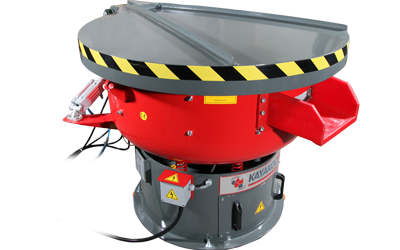
For small to medium stainless steel parts such as fasteners, CNC turned components, valve bodies, surgical instrument blanks, and automotive fittings, a circular vibratory finishing machine is typically the practical choice. The circular bowl creates an orbital media flow that provides uniform contact across all part surfaces. KAYAKOCVIB KVM series circular vibratory machines are used in many industrial applications for this type of work, accommodating different bowl volumes depending on production batch size and part dimensions.
For longer stainless steel parts such as shafts, bars, guide rods, or structural profiles, a trough vibratory finishing machine is more appropriate. The trough geometry allows long parts to travel along the machine axis with continuous media contact without the risk of part-to-part collision or edge damage that can occur when long parts are processed in a circular bowl. The KAYAKOCVIB TVM series trough vibratory machines are designed for this application range.
The process intensity of vibratory machines is controlled by vibration frequency and amplitude. Higher amplitude increases media pressure on the part surface, which accelerates cutting and deburring but also increases the risk of part damage on thin-walled or delicate components. For polishing stainless steel parts with tight tolerances or thin cross-sections, amplitude should be set conservatively and validated through sample testing.
Process Parameters That Control Surface Quality
Several process variables directly influence the final surface quality when polishing stainless steel parts in a vibratory system. Understanding which variables to control and how to adjust them is essential for consistent production results.
- Vibration frequency and amplitude: Higher settings increase media aggressiveness and material removal rate. Lower settings are used for polishing and burnishing stages where surface refinement rather than material removal is the objective.
- Cycle time: Longer cycles allow more media contact and smoother surfaces, but over-processing can cause rounding of edges or dimensional change on precision parts. Cycle time must be validated per part geometry.
- Media-to-part ratio: A higher volume of media relative to parts reduces part-to-part contact and improves surface uniformity. For stainless steel polishing, ratios typically range from 3:1 to 8:1 depending on part size and shape.
- Compound dosing rate: Consistent dosing is required to maintain the correct lubrication and cleaning balance in the process bowl. Automatic dosing systems reduce variability.
- Water flow rate: Continuous water flow removes swarf, media fines, and compound breakdown products. Insufficient flow causes bowl contamination and surface staining.
Integration with Washing and Drying
After vibratory finishing, stainless steel parts must be separated from the media, rinsed, and dried promptly to prevent water marks, flash rusting on any exposed iron in the alloy, or recontamination from the process bowl residue. Part-media separation is typically performed using a separator unit, after which parts pass through a rinse stage using clean water or a dilute rust inhibitor solution appropriate for stainless steel.
Drying of stainless steel parts after wet finishing can be performed using vibratory dryers loaded with dry media such as corn cob or walnut shell granules, which absorb surface moisture while providing a light polishing action. For high-volume production lines, dryer capacity must be matched to the finishing machine output to avoid bottlenecks. Automated finishing lines with integrated separation, washing, and drying units provide the most consistent results and reduce manual handling risk, which is important for polished stainless surfaces that are susceptible to fingerprinting and handling marks.
Industrial Applications and Quality Considerations
Polishing stainless steel parts with mass finishing serves a wide range of industrial sectors. In the fastener industry, stainless steel bolts, nuts, and screws are batch-finished to remove thread burrs and improve surface appearance for aesthetic and functional purposes. In CNC machining, turned and milled stainless components receive vibratory finishing to remove machining marks and achieve a controlled surface roughness before assembly or coating. In the medical sector, surgical instrument blanks, implant trial components, and instrument handles may receive multiple finishing stages to achieve smooth, cleanable surfaces. In the automotive and aerospace sectors, stainless fittings, valve components, and structural brackets are finished to meet functional surface requirements.
Quality control after finishing should include visual inspection for media residue, surface discoloration, and edge condition, as well as surface roughness measurement using a contact profilometer. For medical or food-contact applications, passivation treatment is often performed after finishing to restore or enhance the chromium oxide layer. Mass finishing itself does not constitute passivation, and this distinction must be understood during process planning.
Frequently Asked Questions
Can ceramic media scratch stainless steel during polishing?
Coarse ceramic media can leave visible scratches or a matte cut surface on stainless steel, which is intentional in the deburring stage. For polishing stages, finer ceramic or porcelain media is used to progressively smooth the surface. The media sequence must be designed to move from higher cut to lower cut to avoid residual scratch patterns from earlier stages.
Is vibratory finishing suitable for high-gloss stainless steel surfaces?
Vibratory finishing with porcelain media or stainless steel burnishing balls can achieve semi-bright to bright finishes on stainless steel. True mirror finishes typically require additional processes such as drag finishing or manual polishing. The achievable gloss level depends on part geometry, alloy grade, starting surface condition, and the number of finishing stages used.
How is iron contamination prevented during stainless steel finishing?
Iron contamination is prevented by using stainless-compatible media without iron-based binders, using clean process water, avoiding mixing of carbon steel and stainless steel parts in the same batch, and ensuring the machine bowl is clean before loading stainless steel batches. Regular bowl inspection and media replacement contribute to contamination control.
What cycle times are typical for vibratory polishing of stainless steel?
Cycle times vary widely depending on the part, starting surface condition, and required finish. Deburring stages may run from 30 minutes to several hours. Polishing or burnishing stages may require additional time. Actual cycle times must be determined through sample testing and process validation for each specific application.
Related Process Equipment
Conclusion
Polishing stainless steel parts with mass finishing is a technically manageable process when the media sequence, compound selection, machine type, and process parameters are matched to the specific alloy, part geometry, and surface quality requirement. Stainless steel demands clean process conditions, appropriate media that avoids iron contamination, and a staged approach that progressively refines the surface from deburring through polishing. Circular vibratory machines are suitable for most small to medium stainless components, while trough vibratory machines are preferred for longer parts. Integration with washing, separation, and drying systems is important to protect the polished surface after processing. All process parameters and achievable surface quality must be confirmed through sample testing before committing to full production.
Sorry, the comment form is closed at this time.