


16 Jul Vibratory Polishing
Vibratory polishing is a continuous mass finishing process in which metal parts are loaded into a vibrating work bowl together with finishing media and process compound. The combined vibrating motion creates controlled relative movement between the media and the parts, progressively smoothing surfaces, removing sharp edges, and reducing surface roughness to levels suitable for downstream operations such as coating, plating, or final inspection. Unlike manual polishing or fixed-tool deburring, vibratory polishing processes entire part batches simultaneously, making it well suited to high-volume industrial production across CNC machining, automotive, aerospace, fastener, and medical manufacturing sectors.
In This Article
What Vibratory Polishing Does to a Metal Surface
At the surface level, vibratory polishing works through mechanical abrasion. Media particles contact part surfaces repeatedly at low force and high frequency. Each contact removes a very small amount of material, gradually reducing surface peaks, smoothing tool marks, rounding sharp edges, and closing micro-porosity on cast or sintered parts. The result depends on media type, abrasive grain size, compound chemistry, vibration amplitude, process time, and the initial surface condition of the part.
The process does not cut aggressively. It works through accumulated low-energy contact over a defined cycle time. This distinguishes it from centrifugal disc finishing or drag finishing, which apply higher media pressure and achieve faster cutting or higher final surface quality. For many standard industrial applications, vibratory polishing provides a practical balance between process speed, surface quality, and operating cost.
Process Sequence: From Raw Part to Finished Surface
A properly structured vibratory polishing process follows a defined sequence. Skipping stages or combining incompatible steps reduces surface quality and increases reject rates.
- Pre-cleaning and inspection: Parts should arrive at the finishing stage free of heavy oils, chips, or cutting fluids that would contaminate the process bowl or degrade compound performance. Light oil is generally acceptable for wet processes because the compound handles degreasing. However, parts with heavy contamination benefit from a pre-wash step before finishing.
- Machine loading: Parts and media are loaded into the work bowl at the correct ratio. A common starting point for mixed metal parts is a media-to-part volume ratio of approximately 2:1 to 3:1, but this varies with part geometry and media type. Overloading reduces media-to-part contact and slows the process. Underloading increases the risk of part-to-part impact damage, particularly for thin-walled or precision components.
- Compound dosing and water flow: For wet vibratory polishing, process compound is added either directly at startup or dosed continuously through a drip system. Compound performs multiple functions simultaneously: it prevents rust and corrosion during processing, provides lubrication, carries abraded fines out of the bowl, and in some formulations contributes a brightening or passivating effect. Water flow rate must be balanced to maintain correct compound concentration without diluting it below effective working levels.
- Vibration and process run time: The machine runs at the set amplitude and frequency for the defined cycle time. Most industrial vibratory polishing cycles for steel and stainless steel parts range from 30 minutes to several hours depending on the starting surface condition, target finish, and media selection. The process engineer monitors part condition at intervals during development runs to establish the optimal cycle time before production release.
- Part-media separation: At the end of the cycle, parts and media are separated. This is typically done using a separator screen sized to allow media to pass through while retaining parts. KAYAKOCVIB SM series separator machines are designed to integrate with vibratory finishing lines for automated separation.
- Post-process washing: After separation, parts often carry compound residues, fine abrasive particles, and surface films. A rinse or wash step removes these before drying or downstream processing. For parts with tight tolerances or complex geometries, pressure washing or ultrasonic cleaning may be required to remove residues from recesses or blind holes.
- Drying: Wet parts must be dried promptly to prevent rust, water staining, or white spotting, particularly on steel, aluminum, and mixed metal batches. Centrifugal or vibratory drying using corn cob or synthetic drying media removes surface moisture efficiently. KAYAKOCVIB DVM series circular dryers are designed for this purpose and can be integrated directly after separation.
Machine Selection: Circular vs. Trough Configuration
The two primary machine types used for vibratory polishing in industrial production are circular vibratory finishing machines and trough vibratory finishing machines. The correct choice depends on part geometry, part size, production volume, and handling requirements.
| Parameter | Circular Vibratory Machine | Trough Vibratory Machine |
|---|---|---|
| Typical part size | Small to medium parts | Long, large, or delicate parts |
| Part circulation | Continuous toroidal flow | Controlled linear or slow flow |
| Risk of part damage | Low for robust parts | Lower for fragile or long parts |
| Automation compatibility | High, easy to integrate | Moderate, requires adapted handling |
| Typical applications | Fasteners, CNC parts, stamped parts, castings | Shafts, profiles, large housings, medical instruments |
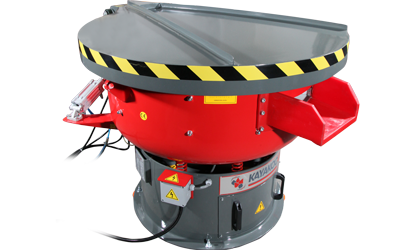
The KAYAKOCVIB KVM series circular vibratory finishing machines are commonly used for standard industrial polishing applications involving CNC machined parts, fasteners, stamped components, and die cast parts. For longer components or parts where controlled part movement is important, the KAYAKOCVIB TVM series trough vibratory finishing machines provide a more suitable working environment.
Media and Compound Selection for Polishing
Media selection directly controls cutting rate, surface finish level, and process cycle time. For vibratory polishing, the media selection logic follows the base material of the parts being processed.
For steel and stainless steel parts, ceramic media is the standard choice. Ceramic media provides sufficient cutting action to remove machining marks, light burrs, and oxide layers within reasonable cycle times. Finer ceramic grades are used for polishing stages where the goal is surface smoothing rather than aggressive material removal. Process compound 943 deburring and polishing liquid is commonly paired with ceramic media for steel parts, combined with 028-S degreasing liquid when oil removal is required.
For aluminum, zinc alloy, and softer non-ferrous parts, plastic media is generally preferred. Plastic media is less aggressive than ceramic, which reduces the risk of excessive material removal, surface scratching, or geometric distortion on softer materials. Process compound 085 deburring and polishing liquid is typically used with plastic media for aluminum and zamak applications, with 028-S added when degreasing is needed.
For copper, brass, and yellow metal parts, 028 degreasing liquid is suitable due to its acidic formulation, which is effective at removing oxide films and surface contamination from these materials.
Media shape also influences the process. Cylindrical and triangular media shapes provide good general coverage on machined surfaces. Cone and wedge shapes improve access into recesses and undercuts. Ball shapes are used for burnishing and final polishing stages where a bright surface effect is the target.
Process Parameters and Their Effect on Surface Quality
Several process variables control the final surface result in vibratory polishing. These must be understood and controlled by the process engineer to achieve consistent output.
- Vibration amplitude: Higher amplitude increases media pressure against part surfaces, increasing cutting rate. Lower amplitude reduces aggressiveness and is preferred for delicate or precision parts. Most industrial vibratory machines allow amplitude adjustment through eccentric weight settings.
- Cycle time: Longer cycle times produce smoother surfaces but increase energy consumption and reduce throughput. The optimal cycle time for a given part and media combination must be established through sample testing.
- Compound concentration: Too little compound reduces lubrication and anti-rust protection. Too much compound creates foam, reduces media cutting action, and increases wastewater treatment load. Continuous drip dosing with a controlled flow rate is more reliable than batch dosing.
- Water flow rate: Water flow carries abraded fines out of the bowl and maintains compound concentration. Insufficient flow allows fine particles to accumulate, which reduces media effectiveness and can cause surface staining.
- Media-to-part ratio: A higher media volume relative to part volume provides more contact points and more uniform surface coverage. A lower ratio reduces processing time but increases part-to-part contact risk.
- Part loading sequence: For parts with complex geometries or thin walls, gradual loading into an already-running machine reduces shock loading and part damage at startup.
Industrial Applications of Vibratory Polishing
Vibratory polishing is used across a broad range of manufacturing sectors where consistent, cost-effective surface finishing of metal parts in production volumes is required.
In CNC machining, vibratory polishing removes machining marks, sharp edges, and light burrs from turned and milled components. This improves surface texture, reduces stress concentration at edges, and prepares parts for coating or plating. In the fastener industry, large volumes of screws, bolts, and nuts are processed in circular vibratory machines to remove thread burrs, improve surface appearance, and prepare parts for zinc coating or hot-dip galvanizing.
In the automotive sector, vibratory polishing is applied to transmission components, hydraulic valve bodies, brackets, and stamped parts to achieve controlled edge rounding and surface smoothing within tight production tolerances. In the aerospace sector, the same principles apply, but process validation requirements are more stringent and process documentation is typically required.
Medical component manufacturers use vibratory polishing for surgical instruments, implant subcomponents, and device housings, where consistent surface roughness and clean edge geometry are required. In these applications, media selection and compound chemistry must be carefully controlled to avoid contamination and to meet material-specific surface requirements. Actual compliance with medical device surface standards requires process validation and should not be assumed solely based on media or compound selection.
Automation and Line Integration
For high-volume production, vibratory polishing is most effective when integrated into a continuous finishing line rather than operated as a standalone batch process. An automated line typically includes a loading station, the vibratory finishing machine, a separator, a washing station, a drying unit, and a discharge conveyor.
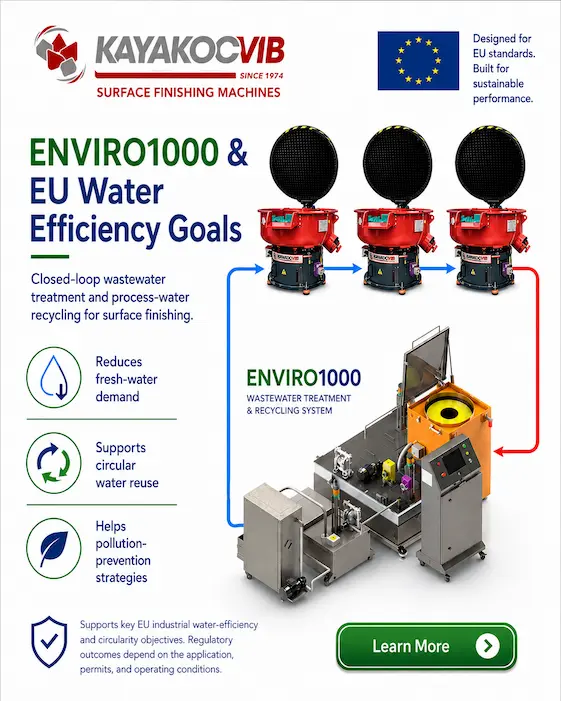
Automated compound dosing systems eliminate manual compound addition errors and maintain consistent compound concentration throughout the production shift. Parts handling between stages can be automated using conveyors, tipping devices, or robotic transfer systems depending on part size and fragility. Water from the process can be managed through a wastewater treatment and recycling system, reducing fresh water consumption and controlling compound discharge within regulatory limits.
Automation reduces labor requirements, improves process repeatability, and enables consistent surface quality across high-volume batches. The level of automation that is economically justified depends on production volume, part value, labor cost structure, and available floor space. For lower-volume operations, semi-automated configurations where loading and unloading are manual but compound dosing and timing are controlled are a practical intermediate solution.
Frequently Asked Questions
What surface roughness can vibratory polishing achieve on steel parts?
Achievable surface roughness depends on the starting surface condition, media type and grit, cycle time, and compound selection. In many industrial applications involving CNC machined steel parts, vibratory polishing can reduce Ra values noticeably from the initial machined condition, but actual results require sample testing and process validation for each specific application.
Can aluminum and steel parts be processed together in the same batch?
Mixing aluminum and steel parts in the same finishing batch is generally not recommended. Steel particles abraded from steel parts can embed in aluminum surfaces, causing galvanic corrosion or surface contamination. Separate process batches with appropriate media and compound for each material are the standard industrial practice.
How is media lodging prevented during vibratory polishing?
Media lodging occurs when media becomes trapped in holes, recesses, or undercuts in the part. It is prevented by selecting media that is larger than the smallest hole or opening in the part, by using elongated media shapes that are less likely to become wedged, and by programming an unload inspection step to verify that no media remains in parts before they move to the next production stage.
What is the difference between vibratory polishing and vibratory deburring?
Vibratory deburring targets the removal of burrs and sharp edges using more aggressive ceramic media at higher amplitudes and with cutting-action compounds. Vibratory polishing typically uses finer media, lower amplitude, and polishing-action compounds to reduce surface roughness and improve surface appearance without significant material removal. In practice, many production processes combine both actions sequentially or simultaneously depending on part requirements.
Related Process Equipment
Conclusion
Vibratory polishing is an established and reliable surface finishing method for industrial metal parts when the process is correctly configured for the part material, geometry, burr condition, and target surface quality. The key engineering decisions are media type and grade selection, machine configuration, compound chemistry, process parameters, and downstream washing and drying stages. Each of these variables must be matched to the specific application and validated through sample testing before production release. For manufacturers evaluating whether vibratory polishing is the right process route, the practical starting point is always a combination of part analysis, media selection logic, and a controlled sample run under realistic production conditions.
Sorry, the comment form is closed at this time.