



14 Jul Vibratory Deburring CNC Parts
Vibratory deburring CNC parts is one of the most widely applied mass finishing processes in modern machining facilities. CNC machined components routinely exit turning, milling, and drilling operations with sharp edges, burrs, and tool marks that must be removed before assembly, coating, or inspection. Vibratory finishing addresses these requirements at production scale, processing batches of parts simultaneously without individual operator attention. This article explains the process from an engineering perspective, covering part and defect characteristics, machine and media selection, process parameters, production integration, and quality control points relevant to machining environments.
In This Article
Typical Defects on CNC Machined Parts
CNC machining produces consistent part geometry but also generates predictable surface conditions that require finishing. The most common defects requiring post-machining treatment include burrs at drilled hole entries and exits, sharp edges at intersecting faces, tool marks on flat and contoured surfaces, light chatter marks, and residual cutting fluid contamination mixed with metal chips.
Burr size and character vary significantly by material and operation type. Turning and milling aluminum produces thin, flexible burrs that respond quickly to gentle abrasive action. Drilling and tapping steel or stainless steel generates harder, stiffer burrs that require stronger cutting media and longer process cycles. Understanding burr morphology before selecting a finishing process directly determines whether the result will be acceptable within a single cycle or will require multiple stages.
Edge condition requirements also vary by application. Automotive brackets and housings may require only cosmetic deburring. Hydraulic valve bodies and aerospace structural parts may require controlled edge rounding within a defined radius tolerance. Medical components may require both deburring and a defined surface roughness target. Each of these requirements influences the finishing process differently.
How Vibratory Finishing Works for Machined Components
In a vibratory finishing machine, an eccentric motor or vibration drive generates controlled oscillatory motion across the machine bowl or trough. This motion causes the process mass, a mixture of finishing media, compound solution, and parts, to move in a continuous toroidal or helical flow pattern. Every part surface is continuously contacted by media under controlled pressure, producing uniform abrasion, edge rounding, and surface refinement across the entire batch.
The process is self-acting in the sense that parts do not require individual fixturing. The motion of the mass creates the relative sliding contact between media and part surfaces. Process intensity is controlled through vibration amplitude, vibration frequency, media type and density, compound concentration, water flow rate, and batch load volume. These variables together determine the rate of material removal, the aggressiveness of edge rounding, and the final surface condition.
Wet vibratory finishing uses compound and water continuously circulated through the process mass. The compound serves multiple functions: it maintains lubrication between media and parts, controls the pH of the process slurry, provides light chemical action to brighten or clean the surface, and prevents re-deposition of removed material. Dry vibratory finishing, using dry media such as corn cob or walnut shell, is typically applied as a secondary polishing or drying step rather than a primary deburring stage for machined metal parts.
Machine Selection for CNC Machined Parts
Machine selection for vibratory deburring CNC parts depends primarily on part geometry, part size, production volume, and the mix of part families being processed. The two principal machine types used in machining environments are circular vibratory finishing machines and trough vibratory finishing machines.
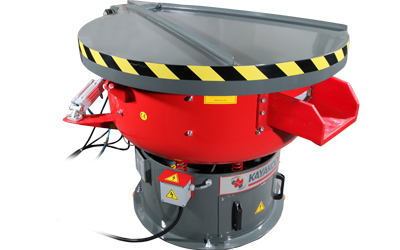
Circular vibratory finishing machines, such as the KAYAKOCVIB KVM series, are the most common choice for small to medium CNC parts. These machines handle a wide range of part shapes including turned components, milled housings, drilled brackets, and fasteners. The circular bowl geometry produces an efficient toroidal media flow that contacts all external part surfaces effectively. KVM series machines are available across a range of working volumes, making them suitable for both low-volume precision batches and high-volume production runs.
Trough vibratory finishing machines, such as the KAYAKOCVIB TVM series, are more appropriate for longer parts such as turned shafts, extruded profiles, long brackets, or prismatic components where circular bowl geometry would not allow sufficient part movement. The elongated trough promotes a linear helical flow that accommodates longer part lengths without parts stacking or concentrating in one area of the bowl.
| Machine Type | Best Fit Part Geometry | Typical Application |
|---|---|---|
| KVM Circular Vibratory | Small to medium, compact, rotational, prismatic | Turned parts, milled housings, fasteners, mixed batches |
| TVM Trough Vibratory | Long, slender, elongated | Shafts, profiles, long brackets, connecting rods |
Machine working volume should be selected to allow a loading ratio that keeps parts separated within the media mass. Overloading reduces part-to-media contact uniformity and increases part-to-part collision risk, which can cause cosmetic damage on precision surfaces or soft materials such as aluminum.
Media and Compound Selection by Material
Media selection is the most consequential process decision in vibratory deburring for CNC machined parts. The wrong media choice can produce under-processing, excessive material removal, surface damage, or media lodging in internal features.
For steel and stainless steel CNC parts with significant burrs from drilling, tapping, or milling, ceramic bonded abrasive media is the standard choice. Ceramic media provides the cutting force necessary to remove harder burrs efficiently. Typical compounds used with ceramic media for steel parts include a deburring and polishing liquid such as 943 compound, combined with 028-S degreasing liquid to control surface contamination from cutting oils and chips.
For aluminum CNC parts, plastic bonded abrasive media is generally preferred. Aluminum is significantly softer than steel, and ceramic media can produce excessive surface scratching or unwanted material removal on finished surfaces. Plastic media offers a gentler cutting action appropriate for aluminum while still providing sufficient deburring capability for typical machining burrs. Recommended process chemicals for aluminum include 085 deburring and polishing liquid combined with 028-S degreasing liquid.
Media geometry matters in addition to media composition. Triangular, cylindrical, and wedge-shaped media are commonly used for general deburring on CNC parts. The geometry selection must account for part feature sizes to avoid media lodging in holes, slots, or internal channels. Parts with small drilled holes require media large enough that individual pieces cannot enter and become trapped. This must be verified before committing to a production run.
For mixed-material batches, separate processes are strongly recommended. Running aluminum and steel parts in the same batch risks contamination of the aluminum surface with steel particles, which can cause subsequent corrosion on the aluminum. Each material group should be processed with a matched media and compound combination.
Process Parameters That Control Deburring Results
The following parameters directly control the outcome of vibratory deburring for CNC machined parts and must be established through sample testing before full production release.
- Vibration amplitude: Higher amplitude increases process intensity and material removal rate. Lower amplitude is preferred for delicate features or thin-walled parts.
- Vibration frequency: Typically fixed by machine design, but some machines allow adjustment. Frequency affects the flow speed of the process mass.
- Cycle time: Longer cycles produce more edge rounding and surface smoothing. Cycle time must be controlled to avoid over-processing.
- Media-to-part ratio: A higher media volume relative to part volume reduces part-to-part contact and improves uniformity. Typical ratios range from 3:1 to 6:1 by volume depending on part geometry and fragility.
- Compound concentration: Determines the chemical aggressiveness of the process slurry, cleaning efficiency, and surface brightness.
- Water flow rate: Continuous flow removes process debris and maintains slurry consistency. Insufficient flow allows debris accumulation that reduces media cutting efficiency.
- Batch load volume: Should not exceed the machine manufacturer’s recommended maximum. Excessive loading reduces effective media movement and process uniformity.
All numerical targets for cycle time, compound dosing, and amplitude must be validated through sample testing on actual production parts. Results depend on part geometry, burr size, material, and machine-specific characteristics. Published ranges are starting points, not guaranteed outcomes.
Production Line Integration and Automation
In high-volume CNC machining environments, vibratory deburring is often integrated directly into the production flow rather than operated as a standalone batch process. Integration can range from simple manual loading and unloading to fully automated cells where parts are loaded, processed, separated, washed, dried, and transferred to the next production stage without operator intervention.
After wet vibratory finishing, parts typically require a post-process washing step to remove compound residues and loose abrasive particles, followed by drying to prevent surface oxidation or corrosion. For steel and stainless steel parts, even short dwell times in a wet state can cause flash rust if compound residues are not properly removed. A pressure washing or ultrasonic cleaning system followed by a vibratory dryer provides a controlled cleaning and drying sequence in production environments.
Part-media separation is handled by a separator machine positioned downstream of the vibratory unit. The separator uses a screen or sieve matched to the part and media size difference to divert parts to the outfeed conveyor while returning media to the finishing machine. This step is essential for continuous or semi-continuous production operation.
Wastewater generated by the wet finishing process must be handled according to local environmental requirements. Compound-laden process water typically requires treatment before discharge. In facilities with high finishing volumes, closed-loop wastewater treatment and recycling systems reduce water consumption and simplify compliance management.
Surface Quality Control After Vibratory Finishing
Quality inspection after vibratory deburring CNC parts should be adapted to the specific requirements of each part family. Visual inspection under directed lighting is the minimum practical check for burr removal and edge condition. For parts with defined edge radius requirements, optical measurement or surface profilometry may be required.
Surface roughness after vibratory finishing depends strongly on the initial machined surface condition, media type, media grade, compound selection, and cycle time. Fine-grade ceramic or plastic media combined with extended cycles can produce smoother surfaces than the original machined condition in many cases. However, the actual Ra improvement achievable in a given application must be confirmed through process development and sample testing rather than assumed from general reference ranges.
Parts with functional surfaces such as sealing faces, bearing bores, or precision mating surfaces require masking, fixture protection, or controlled media exclusion to prevent unintended contact. Vibratory finishing processes all exposed surfaces simultaneously, which is advantageous for general deburring but requires attention when specific surfaces must be protected from abrasive contact.
Consistency between batches depends on maintaining stable process parameters across production runs. Media wear over time reduces cutting efficiency, which requires periodic media top-up or replacement. Compound concentration should be monitored and controlled through metering systems rather than manual addition. These controls are important for maintaining reproducible results in regulated industries such as medical device manufacturing or aerospace component supply.
Frequently Asked Questions
Can vibratory finishing remove all burrs from drilled holes?
Vibratory finishing effectively removes entry and exit burrs from drilled holes when the hole diameter is large enough relative to the media size and the process cycle is sufficient. Internal burrs deep inside long or narrow holes may not be fully reached by media contact. For these features, additional deburring methods or process validation are required.
How long does a typical vibratory deburring cycle take for CNC parts?
Cycle time varies depending on burr size, material, media type, machine amplitude, and required surface condition. Light deburring on aluminum parts may be completed in 20 to 45 minutes in many applications. Heavy deburring on steel parts may require 60 to 120 minutes or longer. Actual cycle times must be determined through sample testing on production parts.
Can aluminum and steel parts be processed together in the same batch?
Mixing aluminum and steel parts in the same finishing batch is not recommended. Steel particles removed during processing can embed in aluminum surfaces, causing galvanic corrosion. Each material should be processed in a separate batch with an appropriate media and compound combination.
What media size should be used to avoid media lodging in small holes?
Media should be selected so that the smallest media dimension is larger than the largest hole diameter in the part. For parts with multiple hole sizes, the critical reference is the smallest hole. Media size selection must be verified on actual parts before production. If media lodging risk cannot be eliminated, masking or fixture protection of critical holes may be required.
Related Machine and Process Resources
Related Video Demonstration
Conclusion
Vibratory deburring CNC parts is a technically mature, scalable process that addresses the most common post-machining surface conditions across steel, stainless steel, and aluminum component families. Effective process results depend on matching machine type to part geometry, selecting media composition based on base material hardness, establishing compound chemistry appropriate for the metal and contamination type, and validating process parameters through sample testing before production release. Circular vibratory machines cover the majority of CNC part families, while trough machines extend the capability to longer components. Integration with washing, separation, drying, and wastewater treatment stages transforms the finishing step into a controlled, repeatable production process rather than an isolated manual operation. The engineering decisions made at the process development stage determine whether vibratory finishing delivers consistent, acceptable results across production volumes.
Sorry, the comment form is closed at this time.