


12 Jul Wet vs Dry Vibratory Finishing
The choice between wet vs dry vibratory finishing is one of the most consequential process decisions in mass finishing. Both methods use vibratory motion to drive media against parts, but they differ fundamentally in how surface contact occurs, what results are achievable, and what downstream handling is required. Selecting the wrong method can lead to insufficient deburring, surface staining, part damage, or unnecessarily long cycle times. This guide explains the engineering logic behind each approach to help process engineers and production managers make the correct selection.
In This Article
How Wet Vibratory Finishing Works
In wet vibratory finishing, water and a liquid compound are continuously introduced into the vibratory bowl or trough during the process. The compound performs several functions simultaneously: it lubricates the media-to-part contact, suspends removed material and fines in the water, controls the cutting rate of the media, and provides corrosion inhibition for ferrous metals. The water-compound mixture drains through a screen or drain port at a controlled flow rate, carrying away swarf and spent compound throughout the cycle.
The presence of liquid changes the tribological behavior of the process. Media cuts more uniformly, heat buildup is suppressed, and fine particles from material removal are continuously flushed away rather than accumulating as a dry paste. This makes wet vibratory finishing well-suited to applications where consistent material removal, edge rounding, or surface smoothing is required over a controlled cycle.
How Dry Vibratory Finishing Works
Dry vibratory finishing operates without water or liquid compound. Instead, the process relies on dry media — typically dry organic media, plastic chips with dry finishing compounds embedded or applied as a powder, or specialized dry ceramic media for specific applications. Dry compound in granule or powder form is sometimes added to support burnishing or light surface treatment.
Without a liquid phase, the cutting action of the media is different. Dry processes tend to produce burnishing, brightening, light surface leveling, or controlled drying of parts already wet from a prior process stage. Dry vibratory finishing is commonly used as a final polishing stage after wet finishing, or for drying wet parts while simultaneously applying a light surface treatment such as rust protection or a surface sheen.
Primary Selection Criteria
The decision between the two methods should be based on a structured assessment of the part and the process requirement, not on equipment availability alone. The following table summarizes the main selection parameters.
| Selection Factor | Wet Vibratory Finishing | Dry Vibratory Finishing |
|---|---|---|
| Primary function | Deburring, edge rounding, surface smoothing, descaling | Burnishing, brightening, light polishing, drying |
| Material removal rate | Moderate to high, controllable | Low to minimal |
| Surface roughness reduction | Significant, depending on media and compound | Light leveling and brightening only |
| Part materials | Steel, stainless steel, aluminum, brass, mixed metals | Steel, stainless steel, brass, some aluminum |
| Typical applications | CNC parts, castings, stampings, fasteners, medical parts | Post-wet polishing, surface protection, drying with treatment |
| Downstream requirement | Separation, rinsing, drying required | Separation only, typically no rinse required |
| Wastewater handling | Required | Not required |
| Corrosion risk (steel) | Managed by compound selection | Low to none with dry rust-inhibiting media |
Part Geometry, Material, and Burr Analysis
Part geometry directly affects how suitable each method is. For CNC-machined parts with sharp milled edges, drilled holes, or light machining burrs, wet vibratory finishing with ceramic media and an appropriate deburring compound is the standard choice. The liquid compound suppresses heat and clears the contact zone of fines, allowing consistent edge rounding across complex part geometries.
For parts with blind holes, deep recesses, or thin cross-sections, wet finishing allows the compound-water mixture to reach these areas and prevent contamination buildup. Dry finishing in these geometries can accumulate dry compound residue in recesses, which may require subsequent cleaning.
Aluminum and zamak parts generally process well in wet finishing with plastic media. Plastic media is preferred because these materials are softer and more sensitive to aggressive cutting action. Suitable process chemicals for aluminum and zinc alloy parts include deburring and polishing liquids such as KAYAKOCVIB 085 compound combined with 028-S degreasing liquid. Steel and stainless steel parts typically require ceramic media in wet finishing, supported by a deburring compound such as 943 series combined with 028-S for degreasing.
For dry finishing of steel parts, the burnishing media must be matched to the required surface condition. Dry burnishing of steel typically uses dry steel balls or treated organic media to produce a bright, lightly compressive surface without significant material removal.
Surface Quality Targets and Process Logic
Surface roughness achievable through wet vibratory finishing depends on the initial surface condition, media type, media size, compound concentration, water flow rate, and cycle time. In many industrial applications, starting Ra values of 3.2 to 6.3 micrometers on CNC-turned steel parts can be reduced to typical finishing ranges of 0.4 to 1.6 micrometers in wet vibratory finishing, but actual results depend on the specific part, media, compound, and machine settings. Process validation through sample testing is required before production release.
Dry vibratory finishing does not produce the same degree of Ra reduction. Its value lies in improving surface appearance, creating a uniform matte or bright finish, or serving as the final step in a two-stage process where wet finishing performs the material removal and dry finishing brings the surface to a refined condition. Two-stage finishing sequences — wet deburring followed by dry burnishing — are used in fastener production, automotive hardware, and decorative metal components where both edge condition and surface appearance are specified.
Wet vs Dry Vibratory Finishing: Compound and Media Interaction
In wet vs dry vibratory finishing, the media and compound selection strategy differs significantly. Wet finishing compounds are water-soluble formulations that control cutting rate, foam level, pH, and corrosion inhibition. Compound concentration and flow rate must be calibrated together. Too little compound reduces cutting effectiveness and can cause part-to-part impingement marks. Too much compound can over-lubricate the media and reduce cutting action. Foam accumulation must also be managed, particularly in high-speed or high-load batches.
Dry finishing compounds are typically in powder or granule form and are consumed gradually during the cycle. They do not require water flow management, but dosing quantity per batch must be controlled to avoid uneven surface treatment or compound residue on parts. For rust protection applications in dry finishing, the compound deposits a thin protective layer onto the metal surface during the process, which can serve as a temporary corrosion barrier during storage or transit.
Downstream Handling Requirements
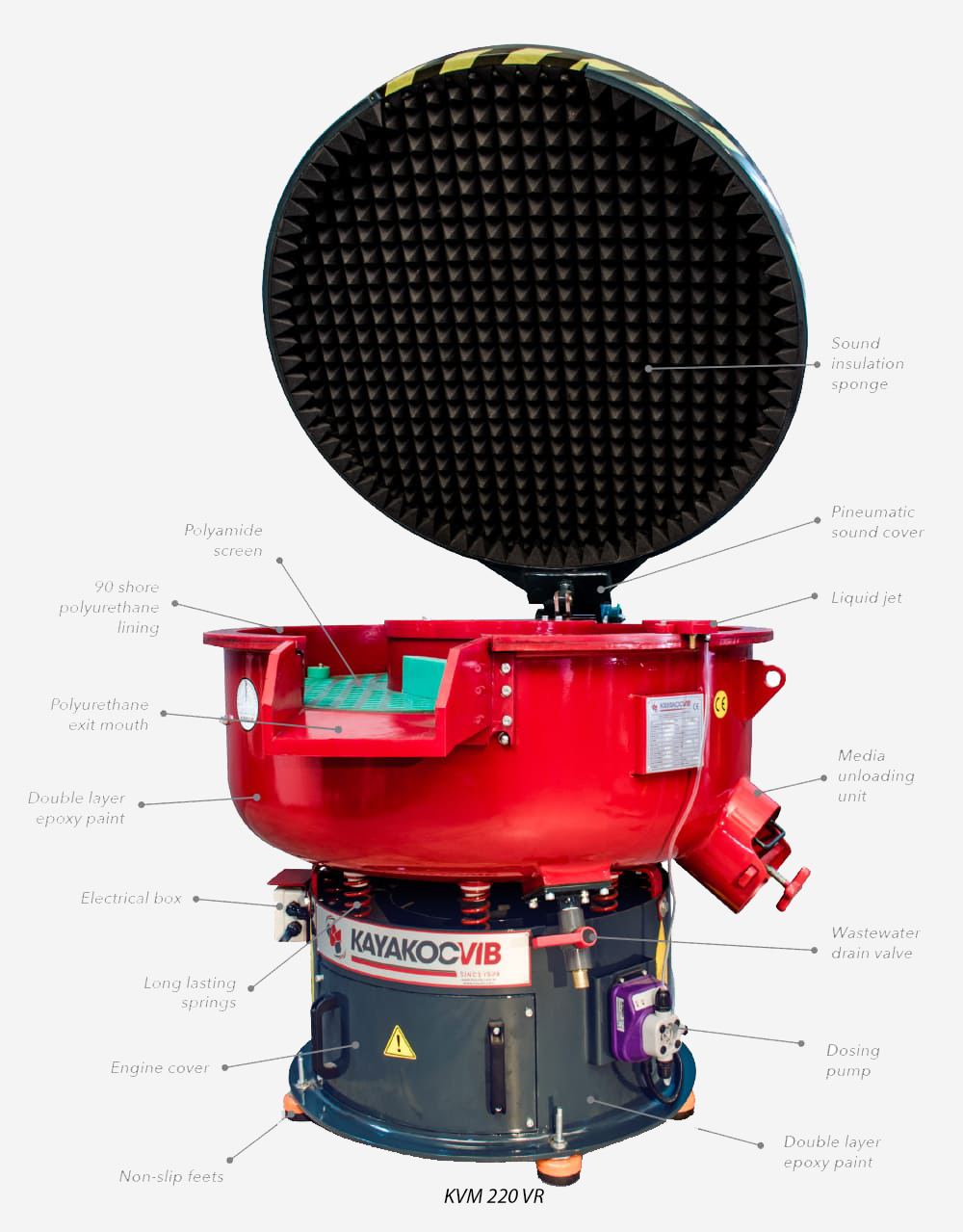
Wet vibratory finishing requires a complete post-process handling sequence. After the finishing cycle, parts and media must be separated using a separation screen or a dedicated separator machine. Parts then require rinsing to remove compound residue and fines, followed by drying. In automated finishing lines, circular vibratory machines such as the KAYAKOCVIB KVM series can be configured with continuous part-media separation, rinse stations, and downstream drying units integrated in sequence.
Drying after wet finishing is a production-critical step for ferrous metals. Parts that remain wet after separation will begin to rust within minutes depending on ambient conditions and the corrosion inhibitor content of the compound. Dedicated vibratory dryers using dry corn cob or walnut shell media are commonly used to absorb surface moisture quickly. In some configurations, the drying step also applies a light surface treatment compound for corrosion protection.
Dry vibratory finishing eliminates the rinsing requirement, which reduces process line length, energy consumption, and wastewater generation. However, parts may still carry dry compound dust that requires removal by air blast or tumbling in some applications. Facilities processing ferrous parts should evaluate whether dry finishing alone provides adequate corrosion protection for the intended storage and shipping environment.
Wastewater and Environmental Considerations
Wet finishing generates process water containing compound residue, metal fines, and suspended solids. Discharge of this water directly to drain is not permitted in most industrial facilities without treatment. A wastewater treatment system is required to separate solids, adjust pH, and ensure the treated water meets local discharge standards or can be reused in the process. Closed-loop water recycling systems reduce fresh water consumption and compound usage significantly in high-volume production environments.
Dry finishing avoids liquid waste entirely, which simplifies facility compliance for smaller operations or facilities with limited wastewater infrastructure. This operational advantage is sometimes the deciding factor in selecting dry finishing for decorative or light-duty applications where the surface quality requirements are compatible with dry process results.
Common Wrong Choices to Avoid
A common mistake is using dry finishing to attempt significant burr removal or Ra reduction on machined parts. Dry media does not have the cutting efficiency of wet ceramic media, and cycle times will be excessive for minimal results. If the part specification requires measurable edge rounding or surface smoothing, wet finishing is the correct starting point.
Another frequent error is selecting wet finishing for parts that require a dry, dust-free surface immediately after processing, without planning for a proper drying stage. Without drying, wet-finished steel parts will oxidize rapidly. The drying stage must be designed into the process from the start, not added as an afterthought.
Mixing aluminum and steel parts in the same wet finishing batch is also an engineering error. The two materials require different media types and compound chemistry. Running them together compromises the surface result for both materials and can cause galvanic contamination on aluminum surfaces.
Validation Checklist Before Process Release
- Confirm burr type and size on representative parts through inspection before selecting wet or dry process.
- Define the target surface roughness or edge radius specification before choosing media type.
- Run sample batches with the selected media and compound before committing to production parameters.
- Measure Ra before and after the process on sample parts to validate the process result.
- Verify that the drying stage removes all surface moisture on ferrous parts within the required time window.
- Confirm that compound residue is fully removed from blind holes or recesses after rinsing.
- Check for media lodging risk in small holes or narrow slots on representative part geometry.
- Validate that the wastewater handling system is in place and operational before starting wet finishing production.
Frequently Asked Questions
Can wet and dry vibratory finishing be used in sequence?
Yes. A two-stage sequence where wet vibratory finishing performs deburring and surface smoothing followed by dry vibratory finishing for burnishing and surface protection is a well-established approach in fastener, automotive hardware, and decorative metal production.
Which method is faster for deburring steel parts?
Wet vibratory finishing with ceramic media is typically faster for deburring steel parts because the compound and water flush fines continuously, maintaining cutting contact between media and part surface. Dry finishing does not match the deburring rate of a properly configured wet process for medium to heavy burrs.
Does dry vibratory finishing require wastewater treatment?
No. Dry vibratory finishing does not use water, so no liquid wastewater is generated. This simplifies facility compliance and reduces infrastructure requirements compared to wet finishing.
What media is used in dry vibratory finishing?
Dry finishing commonly uses dry corn cob granules, walnut shell granules, or dry burnishing steel media, depending on the application. Dry compound in powder or granule form may be added for brightening or corrosion protection. Media selection depends on the target surface condition and part material.
Related Machine and Process Resources
Related Video Demonstration
Conclusion
Choosing between wet vs dry vibratory finishing requires a clear understanding of the part condition, the target surface specification, the downstream handling capacity, and the environmental compliance requirements of the facility. Wet finishing is the correct choice when meaningful deburring, edge rounding, or surface smoothing is required. Dry finishing is the correct choice for final brightening, burnishing, or drying with surface protection after a wet finishing stage. In many production environments, the two methods work together as a planned sequence rather than as competing alternatives. Process engineers should define the surface specification first and then build the process route backward from that requirement, validating each stage through controlled sample testing before committing to production.
Sorry, the comment form is closed at this time.