



11 Jul Improve Ra Mass Finishing
The ability to improve Ra mass finishing results depends on selecting the right combination of machine type, media geometry, compound chemistry, and process parameters for each specific part and material. Surface roughness Ra is a quantified measure of the average deviation of a surface profile from its mean line, expressed in micrometers. In mass finishing, achieving a consistent and lower Ra value requires engineering discipline, not trial and error. This guide is structured as a selection and optimization reference for process engineers, quality managers, and production planners who need to systematically reduce Ra values in vibratory or other mass finishing operations.
In This Article
What Controls Surface Roughness Ra in Mass Finishing
Surface roughness Ra in a mass finishing environment is primarily controlled by four interrelated factors: media type and geometry, compound chemistry and flow rate, machine motion intensity, and cycle time. Each of these variables affects the cutting and burnishing action applied to the part surface. Reducing Ra means progressively removing surface peaks while preserving part geometry within tolerance. This is different from deburring, where the primary goal is edge condition improvement rather than bulk surface refinement.
The starting Ra of a machined or stamped part also sets the ceiling for what is achievable in a given cycle. A CNC-turned steel shaft with an initial Ra of 3.2 micrometers will require a different process strategy than a die-cast aluminum housing with initial Ra above 6 micrometers. Understanding the starting surface condition is the first engineering input in any Ra improvement project.
Machine Selection Logic for Ra Improvement
Not all mass finishing machines produce the same surface refinement capability. Selecting the right machine is the first step toward improving Ra.
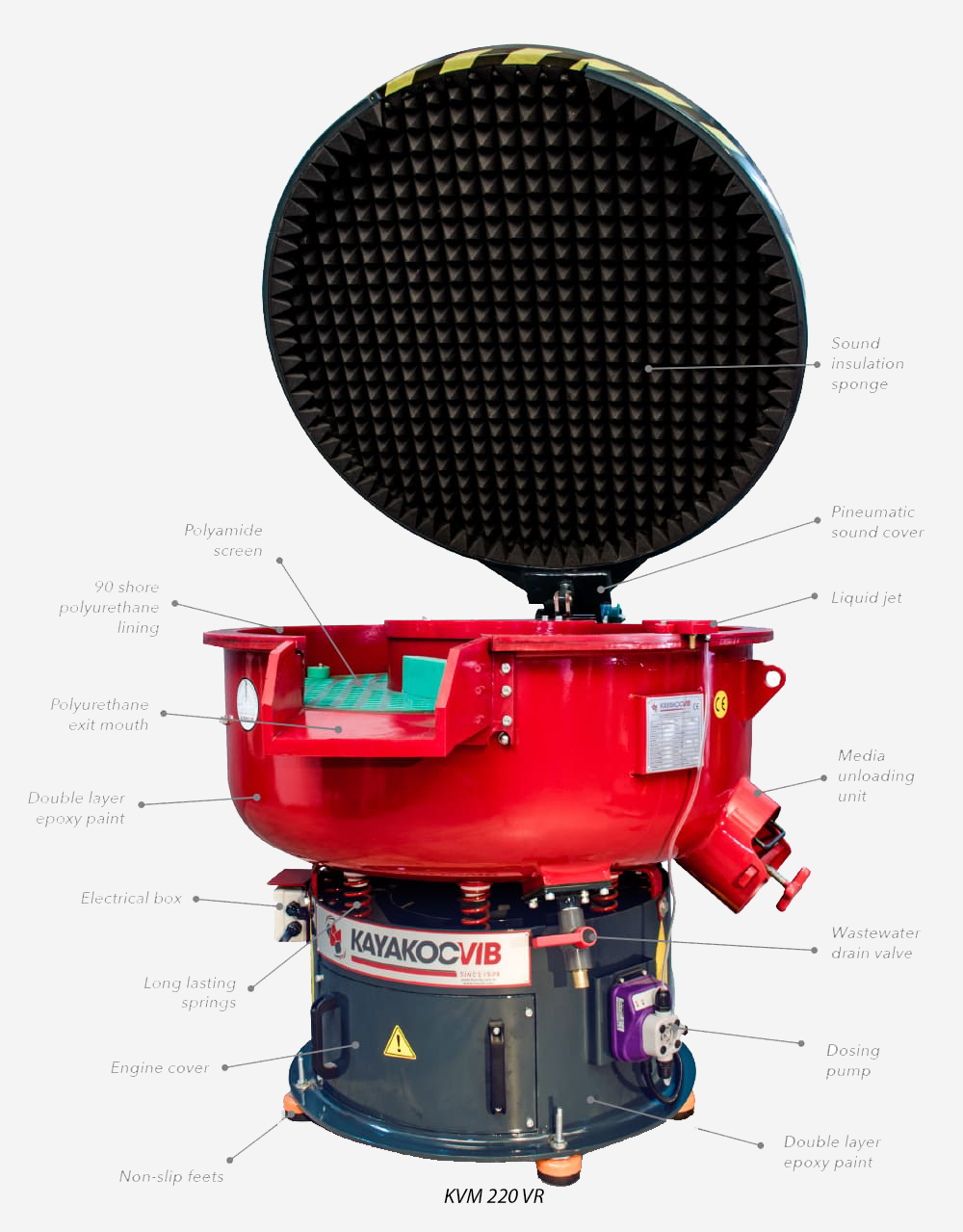
Circular vibratory finishing machines, such as the KAYAKOCVIB KVM series, generate a helical, rolling media motion that produces consistent, multi-directional cutting and burnishing across all part surfaces. This makes them well suited for small to medium parts requiring uniform Ra improvement. They are widely used in CNC machining, automotive, fastener, and general manufacturing applications where moderate to high Ra reduction is needed across batches.
Trough vibratory finishing machines, such as the KAYAKOCVIB TVM series, are preferred for longer components, delicate parts, or parts with complex geometries that must not be randomly tumbled. The trough motion is gentler and more controlled, which is useful when Ra improvement must be achieved without risking part-to-part impact damage.
For applications requiring very fine Ra values, centrifugal disc finishing machines offer higher process intensity and shorter cycle times. These machines are often selected when Ra targets below 0.4 micrometers are required for precision components in medical or aerospace applications. Drag finishing systems provide the highest level of controlled surface refinement for individual precision parts or cutting tools where part-to-part contact must be completely eliminated.
| Machine Type | Typical Ra Reduction Capability | Best Fit Application | Cycle Time Range |
|---|---|---|---|
| Circular vibratory (KVM) | Moderate to high | CNC parts, fasteners, mixed batches | 30 to 120 minutes typical |
| Trough vibratory (TVM) | Moderate | Long, delicate, or large parts | 60 to 180 minutes typical |
| Centrifugal disc finishing (KSM) | High to very high | Small precision parts, short cycle | 5 to 30 minutes typical |
| Drag finishing (DRG) | Very high, controlled | Precision tools, implants, molds | Application dependent |
Actual Ra improvement and cycle times depend on part geometry, base material, starting surface condition, media selection, and compound chemistry. All values above are typical industrial ranges and must be confirmed through sample testing before production release.
Media Selection for Ra Improvement
Media selection is the most consequential decision when trying to improve Ra mass finishing results. The wrong media choice will produce insufficient cutting, excessive material removal, or surface damage that raises Ra rather than reducing it.
For steel and stainless steel parts, ceramic media is the standard choice. Ceramic media provides the aggressive cutting action needed to remove machining marks, turning lines, and burrs from harder metals. The media geometry should be matched to part geometry to ensure access to all surfaces, including recesses and internal features. Common geometries include triangles, cylinders, cones, and wedge shapes. Finer media granulation produces lower Ra but slower material removal, so multi-stage processes often begin with a coarser cutting stage and finish with a fine polishing or burnishing stage.
For aluminum and zamak parts, plastic media is generally preferred. Aluminum is softer and more sensitive to aggressive cutting action. Ceramic media used on aluminum can produce surface scratching or unacceptable material loss. Plastic media in combination with a suitable polishing compound produces controlled Ra reduction without dimensional distortion on thin-walled or precision-cast aluminum components.
For copper, brass, and yellow metals, media selection follows a similar logic to aluminum, favoring plastic or low-cut ceramic grades. Compound selection for these materials should avoid strongly alkaline chemistries that can cause discoloration or surface staining.
Compound and Water Flow Rate Selection
The finishing compound serves multiple functions in wet mass finishing: it acts as a lubricant, a cutting aid, a surface conditioner, and a cleaning agent. Compound selection must be matched to both the part material and the intended surface result.
For steel and stainless steel parts, a deburring and polishing compound such as 943 type chemistry is typical. This chemistry supports active cutting action and prevents rust and staining during the wet process. For aluminum and zamak parts, 085 type compounds are commonly used to support polishing while protecting the softer surface from oxidation or chemical attack. For degreasing or heavy contamination situations, 028-S type compounds support chip and oil removal from the part surface before or during the finishing cycle.
Compound flow rate directly affects Ra outcomes. Too little compound reduces lubrication and causes dry cutting, which raises Ra and increases media wear. Too much compound dilutes the cutting action and may leave surface residues that interfere with measurement or downstream coating adhesion. The correct flow rate is typically established through process trials and depends on machine working volume, media type, part loading, and water hardness.
Water temperature and hardness should also be monitored. Hard water can reduce compound effectiveness or cause scaling on parts. Filtered or conditioned water is recommended for precision finishing applications.
Process Parameters That Affect Ra
Beyond machine and media selection, several process parameters must be actively controlled to reliably improve surface roughness Ra in mass finishing operations.
- Amplitude and frequency settings on the vibratory machine control media pressure and sliding velocity against the part surface. Higher amplitude generally produces faster cutting but may introduce part-to-part impact risks for thin or delicate components.
- Part loading ratio, expressed as the volume of parts relative to total working volume, affects media-to-part contact density. Overloading reduces contact frequency and slows Ra improvement. Underloading may cause excessive part impact.
- Cycle time must be matched to the starting Ra and the target Ra. Each additional stage in a multi-stage process should be evaluated for marginal Ra improvement versus processing cost.
- Separation timing ensures parts are removed before re-contamination from used compound or from media breakdown particles.
- Post-process washing removes compound residues, fine abrasive particles, and metal fines from part surfaces. Residues left on parts can interfere with coating adhesion, dimensional measurements, and surface inspection.
Multi-Stage Process Strategy for Low Ra Targets
Achieving low Ra values, typically below 0.8 micrometers, in mass finishing generally requires a multi-stage process rather than a single combined cycle. A typical three-stage strategy for steel CNC parts includes a cutting stage with aggressive ceramic media and compound to remove machining marks and burrs, followed by a medium-cut stage with finer ceramic media to reduce surface peaks created by the first stage, and a final polishing or burnishing stage using porcelain or fine plastic media with a polishing compound to achieve the target Ra.
Each stage transition requires separation of parts from media, rinsing, and loading into the next stage. For high-volume production, this process can be automated using sequential vibratory machines, conveyors, and automatic loading and unloading systems. KAYAKOCVIB finishing lines can be configured with multiple vibratory units, separators, washing, and drying stations integrated into a single automated flow.
When aluminum parts require Ra improvement below 0.6 micrometers, a similar multi-stage approach using progressively finer plastic media grades is recommended. Burnishing with steel or ceramic balls as a final stage can further close surface pores and reduce Ra on non-ferrous metals, although this technique requires validation for each specific alloy and geometry.
Common Selection Mistakes That Prevent Ra Improvement
Several recurring selection errors prevent engineers from achieving their Ra targets in mass finishing projects.
Using ceramic media on aluminum parts without understanding the material sensitivity is a frequent mistake. While ceramic media will cut aluminum aggressively, the result is often surface scratching and dimensional loss rather than controlled Ra reduction. Plastic media with appropriate compound chemistry is almost always the correct starting point for aluminum.
Mixing steel and aluminum parts in the same finishing batch creates contamination risk. Iron particles from steel parts can embed in aluminum surfaces during processing, causing cosmetic defects and potential corrosion. Parts of different base materials should always be processed in separate batches.
Selecting media that is too large relative to part features causes inadequate contact on recesses, threads, and internal channels. Media geometry must be checked against part drawing features to confirm that all surfaces requiring Ra improvement are accessible during the process.
Running a single long cycle at high intensity instead of a properly staged multi-step process is another common mistake. Beyond a certain cycle duration, continued media action may plateau or even degrade Ra on sensitive surfaces. Diminishing returns in Ra improvement are measurable, and cycle time should be optimized through periodic Ra measurement during process development.
Validation and Surface Quality Control
Ra improvement in mass finishing must be validated through measurement, not assumed from cycle time alone. Surface roughness measurement using a contact profilometer should be performed at defined locations on a representative sample of parts after each process stage. Statistical sampling should be applied for production batches to confirm that Ra results are consistent across the batch and within specification.
Measurement direction relative to lay is important. On machined parts, measuring Ra perpendicular to the machining direction captures the dominant surface profile. After mass finishing, the surface becomes more isotropic, and measurement in multiple directions may be required to characterize the final surface condition.
For applications requiring documented surface quality, such as medical device components or aerospace parts, Ra measurement records should be maintained and linked to specific machine settings, media lot, compound batch, and process parameters. This traceability supports process validation and change control requirements.
Frequently Asked Questions
What is a realistic Ra target achievable in vibratory mass finishing?
In vibratory mass finishing, Ra values from 0.4 to 1.6 micrometers are commonly achievable for steel and stainless steel parts depending on starting surface condition, media selection, and process staging. Aluminum parts with plastic media typically reach similar ranges. Values below 0.4 micrometers generally require centrifugal disc finishing, drag finishing, or additional burnishing stages. Actual results depend on application conditions and must be confirmed through sample testing.
How many stages are needed to reach Ra below 0.8 micrometers?
Reaching Ra below 0.8 micrometers typically requires at least two process stages: one cutting stage to remove machining marks and one fine polishing or burnishing stage to refine the surface. For starting Ra values above 3 micrometers, three stages are commonly required. Each stage transition should be validated by measurement rather than assumed from cycle time.
Can the same mass finishing process work for both steel and aluminum parts?
No. Steel and aluminum parts require different media and compound selections. Steel parts generally require ceramic media with a polishing or deburring compound, while aluminum parts require plastic media with a softer compound chemistry. Mixing these materials in the same batch is not recommended due to contamination and surface damage risks.
How does compound flow rate affect surface roughness Ra?
Compound flow rate affects lubrication, cutting efficiency, and surface cleanliness during the process. Too little compound causes dry cutting that raises Ra and accelerates media wear. Too much compound reduces cutting action. The correct flow rate must be established through process trials for each specific application and machine configuration.
Related Process Equipment
Conclusion
The ability to reliably improve Ra mass finishing results is a function of systematic engineering decisions rather than running a standard process and hoping for consistent outcomes. Machine type selection sets the boundary of achievable Ra. Media geometry and grade control cutting intensity and surface access. Compound chemistry supports or limits the reaction between media and part surface. Process parameters including amplitude, loading ratio, cycle time, and staging determine how efficiently the target Ra is reached. Avoiding common selection mistakes, validating results through measurement, and applying a multi-stage strategy where low Ra targets are required are the engineering disciplines that separate consistent production results from unpredictable ones. All Ra improvement targets must be confirmed through sample testing before production release, as actual results depend on part geometry, base material, surface condition, and the complete process configuration used.
Sorry, the comment form is closed at this time.