




08 Jul Repeatable Vibratory Finishing
Repeatable vibratory finishing is the ability to produce consistent surface quality, edge condition, and dimensional results across every production batch without significant operator-dependent variation. For manufacturers in CNC machining, automotive, aerospace, fasteners, and medical component production, repeatability is not optional — it is a process requirement. Understanding which variables control consistency, and how to manage them systematically, is the foundation of a reliable vibratory finishing operation.
In This Article
Why Repeatability Fails in Vibratory Finishing
Inconsistent results in vibratory finishing are rarely caused by a single factor. In most production environments, poor repeatability is the result of multiple uncontrolled variables acting simultaneously. The most common causes include variable load weight, inconsistent compound dosing, irregular media replacement schedules, and machine amplitude settings that drift over time without verification.
A batch that produces acceptable surface quality in the morning can produce underfinished or overfinished parts by the afternoon if compound concentration, water flow rate, or media volume has changed. Process engineers who approach vibratory finishing as a set-and-forget operation will consistently encounter repeatability problems. The process must be treated as a controlled manufacturing step with documented parameters and regular validation checkpoints.
Core Engineering Variables That Control Consistency
Vibratory finishing machines generate a toroidal media flow through controlled vibration. The amplitude and frequency of vibration determine the relative motion between media and parts, which directly controls the cutting or polishing rate. For repeatable vibratory finishing, these settings must remain stable across every production cycle.
The following variables must be defined, documented, and controlled to achieve reliable batch-to-batch consistency:
- Machine amplitude and frequency settings
- Media type, size, shape, and volume in the working bowl
- Compound type and dosing rate per unit time
- Water flow rate and water temperature
- Part load weight per batch
- Cycle time
- Media-to-part ratio
- Media condition and replacement schedule
Each of these variables contributes independently to the finishing result. Changing any one of them without adjusting the others will shift the surface outcome. For this reason, the first step in improving repeatability is establishing a written process specification that defines the acceptable range for each variable.
Machine Amplitude and Frequency Control
The amplitude of a vibratory finishing machine is the primary driver of process intensity. Higher amplitude generates more aggressive media-to-part contact, which increases cutting action and material removal rate. Lower amplitude reduces contact force, which is appropriate for polishing, fine surface smoothing, or delicate parts.
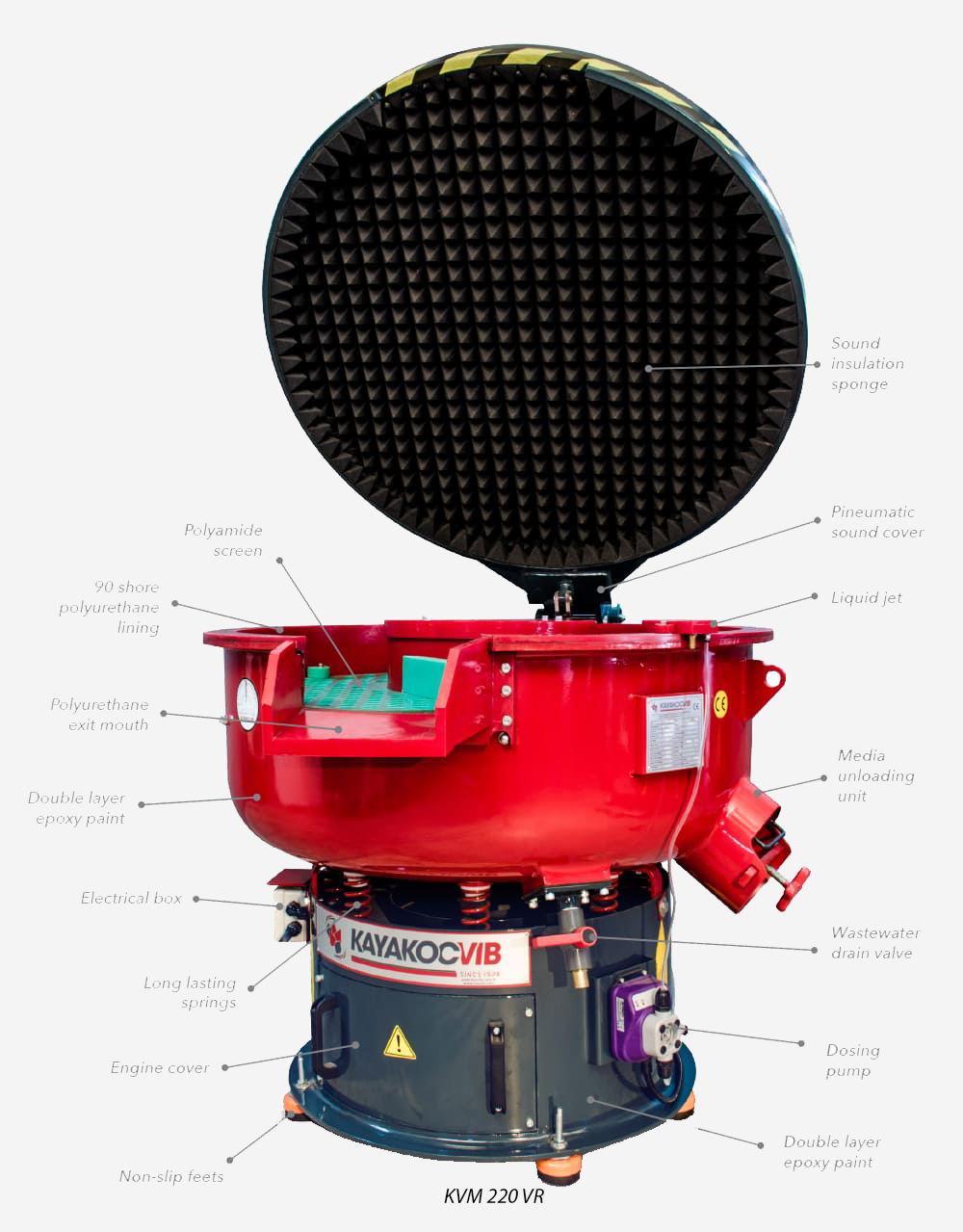
In circular vibratory machines such as the KAYAKOCVIB KVM series, amplitude is controlled through eccentric weight settings on the motor. Once the correct amplitude is set for a specific application, the eccentric weights must be locked and not adjusted between batches unless the process specification is being intentionally revised. Any unauthorized adjustment to amplitude is a direct cause of inconsistent results.
Frequency is less commonly adjusted in standard vibratory machines, but in machines with variable frequency drives, frequency settings must also be documented and verified at the start of each shift. Wear in the machine springs or bearing system can gradually reduce effective amplitude over time, so periodic amplitude verification using a vibration measurement device is recommended for high-volume or quality-critical applications.
Media Selection and Condition Management
Media type has a direct effect on surface roughness, edge radius, and cycle time. For steel and stainless steel parts with moderate to heavy burrs, ceramic media is the standard choice because it provides the cutting force required to remove hard burrs efficiently. For aluminum parts or softer alloys, plastic media is generally preferred to avoid aggressive surface attack and dimensional loss.
Media condition is one of the most underestimated repeatability factors. As media wears, individual pieces become smaller, lighter, and less aggressive. A bowl running heavily worn media will produce a different result than the same bowl with fresh media at the same cycle time, amplitude, and compound dosing. To maintain consistent output, a media replacement schedule based on measured media volume or weight must be established and followed.
Media-to-part ratio also affects repeatability. If operators load different part quantities per batch without adjusting cycle time or media volume, the effective contact ratio changes and results will vary. A standardized load weight per batch, verified before each run, eliminates this source of variation.
Compound Dosing and Water Flow Rate
Finishing compounds serve multiple functions in vibratory finishing: they provide lubrication, control pH, carry away swarf and abraded material, and contribute to surface chemistry such as brightening or passivation. For repeatable vibratory finishing, compound dosing rate and water flow rate must be set using calibrated metering pumps or dosing systems, not manual addition.
Manual compound addition is one of the most common sources of process inconsistency in small and medium production environments. An operator adding compound by eye or by hand will produce variable concentrations from batch to batch. Installing a timed dosing pump or a flow-controlled compound delivery system removes this variation and is one of the most cost-effective improvements available for repeatability.
For steel and iron parts, a compound such as a deburring and polishing liquid combined with a degreasing compound is typical. For aluminum parts, a compound formulated for non-ferrous metals should be used to avoid surface staining or discoloration. Compound selection must match the base material, and the same compound must be used in every batch to maintain consistent surface chemistry.
Water flow rate affects compound concentration in the bowl. If water pressure varies across shifts or if supply valves are not precisely set, effective compound concentration will fluctuate. A fixed water flow rate, verified with a flow meter and set by a dedicated valve position, is the correct approach for production environments where repeatability is required.
Cycle Time and Load Consistency
Cycle time is the most directly controllable parameter in vibratory finishing. Most modern vibratory machines include programmable timers. Once the correct cycle time is validated through sample testing, it must be fixed in the machine control and not adjusted by operators without engineering authorization.
Load consistency means that each batch contains the same type of parts, in the same quantity by weight, with the same incoming surface condition. Mixed batches — where different part geometries, different materials, or different burr sizes are combined — are a primary cause of inconsistent finishing results. Each part family should have its own defined process specification including load weight, cycle time, media type, and compound dosing.
For trough vibratory machines such as the KAYAKOCVIB TVM series, load consistency is particularly important because the linear media flow pattern is sensitive to uneven loading. Long parts or large castings should be positioned consistently in the trough to ensure uniform media contact across all surfaces.
Process Parameter Documentation and Operator Control
A vibratory finishing process that relies on operator judgment for parameter setting will not deliver repeatable vibratory finishing across shifts, operators, or production periods. The solution is a documented process specification card for each part family, mounted at the machine, that defines every controlled parameter.
The process specification card should include the following information:
- Part number and material
- Media type, size, and shape
- Target media volume in the bowl
- Load weight per batch
- Compound type and dosing rate
- Water flow rate setting
- Machine amplitude setting
- Cycle time
- Inspection criteria and acceptable surface standard
- Media replacement interval
Operators should be trained to verify each parameter against the specification card before starting a batch. Any deviation from the specification should require a supervisor decision before proceeding. This single operational discipline is responsible for more repeatability improvements than any machine upgrade in most production environments.
Process Parameter Reference Table
| Parameter | Control Method | Effect on Repeatability |
|---|---|---|
| Machine Amplitude | Eccentric weight setting, verified by measurement | Controls process intensity; uncontrolled amplitude causes over or underfinishing |
| Media Volume | Measured fill level before each batch | Low media reduces contact; high media may cause part damage |
| Compound Dosing | Calibrated metering pump | Manual dosing causes concentration variation and inconsistent surface chemistry |
| Water Flow Rate | Fixed valve position, verified by flow meter | Variable water flow changes effective compound concentration |
| Cycle Time | Programmable machine timer | Operator-adjusted cycle time causes underfinished or overfinished parts |
| Load Weight | Parts weighed before loading | Variable batch weight changes media-to-part ratio and surface result |
| Media Condition | Scheduled replacement by volume or weight | Worn media reduces cutting rate and alters surface result over time |
Validation and Quality Control Points
Even with a fully documented process, repeatability must be verified through structured validation. Before releasing a new or revised vibratory finishing process to production, sample parts should be processed and inspected against the defined surface quality standard. Surface roughness measurement, visual inspection under consistent lighting, and edge radius verification where required are the standard inspection methods.
Once the process is in production, periodic quality checks at the start of each shift, after media additions, and after any equipment maintenance are recommended. If surface results drift outside the acceptable range, the parameter audit sequence should start with media condition, compound dosing verification, and amplitude check before changing cycle time or other parameters.
For applications requiring documented process control such as aerospace subcontracting or medical component finishing, a process control log should be maintained for each production batch. This log records the actual parameter values used and the inspection result, creating a traceability record that supports quality system requirements.
Automation for Consistent Batch Processing
The highest level of repeatable vibratory finishing is achieved when manual handling, manual loading, and manual parameter setting are removed from the process. Automated finishing lines integrate part loading, machine operation, separation, washing, drying, and unloading into a controlled sequence that runs identically for every batch.
In automated lines, compound dosing is controlled by programmable logic controllers, water flow is regulated by automated valves, and cycle time is fixed in the machine program. Human intervention is limited to loading raw parts at the input and inspecting finished parts at the output. This level of automation eliminates the shift-to-shift and operator-to-operator variation that accounts for most repeatability problems in manual finishing operations.
For high-volume production in automotive fasteners, CNC turned parts, or stamped components, automation is not only a quality improvement but also a production efficiency improvement. Automated separation and drying eliminates the handling time between process stages and reduces the risk of part damage from manual transfer.
Frequently Asked Questions
What is the most common cause of inconsistent results in vibratory finishing?
The most common causes are variable compound dosing, inconsistent media volume or condition, and operator-adjusted cycle times. Addressing these three factors accounts for the majority of repeatability improvements in production environments.
How often should vibratory finishing media be replaced?
Media replacement intervals depend on media type, part material, process intensity, and production volume. A practical approach is to define a media volume threshold — typically when the bowl volume has reduced by 15 to 25 percent from the original fill — and replace or top up media at that point. Actual replacement intervals must be determined through process monitoring, not assumed from a fixed calendar schedule.
Can repeatability be improved without adding automation?
Yes. Documented process specification cards, calibrated compound dosing pumps, fixed water flow settings, and operator training to follow defined parameters can significantly improve repeatability in manual finishing operations. Automation offers the highest level of consistency, but structured manual process control is a practical first step for most production environments.
Should different part materials be finished in the same batch?
Mixing materials in the same batch is generally not recommended. Aluminum and steel parts should never be mixed because the abrasive action appropriate for steel will be too aggressive for aluminum, and the different densities will cause uneven media contact. Each material and part family should have its own defined process specification and run as a separate batch.
Related Machine and Process Resources
Related Video Demonstration
Conclusion
Achieving repeatable vibratory finishing across production shifts, operators, and machine conditions requires treating the finishing process as a controlled manufacturing step with documented parameters, validated settings, and structured quality verification. Machine amplitude, media type and condition, compound dosing, water flow, cycle time, and load weight are the seven core variables that must be defined and controlled to eliminate batch-to-batch variation. For high-volume or quality-critical applications, automated dosing systems and programmable machine controls remove the operator-dependent variation that most commonly causes inconsistency. Whether operating a circular vibratory machine for small CNC parts or a trough machine for long components, the engineering discipline of process documentation and parameter control is the foundation of reliable, repeatable surface finishing results.
Sorry, the comment form is closed at this time.