


07 Jul Tumbling vs Vibratory Finishing Casting
The choice between tumbling vs vibratory finishing casting applications is one of the most common process decisions in foundry and die casting production. Both methods belong to the mass finishing category and use abrasive media to deburr, radius, and improve the surface condition of cast metal parts. However, the underlying mechanics, part handling behavior, machine geometry, and achievable results differ significantly between the two approaches. Understanding these differences is essential for selecting the correct process for a given casting application.
In This Article
Core Mechanical Difference Between the Two Methods
In tumbling, also referred to as barrel finishing, parts and media are loaded into a rotating hexagonal or octagonal barrel. The barrel rotates around a horizontal axis, lifting the batch and causing it to cascade or slide against itself. This cascading action generates the abrasive contact between media and part surfaces. The intensity of this contact is relatively high, and the parts are in direct contact with each other during the cycle.
In vibratory finishing, parts and media are loaded into a bowl or trough that vibrates at a controlled frequency and amplitude. The vibration creates a toroidal or helical flow in the bowl, where parts and media circulate continuously and maintain consistent relative motion. Parts do not collide with each other in the same way as in a tumbling barrel. The contact between media and parts is more distributed, more uniform, and generally gentler in terms of impact force per cycle.
This mechanical difference has direct consequences for which casting types and geometries are suitable for each method.
Process Suitability for Casting Geometry and Material
Tumbling is well suited for simple, compact, and robust castings where aggressive deburring or flash removal is the primary objective. Parts must be able to tolerate direct metal-on-metal or media-on-part impact without deformation, chipping, or surface damage. Cast iron brackets, heavy steel forgings, and thick-walled aluminum castings with large gate stubs or heavy flash are typical candidates. Cycle times in tumbling can be shorter for aggressive material removal, but the process offers limited control over where and how much material is removed.
Vibratory finishing is better suited for castings with more complex geometry, thinner walls, sharper edges that require controlled rounding, or surfaces where a consistent finish across multiple faces is required. Die casting parts made from aluminum, zinc, and magnesium alloys benefit from vibratory processing because the gentler media contact reduces the risk of part-to-part damage and surface distortion. The continuous circulation in a vibratory bowl also means that media reaches recesses, undercuts, and internal channels more consistently than in a tumbling barrel.
For most aluminum and zinc die casting parts produced in volume, vibratory finishing is the preferred industrial method because it delivers more consistent and controllable results across complex part geometries.
Tumbling vs Vibratory Finishing Casting: Process Parameters Compared
The two methods operate under fundamentally different parameter sets. Understanding these parameters helps engineers match the process to the casting application.
| Parameter | Tumbling (Barrel) | Vibratory Finishing |
|---|---|---|
| Action type | Cascading, high impact | Flowing, distributed contact |
| Part-to-part contact | High risk | Low to moderate risk |
| Media coverage | Partial, batch-dependent | Uniform, continuous circulation |
| Suitable part complexity | Simple, robust geometries | Complex, thin-walled, precision |
| Surface finish consistency | Variable | High consistency |
| Cycle time for deburring | Shorter for heavy burrs | Moderate, depends on media and compound |
| Automation integration | Limited | High, suitable for continuous lines |
| Wet process capability | Yes, with limitations | Yes, fully integrated |
| Part loading capacity | Batch only | Batch or continuous flow |
Media and Compound Selection for Casting Parts
Media and compound selection depends on the base material of the casting, the severity of the burr, and the required surface condition after finishing.
For aluminum and zinc die casting parts, plastic media is generally preferred. Plastic media is softer and less aggressive, which prevents over-cutting or surface damage on these relatively soft alloys. Typical abrasive grades range from light cutting to medium cutting depending on burr size. A deburring and polishing liquid compound supports the cutting action and prevents re-deposition of removed material onto part surfaces. A degreasing liquid is used when oil, coolant, or mold release residue is present on incoming castings.
For steel and iron castings, ceramic media is generally the correct choice. Ceramic media provides harder and more aggressive cutting action suitable for removing tough casting burrs, flash, and scale on ferrous materials. A ceramic deburring compound supports the process and prevents corrosion during wet processing. Parts with heavy flash or large gate stubs may require pre-trimming before vibratory finishing, because mass finishing media is not designed to remove large volumes of material in a single pass.
Mixing aluminum and steel castings in the same batch is not recommended. Material contamination, media wear differences, and compound incompatibility can reduce finishing quality and cause surface staining or uneven results.
Machine Selection for Foundry and Die Casting Applications
When selecting a vibratory finishing machine for casting parts, the bowl geometry, drive system, amplitude, and frequency must match the part size, weight, and geometry.
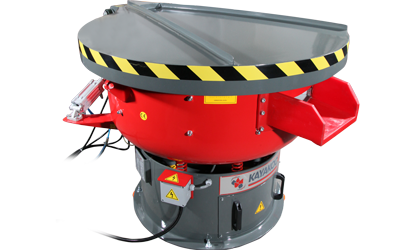
Circular vibratory finishing machines, such as the KAYAKOCVIB KVM series, are well suited for small to medium casting parts. The toroidal flow in a circular bowl provides uniform media coverage across all part surfaces and is highly repeatable in production. These machines support wet processing with compound and water, and can be integrated with separation, washing, and drying equipment for fully automated finishing lines.
For long or large castings that do not tumble freely in a circular bowl, trough-type vibratory machines such as the KAYAKOCVIB TVM series are a more appropriate choice. The linear or spiral flow in a trough machine moves parts along the length of the trough while media contacts all surfaces, which is advantageous for connecting rods, suspension arms, or other elongated cast parts.
Tumbling barrels are simpler machines with fewer process control variables. They are suitable for high-volume deburring of robust parts where surface finish consistency is less critical and part damage risk is acceptable. For most modern die casting and foundry applications where quality requirements are more demanding, vibratory finishing machines offer superior process control.
Surface Quality Factors in Casting Finishing
Several variables determine the final surface quality achievable through either method. Engineers must account for all of these before setting production parameters.
- Initial surface condition of the casting, including porosity, scale, and mold release residue
- Burr height and type, whether sharp, thin, or thick-walled
- Part material hardness and susceptibility to surface damage
- Media shape, size, abrasive type, and hardness
- Compound concentration, flow rate, and pH
- Machine amplitude and frequency in vibratory processing
- Cycle time and batch load ratio
- Part-to-media volume ratio in the working bowl or barrel
In vibratory finishing, the amplitude and frequency of the machine directly control the energy transferred to the media-part interface. Higher amplitude increases cutting rate but also increases the risk of part-to-part contact damage on delicate castings. Lower amplitude with longer cycle time is often preferred for complex die casting parts that require surface improvement without dimensional change.
In tumbling, the rotation speed and barrel fill level are the primary variables. Overfilling the barrel reduces the cascading action and extends cycle time. Underfilling increases part-to-part impact and can cause surface denting on soft alloys.
Industrial Automation and Line Integration
Vibratory finishing machines are significantly more compatible with industrial automation than tumbling barrels. A circular vibratory machine can be connected inline with a media separator, a washing unit, and a drying machine to create a continuous finishing line. Parts can be fed automatically from a conveyor, processed through the vibratory bowl, separated from media, rinsed with clean water, and dried before moving to inspection or packaging.
Automated lines based on vibratory finishing are common in high-volume aluminum die casting production for the automotive sector, where consistent surface quality, cycle repeatability, and low labor cost are all required simultaneously. The ability to control compound dosing, water flow, and cycle time through a central controller further improves process repeatability compared to manual tumbling operations.
Tumbling operations can be automated for loading and unloading, but the process itself offers fewer parameter adjustment points during a cycle. For batch-to-batch consistency in precision casting applications, vibratory finishing with controlled parameters is the more reliable choice.
Frequently Asked Questions
When is tumbling preferred over vibratory finishing for casting parts?
Tumbling is preferred when castings are robust, simple in geometry, made from hard ferrous materials, and require aggressive deburring or flash removal where surface finish consistency is secondary. It is also used when low equipment investment and simple operation are priorities for a specific production context.
Can vibratory finishing remove casting flash completely?
Vibratory finishing can remove thin flash and sharp burrs effectively. However, heavy casting flash, thick gate stubs, or large parting line projections typically require mechanical trimming or grinding before vibratory processing. Mass finishing media is designed for fine deburring and surface improvement, not for bulk material removal.
What media shape is best for complex die casting geometries?
For complex die castings with recesses, cross-holes, and undercuts, smaller media with rounded or conical shapes provide better access than large flat or cylindrical media. The media must be sized to prevent lodging inside part features. Trial processing with sample parts is always recommended before committing to a production media type.
Is wet or dry processing better for aluminum casting parts in vibratory finishing?
Wet processing with compound and water is generally preferred for aluminum casting parts. The compound prevents aluminum oxidation, removes mold release residue, assists cutting action, and keeps the media and bowl clean during the cycle. Dry processing may be used for specific brightening or polishing stages, but is less common for primary deburring of aluminum castings.
Related Process Equipment
Related Video Demonstration
Conclusion
The decision between tumbling vs vibratory finishing casting applications depends on part geometry, material, burr characteristics, surface quality requirements, and production automation needs. Tumbling provides high cutting intensity for simple robust parts but offers limited control and higher part damage risk. Vibratory finishing provides consistent, controlled processing suitable for complex die casting parts in aluminum, zinc, steel, and mixed metal production environments. For modern foundry and die casting operations where quality, repeatability, and line integration matter, vibratory finishing with correctly selected media, compound, and machine parameters is typically the more capable and scalable solution. Final process parameters must always be validated through sample testing before production release.
Sorry, the comment form is closed at this time.