


06 Jul Turkish vs German Surface Finishing Machines
The decision between Turkish vs German surface finishing machines is one that process engineers, production managers, and technical buyers increasingly face as the global industrial finishing equipment market becomes more accessible. Both manufacturing traditions offer viable machines for deburring, edge rounding, polishing, and surface preparation across automotive, aerospace, CNC machining, fastener, and medical applications. However, the two supply bases differ significantly in engineering philosophy, cost structure, lead time, customization capability, and long-term support. Understanding these differences at a technical level is essential before making a capital equipment decision.
In This Article
Engineering Background of Both Manufacturing Traditions
German surface finishing machine manufacturers have historically set international benchmarks for mass finishing equipment. Companies in Germany pioneered industrial vibratory finishing technology from the 1950s onward, developing systematic approaches to machine design, media engineering, compound chemistry, and process documentation. German-made machines are generally associated with tight mechanical tolerances, highly engineered drive systems, modular construction, and well-documented process databases built from decades of application testing.
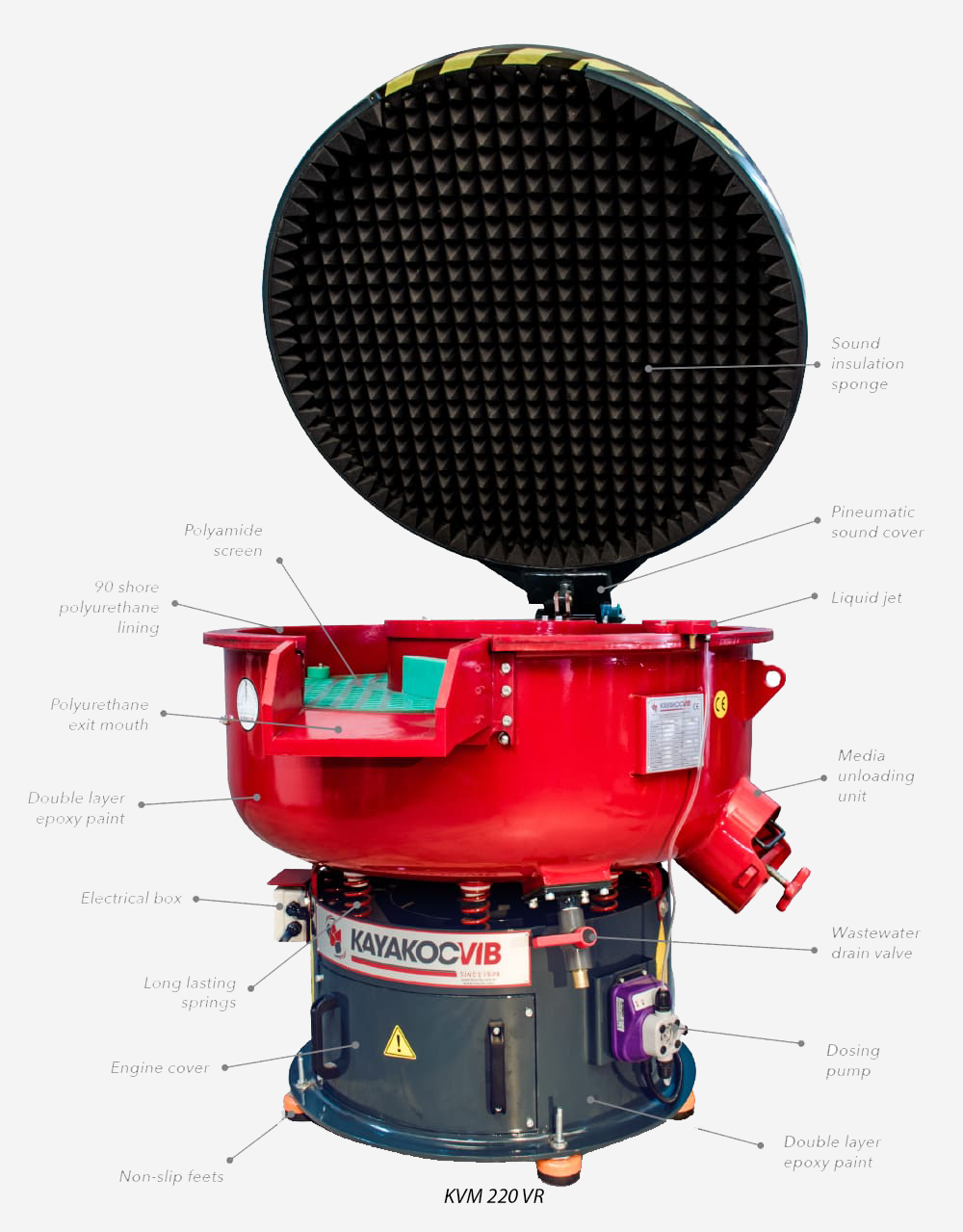
Turkish surface finishing machine manufacturing emerged as a serious industrial sector over the past two to three decades. Turkish manufacturers initially entered the market by producing functional machines at competitive price points, serving cost-sensitive segments. Over time, a number of Turkish manufacturers have significantly advanced their engineering capabilities, producing machines that meet the technical requirements of demanding industrial applications. KAYAKOCVIB is one example of a Turkish manufacturer that has developed a full range of vibratory and centrifugal finishing systems including the KVM circular vibratory series, TVM trough vibratory series, KSM centrifugal disc series, and DRG drag finishing systems, alongside integrated automation, washing, and wastewater treatment lines.
Machine Design and Mechanical Engineering Comparison
At the mechanical level, both German and Turkish finishing machines share the same fundamental operating principles. Circular vibratory machines use eccentric mass drives to generate three-dimensional motion in the finishing bowl, causing the media and parts to circulate and interact. Trough vibratory machines use a similar drive principle but apply it to a linear or curved trough geometry, making them more suitable for long or large components. Centrifugal disc machines generate high-speed rotational energy through a spinning disc at the bowl base, producing significantly faster material removal rates than conventional vibratory machines.
The mechanical differentiation between Turkish and German machines appears in the quality of castings, drive component sourcing, bearing specifications, polyurethane lining durability, and noise and vibration management. Premium German machines typically use very high-grade polyurethane linings, precision-balanced drives, and proprietary motor and vibration generator designs. Turkish machines from established manufacturers increasingly use European-sourced drive components, Siemens or ABB motors, and quality-controlled polyurethane linings, but the specific component grade and process validation depth may still differ from top-tier German specifications.
For most standard industrial applications, the mechanical performance difference between a well-engineered Turkish machine and a mid-range German machine is less significant than the difference in purchase price and lead time. For applications requiring ultra-tight surface finish tolerances, high-value implant polishing, or aerospace-grade process documentation, the engineering depth of leading German manufacturers may provide measurable advantages.
Technical Buying Factors: A Structured Comparison
When evaluating Turkish vs German surface finishing machines, technical buyers should assess each factor against their specific application requirements rather than applying a general preference. The table below summarizes the key technical and commercial differentiation points.
| Buying Factor | German Machines | Turkish Machines |
|---|---|---|
| Purchase price | High to very high | Moderate to competitive |
| Lead time | Typically 12 to 24 weeks | Typically 6 to 14 weeks |
| Mechanical build quality | Premium, tightly documented | Good to very good depending on manufacturer |
| Process application database | Extensive, decades of data | Growing, application-specific testing required |
| Customization capability | High but cost-intensive | Often flexible and faster to execute |
| Spare parts availability | Good in Europe, variable globally | Direct from manufacturer, often shorter lead time |
| CE certification | Standard | Available from established manufacturers |
| After-sales support | Strong in domestic and European markets | Varies by manufacturer; direct support from Turkish suppliers often responsive |
| Integration capability | High, standardized modules | Good, often project-specific |
| Media and compound supply | Proprietary systems often required | Open media compatibility more common |
Process Capability and Surface Quality Considerations
From a process engineering perspective, the surface quality outcome in mass finishing depends primarily on media type, media size and shape, compound chemistry, water flow rate, machine load ratio, cycle time, and machine motion amplitude and frequency. The machine itself is an enabler of process conditions, not the sole determinant of surface quality. A well-tuned Turkish vibratory machine running the correct media and compound for a specific application can achieve surface results comparable to a German machine running an equivalent process.
The practical difference appears when process development is required. German manufacturers with decades of application databases can often recommend a starting process configuration with higher confidence. Turkish manufacturers with growing application experience may require more sample testing and process iteration before a stable process is confirmed. For buyers with internal process engineering resources, this is manageable. For buyers who expect turnkey process delivery with minimal internal development, the depth of a German manufacturer’s application library may reduce project risk.
For applications targeting demanding surface roughness reductions on steel, stainless steel, aluminum, or mixed metal components, both supply bases are technically capable when the correct media and compound selection is applied. Ceramic media is generally appropriate for steel and stainless steel deburring and surface finishing, while plastic media is preferred for aluminum, zamak, and softer alloys. Compound chemistry must be matched to the base material, surface contamination level, and desired surface condition after finishing.
ROI and Total Cost of Ownership Analysis
A direct purchase price comparison between Turkish vs German surface finishing machines typically shows a 30 to 60 percent cost difference in favor of Turkish machines for equivalent machine categories, depending on machine size, specification level, and automation scope. This difference compresses the payback period for Turkish machines but must be evaluated against operational factors over the full machine life cycle.
Total cost of ownership should include purchase price, installation and commissioning costs, media and compound consumption over the machine life, spare parts cost and availability, maintenance labor, and the cost of any process development or technical support required. German machines may carry lower long-term media consumption costs if their process optimization documentation reduces waste, but this advantage is difficult to quantify without application-specific data. Turkish machines with direct manufacturer relationships often provide faster and lower-cost spare parts supply, which can reduce unplanned downtime costs in production environments.
For high-volume production environments where machine uptime is a primary cost driver, spare parts availability and service response time carry significant weight. For lower-volume job shops or facilities with in-house maintenance capability, the lower capital cost of a Turkish machine may represent a straightforward financial advantage.
Application Suitability by Industry Segment
In automotive and fastener production, where high throughput, low cost per part, and process repeatability are the dominant requirements, Turkish vibratory finishing machines have established a strong track record. The KVM series circular vibratory machines and TVM series trough vibratory machines are examples of equipment used in these segments for deburring, edge rounding, and surface preparation of steel and mixed metal components at production scale.
In aerospace and medical device applications, where process documentation, traceability, validated process parameters, and certification support are required, German manufacturers have historically held a stronger position. However, Turkish manufacturers serving these segments are increasingly able to provide CE-certified equipment, documented process validation support, and application-specific engineering. The DRG drag finishing concept, used for precision finishing of cutting tools, implants, and high-value components, is an area where both German and Turkish suppliers compete technically, though German drag finishing technology remains more established at the highest precision levels.
In CNC machining job shops and general manufacturing, the buying decision is most often driven by price, lead time, application flexibility, and supplier responsiveness. Turkish machines have a clear commercial advantage in this segment, provided the selected manufacturer can demonstrate engineering credibility, CE compliance, and reliable after-sales support.
Automation and Line Integration Capability
Modern surface finishing requirements in automotive and CNC production often extend beyond the finishing machine itself. Separation, washing, drying, and wastewater treatment are integral parts of a complete finishing line. Both German and Turkish manufacturers offer integrated automation solutions, but the depth of standard modular integration is typically greater with established German suppliers. Turkish manufacturers with full line capability can design and supply complete systems including separator machines, industrial washing, dryers, and wastewater recycling, but line integration complexity may require closer project engineering collaboration.
For buyers evaluating complete finishing line installations rather than standalone machines, the ability of the supplier to deliver a validated complete system is a more important selection criterion than machine brand origin. A well-engineered Turkish finishing line with integrated separation, washing, drying, and compound management systems can meet the production and quality requirements of most industrial applications when properly specified and validated.
Frequently Asked Questions
Are Turkish surface finishing machines CE certified?
Established Turkish manufacturers supply CE-certified surface finishing machines. Buyers should verify current CE documentation for the specific machine model and confirm that the certification covers the relevant safety directives before purchase.
Can Turkish vibratory finishing machines match German machines for surface quality?
Surface quality in vibratory finishing depends primarily on media selection, compound chemistry, machine load ratio, and cycle time rather than machine brand origin. A correctly specified Turkish vibratory machine running an appropriate process can achieve equivalent surface results to a German machine on the same application. Process development and sample testing are required to validate this for specific parts.
What is the typical price difference between Turkish and German finishing machines?
Purchase price differences typically range from 30 to 60 percent in favor of Turkish machines for equivalent machine categories, though the exact difference depends on machine size, specification, and automation scope. Total cost of ownership over the machine life cycle should be evaluated alongside the purchase price.
Which industries are best suited for Turkish finishing machines?
Turkish surface finishing machines are well suited for automotive components, fasteners, CNC machined parts, stamped metal parts, and general manufacturing applications where process repeatability, cost efficiency, and flexible customization are the primary requirements. For aerospace and medical applications with strict documentation requirements, buyers should verify the specific supplier’s application experience and certification support capability.
Related Process Equipment
Conclusion
The comparison of Turkish vs German surface finishing machines cannot be resolved by brand preference alone. The technically correct decision depends on the specific application, part material, required surface quality, production volume, automation requirement, budget, and the buyer’s internal process engineering capability. German machines offer deeper application databases, premium build quality, and stronger certification infrastructure, which justify their cost premium in demanding or high-value applications. Turkish machines from established manufacturers offer competitive mechanical quality, shorter lead times, lower capital cost, and increasing application engineering capability, making them a technically sound choice for the majority of industrial finishing requirements. Evaluating both options against application-specific criteria, supported by sample testing, is the most reliable path to an informed capital equipment decision.
Sorry, the comment form is closed at this time.