



04 Jul Finishing Machine for CNC Parts
Selecting the correct finishing machine for CNC parts is one of the most consequential process decisions a CNC machining company can make. The wrong machine choice leads to inconsistent deburring, inadequate surface quality, part damage, or unnecessary cycle time. The right machine integrates cleanly into production flow, delivers repeatable results, and supports the surface quality requirements demanded by automotive, aerospace, medical, and general manufacturing customers.
In This Article
Why Machine Selection Matters for CNC Machining Companies
CNC machined parts arrive from the machine center with a predictable set of surface conditions: burrs at intersecting bores, sharp edges from end milling or drilling, tool marks on flat faces, and residual cutting oil or chips on the surface. The finishing machine must address these conditions consistently across large production volumes without damaging part geometry, critical threads, or tight-tolerance features.
Unlike casting or stamping, CNC machined parts often carry tighter dimensional tolerances and more complex internal geometries. This narrows the acceptable range of process intensity and makes media selection, machine type, and process control more critical. A finishing process that works well for a steel bracket may be inappropriate for an aluminum housing with blind bores or a medical implant with surface roughness requirements below Ra 0.4.
Primary Selection Criteria
Before evaluating specific machines, a process engineer should establish a clear picture of the following variables. Each one directly influences which machine type is appropriate.
- Part material: steel, stainless steel, aluminum, copper, or mixed batches
- Part size and geometry: compact or large, simple or complex, prismatic or curved surfaces
- Burr condition: small machining burrs, medium thread burrs, or heavy edge burrs
- Surface quality target: deburring only, edge rounding, surface smoothing, or pre-polish
- Production volume: low batch, medium batch, or continuous high-volume production
- Part fragility: thin walls, delicate features, critical threads, or tight tolerances
- Washing and drying requirement: parts going directly to inspection, coating, or assembly
- Automation level: manual loading, semi-automatic, or fully automated finishing line
Each of these factors filters the available machine options. A systematic review of all criteria together leads to a more reliable machine selection decision than evaluating machines in isolation.
Part Geometry and Material Analysis
Part geometry is often the first hard constraint in machine selection. Circular vibratory finishing machines handle a wide range of part sizes and shapes well, particularly compact prismatic parts, rotational parts, and mixed-geometry batches. Trough vibratory machines are better suited for longer components such as shafts, rails, or elongated brackets that would tumble poorly in a circular bowl.
Material affects both media selection and process intensity. Aluminum and soft alloys require plastic media to avoid over-cutting and surface smearing. Steel and stainless steel parts tolerate and often require ceramic media for effective burr removal. Mixing aluminum and steel parts in the same batch is generally not recommended because the process parameters optimized for one material will compromise the other.
Parts with internal passages, blind holes, or complex recesses carry a media lodging risk. Smaller media sizes increase the risk of lodging in tight cavities. The process engineer should verify minimum hole diameter against the selected media size before finalizing the process specification.
Machine Type Suitability Logic
Four machine types are most commonly relevant for CNC machined parts: circular vibratory finishing machines, trough vibratory finishing machines, centrifugal disc finishing machines, and drag finishing machines. Each operates on different mechanical principles and delivers different process characteristics.
| Machine Type | Best Suited For | Typical Cycle Time | Process Intensity |
|---|---|---|---|
| Circular Vibratory (KVM) | Mixed CNC parts, medium volumes, general deburring and smoothing | 20 to 90 minutes depending on application | Medium |
| Trough Vibratory (TVM) | Long or large parts, shafts, elongated components | 30 to 120 minutes depending on application | Medium |
| Centrifugal Disc (KSM) | Small precision parts, short cycle requirements, high surface quality | 3 to 20 minutes depending on application | High |
| Drag Finishing (DRG) | High-value parts, cutting tools, implants, controlled edge geometry | 5 to 30 minutes depending on application | Very High, Controlled |
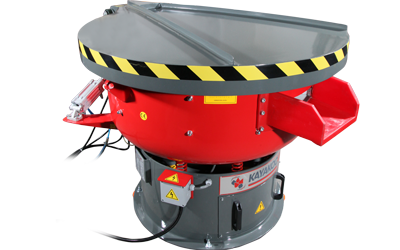
Circular vibratory finishing machines such as the KAYAKOCVIB KVM series are the most widely used finishing machine for CNC parts in general manufacturing environments. The toroidal media flow inside the bowl creates consistent sliding contact between media and part surfaces across the entire batch. This uniform action makes it well suited for deburring, edge rounding, and surface smoothing on mixed part geometries at medium production volumes.
Trough vibratory machines are appropriate when part length exceeds what a circular bowl can accommodate without risk of part-to-part collision or uneven media contact. Long turned components, drive shafts, or structural profiles are typical examples where a trough geometry improves process uniformity.
Centrifugal disc finishing machines generate significantly higher process forces than vibratory machines. This makes them effective for applications where short cycle times or higher surface quality levels are needed, such as small precision turned parts, medical components, or parts requiring pre-polish surface conditions. The trade-off is a higher risk of part damage on thin-walled or delicate features if process parameters are not carefully controlled.
Drag finishing machines hold each part individually in a fixture and drag it through a stationary or rotating media bed. This provides the highest level of process control and is appropriate for high-value parts, cutting tools, mold inserts, or implants where surface geometry must be maintained precisely. Cycle times are longer per part, and the process is better suited for lower production volumes with high quality requirements.
Media and Compound Selection for CNC Parts
Media and compound selection follows directly from part material and the required finishing action. For aluminum CNC parts, plastic media is the standard choice because aluminum is soft and prone to surface smearing under high cutting forces. Ceramic media used on aluminum without careful process control can cause excessive material removal or surface damage.
For steel and stainless steel CNC parts, ceramic media provides the cutting and deburring action needed to remove machining burrs efficiently. The ceramic bond hardness and shape should be matched to the burr size and surface condition. Aggressive pyramid or cone shapes provide faster cutting; spherical or rounded shapes are used when edge rounding without heavy material removal is the objective.
Process compounds control surface chemistry during wet finishing. For aluminum and zamak, 085 deburring and polishing liquid combined with 028-S degreasing liquid is a common starting point. For steel and stainless steel, 943 deburring and polishing liquid combined with 028-S degreasing liquid is typically used. Compound concentration and flow rate affect surface brightness, cleaning efficiency, and media wear rate, and should be set based on application testing rather than default values.
Common Wrong Choices in CNC Finishing Machine Selection
Several recurring mistakes appear when CNC machining companies select finishing equipment without a structured evaluation process.
- Selecting a circular vibratory machine without verifying that part length fits the bowl geometry, leading to part damage from uncontrolled tumbling
- Using ceramic media on aluminum parts to accelerate cycle time, resulting in surface smearing or dimensional loss on thin features
- Selecting a centrifugal disc machine for fragile or complex geometry parts without sample testing, causing edge chipping or feature damage
- Underestimating production volume requirements, leading to insufficient machine capacity and cycle time bottlenecks
- Ignoring washing and drying requirements, resulting in parts arriving at inspection or assembly with compound residue or flash rust
- Mixing materials in the same batch without verifying media and compound compatibility for all materials present
Each of these mistakes is avoidable through a structured pre-selection review and sample testing before committing to a production process specification.
Washing, Drying, and Post-Finishing Requirements
Most wet vibratory or centrifugal disc finishing processes leave parts with compound residue, fine media particles, and surface moisture. For CNC machined parts going directly to quality inspection, protective coating, or precision assembly, post-finishing cleaning and drying steps are necessary.
Separation of parts from media after the finishing cycle is handled by a separator machine. Parts and media are discharged together and separated by screen or vibration. After separation, parts typically pass through a washing stage to remove compound residue and fine debris. Depending on surface cleanliness requirements, pressure washing or ultrasonic cleaning may be integrated into the finishing line.
Drying is required when parts must arrive at the next stage dry and free of moisture. Circular vibratory dryers or trough dryers using dry media or hot air circulation can be incorporated after the washing stage. For CNC machining companies producing parts that go directly to anodizing, painting, or medical packaging, complete drying and cleanliness verification are part of the finishing process requirement, not an optional step.
Automation Readiness for CNC Finishing Lines
CNC machining companies operating at medium to high production volumes increasingly require automated part handling between the machine center and the finishing system. Automated finishing lines can include loading stations, metered compound dosing, timed process cycles, automated discharge, separator systems, washing, drying, and part output conveyors.
The decision to automate depends on production volume, part consistency, and labor cost. Automated finishing lines reduce operator variability, improve cycle time repeatability, and allow finishing to run during unattended or lights-out shifts. For companies machining large volumes of identical or similar parts, automation investment in the finishing line often reduces total per-part finishing cost significantly over time.
The machine type must be compatible with automation. Circular vibratory machines with automated discharge valves and integrated separator systems are well suited to continuous line operation. Centrifugal disc machines with automated lid and discharge control can also be integrated into timed production cells. Drag finishing machines are typically batch-oriented but can be integrated into robotic cell configurations for high-value part production.
Validation Checklist Before Production Release
Before releasing a finishing process to production, the following validation steps should be completed:
- Confirm part-media size compatibility and verify no lodging risk in internal features
- Run sample batches with the selected media and compound at the intended process parameters
- Measure surface roughness before and after finishing across multiple part locations
- Verify edge condition against the specified edge rounding or deburring requirement
- Check dimensional integrity on critical toleranced features after the finishing cycle
- Confirm compound residue removal after washing and verify cleanliness level
- Verify dryness level if parts proceed directly to coating or assembly
- Document process parameters including load weight, compound concentration, flow rate, and cycle time
- Run a short production validation batch before full volume release
Actual surface roughness values, edge rounding dimensions, and cycle times will vary depending on part geometry, material condition, media selection, compound concentration, and machine settings. Sample testing and process validation are required to establish reliable production parameters for each specific application.
Frequently Asked Questions
Which finishing machine is most commonly used for CNC parts in general manufacturing?
Circular vibratory finishing machines are the most widely used option for general CNC machined parts. They handle mixed geometries and batch sizes effectively, provide consistent surface contact across the full media load, and are compatible with automation. A machine such as the KAYAKOCVIB KVM series is a representative example used across automotive, general engineering, and industrial component production.
Can aluminum and steel CNC parts be finished in the same machine at the same time?
Generally, no. Aluminum and steel parts require different media types and process parameters. Mixing them in the same batch typically means compromising the process for at least one material. Separate finishing batches with material-appropriate media and compound settings are recommended for reliable, consistent results.
How do I know if a centrifugal disc machine is appropriate for my CNC parts?
Centrifugal disc finishing is appropriate when short cycle times or high surface quality levels are required and when part geometry is robust enough to withstand higher process forces. Thin-walled parts, delicate features, and complex geometries require sample testing before committing to centrifugal disc processing. Parts with fragile edges or tight tolerances should be tested at reduced intensity settings first.
What happens if the finishing machine is too large or too small for production volume?
An undersized machine creates a production bottleneck and forces short cycles that may not achieve the required surface quality. An oversized machine wastes energy, increases compound consumption, and may cause part damage in under-loaded conditions where parts collide rather than flow freely in media. Machine capacity should be matched to production volume with a reasonable utilization factor.
Related Machine and Process Resources
Related Video Demonstration
Conclusion
Choosing the right finishing machine for CNC parts requires a structured evaluation of part material, geometry, burr condition, surface quality target, production volume, and downstream process requirements. Circular vibratory machines cover the widest range of general CNC machining applications. Trough machines address long or large components. Centrifugal disc machines deliver faster cycles and higher surface quality for small precision parts. Drag finishing provides the highest process control for premium or high-value components. Media and compound selection must follow material type, not default settings. Washing, drying, and automation integration should be planned as part of the overall process design, not added as afterthoughts. All process parameters and surface quality results must be validated through sample testing before production release.
Sorry, the comment form is closed at this time.