



30 Jun Metal Deburring in Industrial Production
Metal deburring is one of the most consistently required operations in industrial part production. Across CNC machining, stamping, casting, and forming processes, burrs and sharp edges are an unavoidable result of material separation. Left untreated, these features create assembly problems, accelerate tool wear in downstream processes, cause injury during handling, and compromise coating adhesion. Understanding how a deburring process is structured from start to finish allows engineers and production managers to select the right machines, media, and parameters for consistent, repeatable results.
In This Article
What Burrs Are and Why They Must Be Removed
A burr is a raised edge or fragment of material that remains attached to a part after a cutting, punching, drilling, milling, or forming operation. Burrs form because metal deforms plastically at the tool exit point rather than shearing cleanly. The size, shape, and hardness of a burr depend on the base material, tooling condition, cutting parameters, and the specific operation involved.
For steel and stainless steel components, burrs are typically harder and more resistant to removal than the base material due to work hardening. Aluminum burrs are softer but can be thin and flexible, which sometimes makes them more difficult to fully remove without smearing. Mixed metal assemblies or parts with complex geometries add further complexity to the deburring requirement.
Edge rounding is often required alongside deburring. Many engineering drawings specify a controlled edge radius rather than simply a burr-free condition. This distinction matters because it changes the required process intensity, media selection, and acceptable cycle time.
The Metal Deburring Process Sequence
A well-structured industrial deburring process follows a defined sequence. Each stage has a specific technical function, and skipping or compressing stages typically leads to inconsistent surface quality or contamination in downstream operations.
- Pre-cleaning or washing: Parts arriving from machining or forming often carry cutting oil, coolant residue, metal chips, or pressing lubricant. Entering a finishing machine with heavily contaminated parts reduces media cutting efficiency, shortens media life, and can create surface staining. A pre-wash step improves process consistency and protects the finishing media.
- Loading and machine setup: Parts are loaded into the finishing machine with the correct media charge and compound concentration. The media-to-parts ratio, fill level, and compound dosing rate must be set according to the part geometry, material, and target surface condition. Overloading reduces part movement and contact frequency. Underloading increases the risk of part-on-part impact damage.
- Wet mass finishing cycle: The machine runs with continuous compound and water dosing. The compound maintains pH control, lubricates the process, prevents rust formation on steel parts, and assists in chip flushing. The media contacts parts continuously through vibratory or centrifugal motion, progressively removing burrs and rounding edges through abrasion and pressure.
- Part-media separation: After the deburring cycle, parts must be separated cleanly from the finishing media. A separator machine screens parts from media using vibration and a mesh screen sized to the part and media dimensions. Incomplete separation creates rework and delays downstream operations.
- Rinsing and washing: After separation, parts typically require rinsing to remove compound residue, fine abrasive particles, and metal fines. For steel and stainless parts, a corrosion inhibitor may be applied during or after rinsing. For aluminum parts, a neutralizing rinse is often used to prevent oxidation.
- Drying: Wet parts entering storage, packaging, or coating lines cause rust, staining, or adhesion failures. Drying is performed in a vibratory dryer loaded with drying media such as corn cob or walnut shell granulate. Heat-assisted drying accelerates the process and improves throughput consistency.
- Inspection and validation: Finished parts are inspected against the surface quality requirement. Inspection may include visual checks, tactile edge radius measurement, surface roughness measurement, or sample testing under magnification. Any out-of-specification condition is investigated through the process parameters before production release.
Machine Selection for Deburring Applications
Machine type is the primary process variable in any metal deburring application. The correct machine depends on part size, part geometry, required edge condition, production volume, and automation requirement.
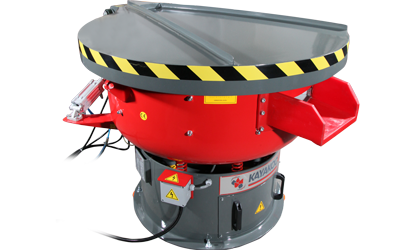
Circular vibratory finishing machines are the most widely used equipment for mass deburring in industrial production. They handle a broad range of part sizes and geometries, accept high part volumes per batch, and provide consistent media contact across the entire part surface. Machines such as the KAYAKOCVIB KVM series circular vibratory finishing machines are commonly used for CNC-machined parts, stamped components, fasteners, and cast parts in steel, stainless steel, and aluminum. The circular trough design creates a continuous spiral flow of media and parts, ensuring even contact and preventing part clustering.
Trough vibratory finishing machines are preferred for long, flat, or large parts that do not fit well in a circular bowl without risk of impact damage. The linear trough geometry allows parts to travel through the media mass along the length of the machine, reducing part-on-part contact during the process. The KAYAKOCVIB TVM series addresses this application range.
Centrifugal disc finishing machines provide significantly higher process intensity than vibratory machines and are selected when short cycle times, high edge rounding precision, or demanding surface quality requirements are present. The KAYAKOCVIB KSM series centrifugal disc finishing machines are frequently applied to small precision components in medical, aerospace, and high-tolerance CNC applications where consistent edge radius control and short production cycles are required.
Media and Compound Selection
Media selection directly controls cutting aggressiveness, edge rounding geometry, and final surface condition. The base material of the part determines the correct media type.
For steel and iron parts, ceramic media is the standard choice. Ceramic media provides strong abrasive cutting action suitable for removing hard burrs from machined or punched steel components. Finer ceramic grades are used for finishing or pre-plate surface preparation after initial deburring is complete.
For aluminum, zinc, and softer non-ferrous metals, plastic media is generally preferred. Plastic media is less aggressive and protects soft surfaces from scratching or surface damage. Using ceramic media on aluminum parts without careful process validation risks excessive material removal and surface marking.
Media geometry affects where the abrasive contact occurs. Triangular, cylindrical, and spherical shapes each have different contact characteristics with part features such as internal bores, cross-holes, slots, and recesses. Media size must be selected to prevent lodging inside part features. Parts with small holes or narrow channels require media large enough to avoid trapping, which would cause parts to be rejected and require manual extraction.
Process compounds serve multiple functions. For steel parts, a deburring and polishing liquid such as a 943-type compound maintains the correct alkaline pH, assists in chip removal, provides surface protection against rust formation during processing, and helps maintain media cleanliness. For aluminum parts, an 085-type deburring and polishing compound is more appropriate because it is formulated for non-ferrous materials and prevents surface discoloration. A degreasing compound such as 028-S is commonly added when parts carry heavy machining oil or pressing lubricant from upstream operations.
Process Parameters and Their Effect on Deburring Quality
The outcome of any metal deburring operation is controlled by a set of adjustable process parameters. These parameters must be understood and set correctly before production release.
| Parameter | Effect on Process | Typical Adjustment Range |
|---|---|---|
| Vibration amplitude | Controls media pressure and cutting intensity | Low to high via eccentric weight setting |
| Cycle time | Determines total material removal and edge radius achieved | 20 to 120 minutes depending on burr size and target condition |
| Media-to-part ratio | Controls contact frequency and part protection | Typically 3:1 to 6:1 by volume |
| Compound concentration | Controls pH, lubrication, and surface protection | 1 to 3 percent dilution depending on compound type |
| Water flow rate | Flushes chips and controls compound concentration in the trough | Adjusted to maintain stable foam and chip removal |
| Media grade | Controls cutting speed and final surface roughness | Coarse for initial deburring, medium to fine for finishing stages |
Cycle time and amplitude are the two parameters most frequently adjusted during process development. Increasing amplitude accelerates metal deburring but may also increase surface roughness or risk part damage for thin or delicate components. Cycle time is the primary lever for achieving a target edge radius when amplitude is fixed. Both parameters must be validated through sample testing before production release, as actual results depend on part geometry, burr size, material condition, and media wear state.
Validation and Quality Control Points
Process validation is essential before committing a deburring process to production. The following checkpoints should be confirmed during qualification:
- Confirm that all part features accessible to media receive uniform contact and deburring treatment.
- Confirm that media does not lodge in holes, slots, or recesses on the part.
- Verify that the edge radius achieved matches the drawing specification or quality requirement.
- Check surface roughness on critical surfaces to confirm that the process does not degrade dimensional or functional surfaces.
- Confirm that no part-on-part impact marks or scratches are present, particularly on flat or functional faces.
- Verify that parts exit the dryer without water marks, staining, or residual compound deposits.
- Confirm that wastewater from the process meets local discharge requirements or that a treatment system is in place.
Process validation results should be documented and used as the baseline for ongoing production monitoring. Any change in media type, compound batch, machine amplitude setting, or part geometry requires re-validation before full production release.
Frequently Asked Questions
What is the difference between deburring and edge rounding?
Deburring removes a raised burr from a part surface. Edge rounding creates a controlled radius on a sharp corner or edge. Both operations can be performed in the same mass finishing cycle, but edge rounding typically requires a longer cycle time and may require a specific media geometry to achieve a uniform radius across all edges.
Can different metals be deburred in the same machine batch?
Mixing steel and aluminum parts in the same batch is generally not recommended. The hardness difference between the two materials can cause the harder steel parts to damage the softer aluminum surfaces during the finishing cycle. Contamination from iron particles can also cause surface staining on aluminum. Separate batches and dedicated media charges are preferred for each material type.
How do I know if my cycle time is correct?
Cycle time is validated by inspecting parts at intervals during process development. The correct cycle time is the minimum time at which the target burr removal and edge condition are consistently achieved across all features of the part. Running beyond the minimum required cycle time increases surface material removal and operating cost without additional quality benefit.
What causes inconsistent deburring results across a batch?
Inconsistent results are most commonly caused by incorrect media-to-part ratio, worn media that has lost cutting ability, incorrect compound concentration, insufficient amplitude setting, or part clustering in the machine. Each of these factors reduces or eliminates media contact with part surfaces and must be investigated systematically before adjusting cycle time.
Related Process Equipment
Related Video Demonstration
Conclusion
Metal deburring in industrial production is a structured, parameter-driven process that requires careful selection of machine type, media grade, compound chemistry, and process settings to achieve consistent results. The process begins with understanding the burr characteristics and part geometry, continues through the finishing cycle with correct parameter control, and ends with validated separation, rinsing, and drying stages. Machine selection between circular vibratory, trough vibratory, and centrifugal disc configurations depends on part size, production volume, required cycle time, and surface quality targets. Media and compound selection must match the base material to avoid surface damage or poor cutting efficiency. Every new application requires sample testing and documented process validation before production release, as actual deburring outcomes depend on the specific combination of part, media, machine, and compound used in production conditions.
Sorry, the comment form is closed at this time.