



30 Jun Finishing Brake Chassis Components
Finishing brake chassis components is a technically demanding application in automotive manufacturing. Brake calipers, brackets, knuckles, control arms, subframe components, and related structural parts carry strict surface quality requirements that directly affect assembly fit, corrosion resistance, coating adhesion, and long-term fatigue performance. Unlike decorative finishing, the process goals here are functional: remove burrs, smooth machined edges, condition contact surfaces, and prepare parts for downstream operations such as phosphating, coating, or anodizing.
In This Article
Typical Parts, Materials, and Surface Defects
Brake and chassis components in automotive production are manufactured from a range of materials depending on the application. Brake calipers, knuckles, and hub carriers are frequently made from gray iron, ductile iron, or aluminum alloy. Control arms, subframe brackets, and mounting plates are commonly pressed, stamped, or machined from steel or high-strength steel. Aluminum is increasingly used in chassis applications for weight reduction.
Typical surface defects found on these parts before finishing include:
- Machining burrs on drilled holes, milled pockets, and chamfered edges
- Tool marks and feed lines from turning or milling operations
- Sand inclusion and casting roughness on iron and aluminum castings
- Sharp edges at punched or stamped features
- Micro-cracks or stress risers at machined transition zones
- Surface contamination from cutting fluids, scale, or corrosion
These defects are not only cosmetic concerns. Sharp edges can create stress concentration points that reduce fatigue life. Burrs left on hydraulic passages in brake components can break off in service, causing system contamination. Rough surfaces can prevent proper coating adhesion, leading to premature corrosion in chassis components exposed to road environment.
Recommended Process Route for Brake and Chassis Parts
The standard process route for finishing brake chassis components in mass production typically follows a defined sequence. The exact steps depend on part material, incoming surface condition, and required output specification.
- Pre-clean parts to remove cutting oil, chips, and loose contamination before loading into the finishing machine. Heavy oil or coolant contamination can saturate media and reduce process effectiveness.
- Load parts into a vibratory finishing machine with appropriate media and compound mixture. For iron and steel parts, ceramic media combined with a deburring and polishing liquid such as 943 compound is typically used. For aluminum chassis parts, plastic media with 085 compound is generally preferred to avoid aggressive cutting that could damage softer surfaces.
- Run the wet vibratory process for a validated cycle time. Deburring cycles for machined steel brake brackets typically range from 20 to 60 minutes depending on burr size, media type, and machine intensity. Aluminum parts may require shorter cycles at lower intensity settings.
- Separate parts from media using an integrated separator. Media and parts should not be mixed during unloading to prevent damage.
- Rinse parts with clean water to remove compound residue. For brake components with internal hydraulic passages, thorough rinsing is important to clear compound from bores.
- Dry parts immediately after rinsing to prevent rust formation on steel and iron parts. Circular vibratory dryers or trough dryers with corncob or other natural drying media are used in production lines where rust inhibitor is not applied.
- Apply rust preventive or transfer parts directly to the next process step such as phosphating, powder coating, or anodizing.
Machine Selection for Brake and Chassis Applications
Machine type selection for finishing brake chassis components depends on part geometry, size, weight, and production volume. Most brake and chassis parts used in passenger vehicles fall into the small-to-medium size range, which is well suited to circular vibratory finishing machines.
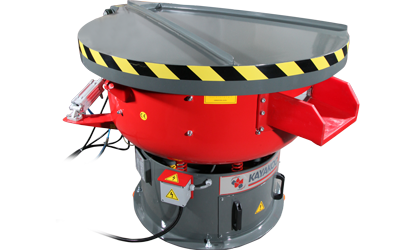
Circular vibratory machines such as the KAYAKOCVIB KVM series are well matched to this application. These machines generate a helical flow pattern that moves parts and media in continuous contact without fixturing. The relatively gentle action of vibratory finishing reduces the risk of part-on-part impact damage, which is relevant for finished machined surfaces on brake components. Machine bowl sizes can be selected to match batch volume and part dimensions, and process intensity can be adjusted through amplitude and frequency settings.
For longer chassis components such as control arms or structural brackets that exceed the proportional limits of a circular bowl, trough vibratory finishing machines offer better part orientation control. The KAYAKOCVIB TVM series trough machines allow long parts to travel longitudinally through the trough, reducing the risk of end-to-end impact damage while maintaining effective media contact across the full part surface.
| Part Type | Typical Material | Recommended Machine | Media Type | Process Chemical |
|---|---|---|---|---|
| Brake caliper body | Aluminum alloy | KVM circular vibratory | Plastic media | 085 deburring compound |
| Brake bracket, mounting plate | Steel | KVM circular vibratory | Ceramic media | 943 deburring compound |
| Knuckle, hub carrier | Ductile iron | KVM circular vibratory | Ceramic media | 943 deburring compound |
| Control arm | Steel or aluminum | TVM trough vibratory | Ceramic or plastic (by material) | 943 or 085 (by material) |
| Subframe bracket | High-strength steel | KVM or TVM vibratory | Ceramic media | 943 deburring compound |
Media and Compound Selection Logic
Media selection is one of the most important variables in finishing brake chassis components. The wrong media type can result in insufficient burr removal, surface damage, or excessive cycle time. Media geometry, size, and cutting grade must all be matched to the part.
For steel and iron brake and chassis parts, ceramic media provides the cutting action needed to remove machining burrs efficiently. Ceramic media is harder and denser than plastic media and generates sufficient abrasion force for deburring mild to medium burrs on machined steel surfaces. Typical ceramic shapes used for brake brackets and iron castings include triangles, cylinders, and cones, selected according to part geometry to avoid media lodging in holes or slots.
For aluminum chassis parts, plastic media is generally preferred. Aluminum is softer and more sensitive to aggressive surface cutting. Plastic media removes burrs and smooths surfaces while generating lower surface roughness impact. Using ceramic media on aluminum parts can cause over-cutting, surface tearing, or dimensional change on precision features if the process is not carefully validated.
Process chemicals serve multiple functions during finishing. They promote cutting, prevent re-deposition of removed material, control media wear, and protect part surfaces. 028-S degreasing liquid is commonly added at the start of the cycle or as a pre-wash stage when parts carry heavy cutting oil or coolant contamination. For steel and iron parts, 943 compound maintains the deburring and polishing action while providing surface protection. For aluminum parts, 085 compound balances deburring action with aluminum-compatible surface chemistry.
Process Parameters and Quality Control Points
Achieving consistent surface quality in high-volume brake and chassis finishing requires control of several process parameters. These parameters should be validated during initial process development and monitored during production.
Machine amplitude and frequency settings determine the intensity of media movement and the rate of part-media contact. Higher amplitude increases cutting aggressiveness, which is useful for heavy burrs on steel parts but may cause surface damage on softer aluminum components. Frequency affects how the media flows in the bowl and should be matched to the machine specification for the media load used.
Media-to-part ratio influences how effectively media contacts part surfaces. A ratio that is too low relative to part volume results in inadequate media coverage and uneven deburring. A ratio that is too high can cause excessive media consumption and increase the risk of part-on-part contact in lighter-loaded machines. Typical mass finishing practice uses a media volume that substantially exceeds part volume, with the exact ratio depending on part geometry and machine type.
Water flow rate and compound dosing must be calibrated to maintain consistent process chemistry throughout the cycle. Under-dosing compound reduces cutting efficiency and can allow surface staining. Over-dosing increases operating cost and can affect media life. Automated compound dosing systems improve consistency in high-volume production lines.
Key quality inspection points after finishing brake and chassis components typically include:
- Visual inspection for remaining burrs on critical edges and hydraulic passage openings
- Surface roughness measurement on functional contact surfaces where specified
- Dimensional check on precision features to confirm no material removal beyond tolerance
- Cleanliness check for compound residue in bores, threads, and passages
- Surface condition check before coating to confirm adequate preparation
Integration into Automotive Production Lines
In high-volume automotive manufacturing, finishing brake chassis components is integrated into the production flow rather than performed as a manual offline step. Automated finishing lines include parts loading, vibratory finishing, separation, washing, drying, and transfer to the next process stage. Automation reduces labor dependency, improves process repeatability, and supports quality traceability.
Separator machines divide finished parts from media continuously or at cycle end, allowing media to be returned to the machine and parts to move forward in the line. Washing stages after finishing remove compound residue and prepare surfaces for coating processes. For steel and iron parts, wastewater from the finishing and washing stages requires treatment before disposal. Wastewater treatment and recycling systems are used in production facilities to manage compound-laden water and meet environmental discharge requirements.
Drying after wet vibratory finishing is important for iron and steel brake components that are susceptible to flash rust. Vibratory dryers using corncob or similar organic drying media absorb surface moisture and leave parts dry for handling and storage. In production lines where parts transfer directly to a rust-preventive dip or phosphating bath, an intermediate drying step may not be required.
Limitations and Practical Validation Notes
Vibratory finishing is effective for batch deburring, edge conditioning, and surface smoothing of brake and chassis components, but it has limitations that production engineers must account for. Parts with very deep blind holes or complex internal geometries may be difficult to finish uniformly because media contact inside those features is limited. In such cases, supplementary operations or different media shapes may be required.
Heavy casting flash or oversized gate stubs on iron castings should be removed before vibratory finishing. The vibratory process is not designed to remove large casting defects and attempting to do so results in excessive cycle times and rapid media consumption. Shot blasting or trimming operations are normally used upstream to condition heavily flashed castings before mass finishing.
Steel and aluminum parts should not be mixed in the same vibratory finishing batch. Mixing materials creates risks of contamination, galvanic reaction, and inconsistent surface results. Separate batches and separate compound formulations are required for each material group.
All cycle times, media types, compound concentrations, and machine settings should be confirmed through sample testing before production release. Published typical values provide a starting point, but actual results depend on part geometry, incoming burr condition, machine configuration, and specific compound and media combination selected.
Frequently Asked Questions
What type of media is recommended for deburring steel brake brackets?
Ceramic media is generally recommended for steel brake brackets. Ceramic provides sufficient cutting action to remove machining burrs efficiently on hard materials. Triangle and cylinder shapes are commonly used, with size selected to prevent lodging in holes or slots on the part.
Can aluminum and iron brake parts be finished in the same batch?
No. Aluminum and iron parts should not be mixed in the same finishing batch. They require different media types and different process chemicals. Mixing them risks contamination, uneven results, and potential surface damage to the softer aluminum parts.
How long does a typical vibratory deburring cycle take for machined brake components?
Cycle times for machined steel or iron brake components typically range from 20 to 60 minutes in vibratory finishing, depending on burr size, media aggressiveness, machine intensity, and target surface condition. Aluminum parts may require shorter cycles. Actual cycle time must be validated through sample testing for each specific part and process configuration.
Is washing required after vibratory finishing of brake components?
Yes, rinsing or washing after vibratory finishing is generally required for brake components. Compound residue must be removed from surfaces and internal passages before downstream operations such as coating, phosphating, or assembly. Thorough rinsing of hydraulic passages is particularly important to prevent contamination of the brake system.
Related Process Equipment
Related Video Demonstration
Conclusion
Finishing brake chassis components with vibratory mass finishing is a reliable and scalable approach when the process is correctly designed for the part material, geometry, and surface quality requirement. Steel and iron parts require ceramic media and appropriate deburring compounds, while aluminum components are better suited to plastic media at lower process intensity. Machine selection between circular and trough vibratory configurations depends on part dimensions and production volume. Quality control inspection after finishing should cover burr removal, surface condition, dimensional integrity, and cleanliness before parts proceed to coating or assembly. Process parameters must be validated through sample testing before production release, as no universal settings apply across the range of materials and geometries found in automotive brake and chassis production.
Sorry, the comment form is closed at this time.