



29 Jun Surface Smoothing Cast Parts
Surface smoothing cast parts is one of the most common finishing requirements in die casting, foundry, and general metalworking operations. Cast components typically leave the mold or die with residual parting lines, flash, rough surface texture, oxide layers, and microscale irregularities that must be reduced before the part proceeds to coating, assembly, or final inspection. Achieving consistent surface quality across high production volumes requires a disciplined approach to machine selection, media geometry, compound chemistry, and process parameters.
In This Article
Typical Surface Conditions of Cast Components
Cast metal parts present a distinctive combination of surface conditions that differ significantly from machined or stamped parts. Die cast aluminum or zinc alloy components often carry thin flash along parting lines, surface porosity pockets, oxide skin from the solidification process, and a slightly irregular surface profile depending on mold condition and alloy composition. Iron or steel sand castings typically present coarser surface texture, heavier scale, and stronger oxide layers.
Understanding the incoming surface condition is the starting point for any finishing process design. Parts with heavy flash or gate stubs may require mechanical trimming or preliminary grinding before vibratory finishing. Attempting to remove large gate remnants purely through vibratory or mass finishing is inefficient and can lead to excessive media wear without achieving the desired result.
Recommended Process Route for Cast Metal Finishing
For most cast aluminum, zinc alloy, and mixed metal die castings, a wet vibratory finishing process provides an effective combination of deburring, flash removal, surface smoothing, and light polishing in a single process stage. The general process route consists of the following sequence.
- Incoming inspection and pre-screening to identify parts with heavy flash or dimensional non-conformances that require prior attention.
- Loading the vibratory machine with the correct media type and volume ratio relative to part volume.
- Running the wet finishing process with compound and water circulation at controlled flow rate and concentration.
- Separation of finished parts from media using a separator unit.
- Washing and rinsing to remove compound residue and media fines from part surfaces.
- Drying using a vibratory dryer or centrifugal dryer loaded with dry drying chips or corncob media.
- Final inspection of surface finish, edge condition, and dimensional conformance.
This sequence addresses the full cycle from raw casting to finished surface-ready component. Each stage requires process validation specific to the part material, geometry, and required surface quality.
Machine Selection for Cast Component Smoothing
The two primary vibratory finishing machine types used for surface smoothing cast parts are circular vibratory finishing machines and trough vibratory finishing machines. Machine selection depends on part size, part geometry, batch volume, and the level of surface contact energy required.
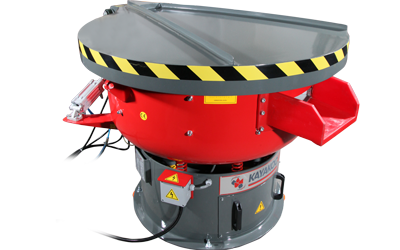
Circular vibratory finishing machines, such as the KAYAKOCVIB KVM series, are well suited for small to medium-sized castings where the parts can tumble freely within the circular tub. These machines generate a toroidal motion pattern that creates continuous part-to-media contact across the full batch volume. For die cast aluminum housings, connector bodies, bracket castings, and similar compact parts, circular vibratory machines provide efficient surface smoothing with good process consistency.
Trough vibratory finishing machines are preferred for longer cast components, larger structural castings, or parts with asymmetric geometry that require more controlled contact. The linear motion pattern in trough machines reduces the risk of part-on-part impact for delicate castings and provides better control over surface contact distribution along the part length.
| Part Type | Recommended Machine | Reason |
|---|---|---|
| Small die cast housings and covers | Circular vibratory (KVM) | High batch capacity, good tumbling motion, efficient surface contact |
| Medium bracket and connector castings | Circular vibratory (KVM) | Suitable part-to-media ratio, consistent finish across batch |
| Long structural castings | Trough vibratory (TVM) | Controlled linear motion reduces part collision risk |
| Delicate thin-wall castings | Trough vibratory (TVM) | Lower impact energy, reduced risk of part deformation |
| Heavy iron or steel castings with thick scale | Circular or trough vibratory with ceramic media | High cutting action required for scale and oxide removal |
Media Selection Based on Casting Material
Media selection is the single most influential variable in surface smoothing cast parts. The wrong media type or geometry can result in insufficient surface improvement, part damage, media lodging, or excessive cycle times.
For aluminum and zinc alloy die castings, plastic media is the standard choice. Plastic media is lighter and less aggressive than ceramic media, which protects softer alloy surfaces from over-cutting or impact marking. Plastic media shapes such as cones, wedges, or triangles are commonly used depending on the part geometry. Cone-shaped plastic media is suitable for parts with internal recesses, while wedge or triangle shapes provide effective contact on flat and slightly contoured surfaces.
For steel and iron castings requiring scale removal, heavy deburring, or significant surface texture reduction, ceramic media is the appropriate choice. Ceramic media provides stronger abrasive cutting action and can handle the harder surface conditions typical of sand cast or investment cast steel parts.
Media size must be matched to part geometry. Media that is too large will not reach recessed areas. Media that is too small creates media lodging risk in holes, slots, or internal passages. As a general rule, media should be large enough to prevent entry into the smallest hole or slot present on the part.
Compound Chemistry and Process Fluid Management
Finishing compounds serve multiple functions in wet vibratory finishing: they maintain cleanliness of the media and part surfaces, provide lubrication to control cutting aggressiveness, prevent re-deposition of removed material, and in some formulations provide mild chemical brightening or surface activation.
For aluminum and zinc alloy castings, a neutral to mildly alkaline deburring and polishing compound such as an 085-type liquid is commonly used. This compound type supports plastic media performance, maintains surface cleanliness, and controls cutting rate. A degreasing compound such as 028-S is typically added during or after the finishing cycle to ensure removal of cutting oils, mold release agents, or handling contamination from the part surface.
For steel and iron castings processed with ceramic media, a stronger deburring compound matched to ceramic media performance is appropriate. Compound concentration and water flow rate must be calibrated to maintain the desired pH and cleanliness level in the process trough throughout the cycle.
Water quality affects compound performance. Hard water can reduce compound effectiveness and cause mineral deposits on part surfaces. Process water conductivity should be monitored periodically, particularly in high-volume production environments.
Process Parameters That Control Surface Quality
Several process parameters directly influence the surface smoothing result. These parameters must be set and validated for each new part type through trial runs before production release.
Vibration amplitude and frequency determine the intensity of media-to-part contact. Higher amplitude settings increase cutting action and reduce cycle time but can also increase part-on-part collision energy, which may be unacceptable for delicate castings. For most die cast aluminum parts, medium amplitude settings provide a good balance between cycle efficiency and surface quality.
Cycle time controls the degree of surface improvement achieved per batch. Typical smoothing cycles for die cast aluminum parts range from 20 to 90 minutes depending on incoming surface roughness, media type, and target surface finish. These are indicative ranges, and actual cycle times must be validated through sample testing for each specific application.
Media-to-part volume ratio affects how efficiently the media contacts and acts on the part surfaces. Most vibratory finishing processes operate with a media-to-part ratio in the range of 3:1 to 6:1 by volume. Higher ratios improve surface contact distribution but reduce batch capacity. The correct ratio depends on part geometry and the degree of surface coverage required.
Compound flow rate and concentration must be maintained consistently throughout the cycle. Insufficient compound flow leads to media glazing, reduced cutting action, and surface staining. Excessive compound concentration can slow cutting action or leave chemical residue on part surfaces.
Separation, Washing, and Drying Requirements
After the vibratory finishing cycle, parts must be separated from the media before washing and drying. Separator machines use a vibrating screen or deck to allow media to pass through openings while finished parts are conveyed forward. For parts with complex geometry, manual inspection after separation is recommended to verify that no media has lodged in blind holes or recesses.
Washing is necessary to remove compound residue, media fines, and surface contamination before the parts proceed to downstream processes such as painting, anodizing, or assembly. Pressure washing or spray rinsing systems are commonly used. For parts with complex internal geometry, ultrasonic cleaning may be required to ensure complete residue removal from inaccessible areas.
Drying is the final process step before inspection or packaging. Vibratory dryers loaded with dry drying chips or corncob media remove surface moisture through mechanical action and gentle heating. Parts must be fully dry before entering any coating or anodizing process to prevent adhesion failures or surface defects.
Quality Control and Inspection After Smoothing
Surface quality inspection after vibratory finishing should include visual inspection for remaining flash, parting line remnants, and surface defects. Surface roughness measurement using contact profilometry provides quantitative data on the Ra improvement achieved relative to the incoming casting condition. Dimensional inspection should verify that no excessive material removal has occurred, particularly on functional surfaces or sealing faces.
For automotive or industrial applications with defined surface quality requirements, sample batches should be processed and inspected before full production release. Process parameter records including cycle time, compound concentration, media type, and machine settings should be documented and controlled as part of the process validation record.
Media condition must be monitored over time. Media wears progressively during use and loses cutting efficiency as the abrasive content is depleted. Periodic media topping or full replacement is necessary to maintain consistent surface smoothing results across production batches.
Production Line Integration for High-Volume Casting Finishing
In high-volume die casting or foundry environments, surface smoothing operations are typically integrated into a continuous or semi-continuous production line. Automated loading systems transfer castings from the output conveyor of trimming or shot blasting operations directly into the vibratory finishing machines. Separator units with integrated conveyors deliver finished parts to washing stations, followed by drying units and automated stacking or part transfer to downstream processes.
Continuous vibratory finishing machines allow a constant input of raw castings and output of finished parts without batch interruptions, which is well suited to high-throughput die casting operations. For smaller production volumes or mixed-part families, batch vibratory machines with manual loading provide more flexibility.
Wastewater from the finishing and washing process must be managed according to local environmental regulations. Closed-loop water recycling systems with sedimentation, filtration, and pH adjustment allow process water to be reused, reducing water consumption and chemical disposal costs. This is increasingly relevant for automotive and industrial customers with sustainability requirements.
Frequently Asked Questions
What types of defects can vibratory finishing remove from cast parts?
Vibratory finishing can effectively remove thin flash, parting line marks, surface roughness from the mold texture, light oxide skin, and minor burrs from machined features on cast components. Heavy gate stubs, large flash, or deep porosity defects typically require prior mechanical processing before vibratory finishing.
Can aluminum and steel castings be processed together in the same batch?
Mixing aluminum and steel parts in the same vibratory finishing batch is not recommended. The materials require different media types and compounds, and harder steel parts can cause surface damage to softer aluminum castings through part-on-part contact. Processing should be separated by material family.
How is cycle time determined for a new cast part?
Cycle time for surface smoothing cast parts is determined through sample testing. A baseline cycle of 30 to 60 minutes is typically used as a starting point, with the surface result evaluated at intervals until the target finish is achieved. Actual cycle time depends on incoming surface roughness, media type, compound, machine amplitude, and the specific alloy being processed.
Is drying always required after vibratory finishing of cast parts?
Drying is required when parts will proceed to painting, powder coating, anodizing, or any coating process where surface moisture would cause adhesion failure. For parts going to assembly without surface treatment, thorough rinsing may be sufficient, but drying is generally recommended to prevent corrosion during storage or transit.
Related Process Equipment
Related Video Demonstration
Conclusion
Effective surface smoothing cast parts requires a process design that is matched to the specific casting material, incoming surface condition, part geometry, and downstream quality requirements. Machine selection between circular and trough vibratory systems, media type matched to alloy hardness, compound chemistry calibrated for cleanliness and cutting control, and validated process parameters collectively determine whether the finishing result meets production and quality targets. For aluminum die castings, plastic media with a neutral polishing compound in a circular vibratory machine provides a well-established and efficient process route. For steel and iron castings, ceramic media with stronger cutting compounds is appropriate. In all cases, process validation through sample testing before production release is essential to confirm surface quality, cycle time, and part integrity.
Sorry, the comment form is closed at this time.