


29 Jun Automated Deburring Line
An automated deburring line is a fully integrated production system in which parts progress through deburring, edge rounding, separation, washing, and drying stages without manual intervention between steps. These lines are used across CNC machining, automotive, aerospace, fastener, and medical manufacturing where consistent surface quality and high throughput must be maintained simultaneously. Unlike standalone finishing machines operated in batch mode, an automated deburring line connects each process stage into a controlled sequence with defined transfer, timing, and quality checkpoints.
In This Article
What an Automated Deburring Line Actually Does
The core function of an automated deburring line is to remove burrs, sharp edges, and surface irregularities from machined, stamped, or cast parts at a production rate that manual deburring cannot match. The line achieves this by combining mechanical finishing action, media abrasion, compound chemistry, and controlled separation into a repeatable sequence that runs continuously or in synchronized cycles.
The term deburring in this context covers several related operations. Edge rounding, micro-deburring of drilled holes, surface refinement of milled faces, and light scale removal can all occur within the same line depending on the media, compound, and machine configuration selected. The distinction between deburring and polishing is a matter of media selection and process intensity, not a difference in line architecture.
Line Architecture and Stage Sequence
A typical automated deburring line follows a defined stage sequence. Each stage is engineered for a specific function, and the output condition of each stage determines the input requirement for the next.
- Part feeding and loading: Parts are fed from a storage hopper, conveyor, or robotic pick station into the finishing machine. Feed rate is controlled to maintain correct parts-to-media ratio inside the working chamber.
- Vibratory or centrifugal finishing: Parts and media interact inside the finishing machine. The finishing machine generates the mechanical motion that drives media contact with part surfaces. This is the primary deburring and edge rounding stage.
- Part-media separation: After the finishing cycle, parts and media are separated using a vibrating screen separator. Parts and media have different geometries and mass, which allows reliable separation when the separator is correctly matched to the part and media sizes.
- Parts washing: Separated parts carry compound residue, fine abrasive particles, and metal fines from the deburring process. A washing stage using pressure washing or ultrasonic cleaning removes these residues before drying.
- Parts drying: Washed parts enter a drying machine, typically a vibratory dryer loaded with dry corn cob granules or similar drying media. The dryer removes surface moisture and leaves parts clean and dry for downstream inspection or packaging.
- Parts discharge and collection: Dried parts exit the line onto a collection conveyor, tray, or bulk container. In automated lines, this stage may include optical sorting, part orientation, or robotic transfer to the next production step.
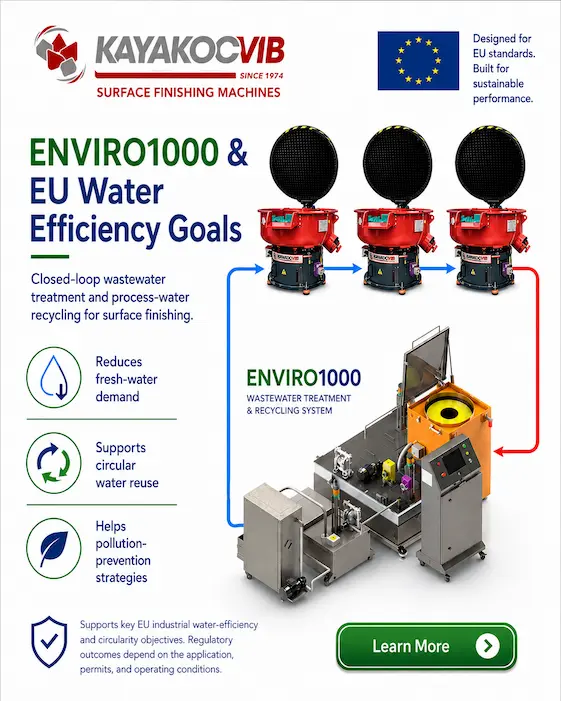
Wastewater from the washing and finishing stages is collected and directed to a wastewater treatment system. Depending on the compound chemistry and local regulations, treatment may involve pH adjustment, coagulation, flocculation, sludge dewatering, and water recycling. Lines operating in high-volume production environments often incorporate closed-loop water recycling to minimize fresh water consumption and reduce effluent disposal cost.
Finishing Machine Selection Within the Line
The finishing machine at the core of the automated deburring line is selected based on part geometry, material, burr characteristics, required surface quality, and production volume. The machine type determines the finishing intensity, cycle time, and part handling method available to the line designer.
Circular vibratory finishing machines are the most common machine type in automated deburring lines for small to medium parts. They provide consistent all-around finishing action, accept high part volumes, and integrate naturally with separators and conveyors. For long or asymmetric parts that do not tumble well in circular machines, trough vibratory machines offer a linear working chamber that accommodates larger part profiles without excessive part-on-part contact.
Centrifugal disc finishing machines are used in automated lines where short cycle times and higher surface quality are required. These machines generate significantly higher finishing forces than vibratory machines, which makes them suitable for precision CNC parts, medical components, and aerospace parts where edge rounding tolerance and surface finish specification are tight. The trade-off is a smaller batch size per cycle and higher sensitivity to part loading variations.
KAYAKOCVIB automation systems are designed to integrate KVM series circular vibratory machines and KSM series centrifugal disc finishing machines with SM series separators, washing units, and DVM series dryers into complete finishing lines. The line architecture can be configured for continuous flow or batch cycling depending on production requirements.
Media and Compound Selection for Deburring Lines
Media and compound selection directly controls finishing intensity, surface quality, and cycle time in any automated deburring line. Selection must be based on part material, burr size, part geometry, and target surface condition.
For steel and stainless steel parts, ceramic media is the standard choice. Ceramic media provides the cutting force necessary to remove burrs from hardened or work-hardened steel edges. For these materials, a deburring and polishing liquid such as a compound in the 943 category is typically used alongside a degreasing compound to maintain clean working conditions inside the machine.
For aluminum, zinc alloy, and softer metal parts, plastic media is generally preferred. Plastic media applies lower cutting force and reduces the risk of surface damage, indentation, or discoloration on softer materials. Aggressive ceramic media on aluminum can cause surface dimpling or excessive material removal on thin-walled areas. The process chemicals for aluminum typically include a compatible deburring and polishing liquid and a degreasing agent suited for non-ferrous metals.
For copper, brass, and yellow metals, compound selection requires care. More acidic degreasing compounds are used to manage surface discoloration and oxide formation. Media shape selection also affects how effectively compound reaches recessed features and internal passages.
Media size must be selected so that media cannot lodge inside holes, slots, or recesses on the part. Media lodging is a significant quality risk in automated lines because lodged media bypasses the separator and can damage downstream equipment or cause part rejection. If lodging risk exists, media geometry should be reviewed before line commissioning.
Process Parameters That Govern Line Performance
An automated deburring line is controlled by a set of process parameters that interact with each other. Adjusting one parameter without considering the others can shift the finishing result away from specification.
| Parameter | Effect on Process | Typical Adjustment Range |
|---|---|---|
| Parts-to-media ratio | Controls finishing intensity and part protection | 1:4 to 1:10 by volume depending on part and media |
| Compound concentration | Controls cutting action, surface brightness, and foam level | Application-dependent, typically diluted in process water |
| Water flow rate | Maintains cleanliness inside working chamber, affects compound distribution | Continuous drip or metered flow |
| Cycle time | Determines finishing depth, edge rounding radius, and surface Ra | Typically 15 minutes to several hours depending on part and target |
| Machine amplitude and frequency | Controls media motion intensity and finishing energy | Set by machine design, limited adjustment via motor and spring configuration |
| Separator screen size | Controls separation reliability | Must be between part minimum dimension and media minimum dimension |
Cycle time in particular requires process validation. Running parts for insufficient time leaves burrs or insufficient edge rounding. Running parts for excessive time can cause over-finishing, dimensional change on thin features, or surface marks from part-on-part contact if the parts-to-media ratio is too high. Actual cycle time for a new application must be determined through sample testing before committing to production settings.
Integration and Automation Control
In a fully automated deburring line, each stage is linked by conveyors, transfer chutes, or robotic handling systems. The control architecture typically uses a PLC-based system that manages timing, part flow, machine states, and fault detection across all stages simultaneously.
Key automation control points in a deburring line include part feed rate regulation, finishing cycle start and end triggers, separator discharge valve timing, wash station flow control, dryer cycle management, and end-of-line part collection. Sensors at critical transfer points detect jams, level overflows, or missing parts and trigger alarms or line stops before rejects accumulate.
For high-volume production environments such as automotive fasteners or CNC machined housings, the line may run continuously with media topped up during operation and compound dosed automatically from metered pumps. For lower-volume mixed-part production, the line may operate in controlled batch cycles where part type, media, and cycle time are recalled from a recipe system for each job.
Surface Quality Validation and Process Control Points
Surface quality in an automated deburring line is validated at the output of the drying stage before parts proceed to downstream operations. Validation typically covers visual inspection for remaining burrs, tactile or profilometer measurement of edge rounding radius, surface roughness measurement where specified, and cleanliness inspection for residue or media fragments.
In regulated industries such as medical device manufacturing or aerospace component production, surface quality records may be required for each production batch. In these cases, automated lines may include integrated inspection stations with vision systems or surface measurement instruments that log results against batch identifiers.
If parts fail visual or dimensional surface quality checks at the output of the line, the root cause investigation should start at the most recently adjusted parameter. Common root causes of inconsistent output include changes in incoming part burr condition, incorrect media top-up, compound dilution drift, separator screen wear, or incorrect cycle timing. Establishing baseline parameter records at initial process validation provides the reference point for troubleshooting any future deviation.
Frequently Asked Questions
What types of parts are best suited for an automated deburring line?
Parts with consistent geometry, moderate burr size, and no features that trap media are well suited for automated deburring lines. CNC machined housings, stamped brackets, fasteners, hydraulic valve bodies, and turned components are common examples. Parts with very deep blind holes, thin flexible walls, or complex internal geometries require careful evaluation before line commissioning.
Can an automated deburring line process mixed materials in the same batch?
Mixing materials such as aluminum and steel in the same finishing batch is generally not recommended. Different materials require different media types and compound chemistry. Mixing can also cause galvanic staining or cross-contamination. Dedicated line recipes for each material group or separate lines for incompatible materials are the standard industrial approach.
How is wastewater managed in an automated deburring line?
Wastewater from the finishing and washing stages contains metal fines, abrasive particles, compound chemistry, and oils removed from the parts. This water must be treated before discharge or recycled back into the process. Treatment systems typically involve sedimentation, chemical precipitation, pH correction, and dewatering. Closed-loop water recycling systems reduce fresh water consumption and lower disposal costs, which is relevant to both environmental compliance and operating cost.
What is the typical commissioning process for a new automated deburring line?
Commissioning starts with sample part testing to validate media selection, compound chemistry, and cycle time for the target surface condition. After sample validation, the line is set up with production parameters and run for a qualification batch. Output parts are inspected against surface quality specifications. Parameter records are documented and locked into the recipe system. Full production release follows after quality confirmation. Actual results depend on application conditions and require sample testing and process validation.
Related Process Equipment
Related Video Demonstration
Conclusion
An automated deburring line delivers consistent edge rounding and surface quality at production volumes that manual or semi-manual finishing cannot match. The engineering decisions that determine line performance are media and compound selection, machine type, process parameter control, separation reliability, and wastewater management. Each stage in the line sequence must be sized and configured for the actual part geometry, material, and production volume rather than derived from a generic line template. For manufacturers evaluating automated deburring line integration, the recommended starting point is sample testing with validated media and compound combinations under representative production conditions before finalizing line layout and control architecture.
Sorry, the comment form is closed at this time.