



29 Jun Deburring Stamped Parts
Deburring stamped parts is one of the most common surface finishing requirements in metal manufacturing. Press-stamped components consistently produce shear burrs, rollover edges, and sharp corners that must be controlled before parts move to assembly, coating, or functional use. Vibratory finishing machines provide a reliable, scalable method for handling these defects across a wide range of stamped materials including steel, stainless steel, and aluminum.
In This Article
Typical Defects on Stamped Metal Parts
Stamping operations create predictable surface defects depending on tool condition, material thickness, and punch-die clearance. The most common defects requiring finishing attention include shear-zone burrs along cut edges, rollover deformation on the punch entry side, sharp corner radii, and minor surface contamination from stamping lubricants or die release agents.
Burr height on stamped steel parts typically ranges from minor feathered edges to heavier mechanical burrs on thicker stock. Aluminum stampings tend to produce softer, more ductile burrs that smear rather than fracture cleanly. Stainless steel stampings often produce harder, springback-prone burrs that resist deformation and require stronger media action to remove effectively.
Understanding burr character before selecting a finishing process is important. A thin feathered burr on a 0.8 mm aluminum bracket requires a very different approach compared to a 2 mm stainless steel bracket with a defined mechanical burr along punched hole edges. Process validation through sample testing is always required before committing to production parameters.
How Vibratory Finishing Works for Stamped Components
Vibratory finishing machines use a vibrating bowl or trough filled with abrasive or non-abrasive media and process compound. The vibration generates a toroidal or helical mass flow inside the working chamber. Parts placed in the media load move with the mass, continuously contacting media surfaces at controlled angles and frequencies. This relative motion between media and part surfaces produces deburring, edge rounding, and surface smoothing effects without part-to-part contact damage.
The intensity of the finishing action is controlled primarily by vibration amplitude, frequency, media fill level, and compound concentration. Higher amplitude and harder media produce more aggressive cutting action, which is appropriate for steel or stainless steel stampings with defined burrs. Lower amplitude and softer plastic media produce gentler action suitable for thin aluminum stampings or parts with tight dimensional tolerances.
Unlike manual deburring or belt finishing, vibratory finishing treats all exposed surfaces simultaneously. Punched holes, formed features, and stamped contours all receive media contact without operator intervention, making the process inherently consistent across large production batches.
Machine Selection for Stamped Part Applications
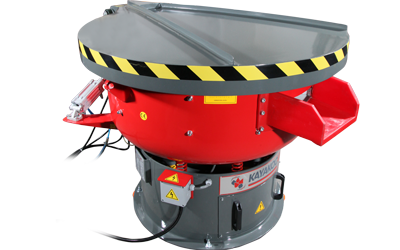
Machine type selection depends on part geometry, part size, material, production volume, and automation requirements. For most stamped parts in small to medium size ranges, circular vibratory finishing machines are the standard choice. A circular machine such as the KAYAKOCVIB KVM series provides continuous part flow, good media-to-part mass ratio control, and straightforward integration with downstream separation and drying equipment.
Trough vibratory finishing machines, such as the KAYAKOCVIB TVM series, are better suited for longer stamped components such as brackets, rails, or structural stampings that do not tumble freely in a circular bowl. Trough machines maintain part orientation more consistently and reduce the risk of part damage during finishing.
| Part Characteristic | Recommended Machine Type | Reason |
|---|---|---|
| Small to medium stampings, mixed geometry | Circular vibratory (KVM) | Good mass flow, high throughput, easy media management |
| Long or flat stampings, rails, brackets | Trough vibratory (TVM) | Controlled part orientation, reduced impact risk |
| Thin or delicate stampings | Circular vibratory with reduced amplitude | Lower energy input prevents distortion |
| High-volume small fastener stampings | Circular vibratory with separator output | Continuous batch throughput, automated separation |
Machine bowl capacity should be matched to part size and required batch volume. Overloading the bowl reduces finishing uniformity. Underloading reduces part-media contact efficiency. A typical media-to-part volume ratio in vibratory finishing falls between 3:1 and 5:1 depending on part geometry and target surface condition, though this should be confirmed during process trials.
Media Selection Based on Material and Burr Condition
Media selection is the most important variable in vibratory deburring of stamped parts. The wrong media choice produces either insufficient burr removal or surface damage, making material compatibility the starting point for any process design.
For steel and stainless steel stampings, ceramic media is the standard choice. Ceramic media provides the cutting hardness needed to fracture and remove mechanical burrs on harder metals. Ceramic media is available in multiple shapes including triangle, cylinder, cone, and star, each suited to different part geometries. Triangular and cylindrical shapes provide good access to punched holes and formed corners on typical steel stampings.
For aluminum stampings, plastic media is generally preferred because aluminum is a softer metal more susceptible to surface scratching and edge distortion from aggressive ceramic contact. Plastic media produces lighter cutting action and surface refinement without removing excessive material or deforming thin features.
Mixed metal loads, such as aluminum and steel stampings processed together, should be avoided. The harder steel parts act as additional cutting elements against the aluminum surfaces, producing unpredictable surface damage. Each material should be processed in a dedicated batch with matched media.
Media size must also be selected to prevent lodging inside punched holes, slots, or formed features. Media should be dimensionally larger than the smallest hole or slot on the part to prevent entrapment. When parts contain multiple feature sizes, media selection should target the most restrictive geometry.
Process Compound Selection and Function
Process compounds serve multiple functions in vibratory finishing: lubricating the media-part interface, controlling pH to protect part surfaces, suspending swarf and abraded particles, and providing mild cleaning action to remove stamping lubricants. Compound selection depends on the base material and surface condition requirements.
For steel stampings, a deburring and polishing liquid such as compound type 943 is commonly used. It provides alkaline conditions that protect steel from flash rusting during the wet process while supporting cutting action. A degreasing additive such as 028-S can be included when parts carry significant stamping oil residue that must be removed before downstream coating or assembly.
For aluminum stampings, compound type 085 is typically used because it is formulated for non-ferrous metals and does not cause surface staining or chemical attack on aluminum. When heavier scale, oxide, or contamination is present on non-ferrous parts, compound 028 may also be considered for its cleaning capacity.
Compound dosing rates and water flow rates must be controlled throughout the process cycle. Insufficient compound concentration leads to media glazing, reduced cutting efficiency, and part staining. Excessive compound concentration may produce foam, reduce media-part contact, or create wastewater treatment challenges downstream.
Process Parameters and Cycle Time Variables
Deburring stamped parts in a vibratory machine requires control of several interdependent process parameters. Adjusting any one variable affects the overall finishing result, so parameters should be optimized systematically during process development rather than changed simultaneously.
- Vibration amplitude: Controls the energy input and relative velocity between media and parts. Higher amplitude increases cutting rate but also increases impact energy, which may cause part-on-part collision damage in sensitive stampings.
- Vibration frequency: Typically fixed by machine design, but some machines allow adjustment. Higher frequency generally increases throughput of small parts.
- Media fill level: Determines the mass of the working charge and influences the toroidal flow pattern. Insufficient fill reduces part immersion and finishing uniformity.
- Compound flow rate: Controls lubrication, pH, and swarf removal. Must be matched to media consumption rate and part soil load.
- Water flow rate: Affects compound dilution and slurry consistency inside the bowl. Too much water dilutes compound excessively; too little causes media clogging.
- Cycle time: Determined by burr severity, media type, and required edge radius. Typical deburring cycles for stamped steel parts range from 20 to 60 minutes in most applications, but this varies significantly with burr size, media abrasivity, and required surface condition. Actual cycle time must be confirmed by sample testing.
Separation, Washing, and Drying After Finishing
After the finishing cycle, parts must be separated from media before washing and drying. Vibratory machines can be equipped with integrated separation screens or connected to standalone separator units. The separator screen aperture must be sized to pass parts cleanly while retaining all media shapes used in the process.
Wet-finished stamped parts typically carry compound residue, swarf, and fine particles on their surfaces after separation. For parts destined for painting, powder coating, plating, or assembly, a wash stage is required to remove this residue. Depending on cleanliness requirements, this may involve a rinse stage integrated with the separator output, a pressure washing system, or an ultrasonic cleaning stage for parts with complex geometries or inaccessible features.
Drying is required before storage or downstream processing to prevent flash rusting on steel parts and water spotting on aluminum. Vibratory dryers using warm air and drying media chips are commonly used after wet vibratory finishing. For high-volume stamped part lines, dryer capacity must be matched to the finishing machine output to avoid creating a production bottleneck.
Quality Control and Surface Inspection Points
Quality control for deburring stamped parts should be structured around the specific rejection criteria relevant to the downstream application. Visual inspection under controlled lighting is the minimum requirement. For functional parts, tactile inspection of critical edges using a profilometer, burr height gauge, or structured light scanner may be required to confirm edge condition meets drawing specifications.
Key inspection points include shear-zone edges along cut profiles, punched hole entry and exit edges, formed corner radii, and any surface condition requirements related to coating adhesion or functional contact. Surface roughness is typically not a primary specification for deburring operations, but stamping lubricant removal should be verified when parts proceed to coating.
Process consistency depends on maintaining stable media condition throughout the production run. Media wears progressively during use, losing cutting abrasivity and changing shape. Regular media top-up schedules and periodic inspection of media condition are part of a controlled finishing process. Changes in media condition will affect cycle time and surface result if not compensated.
Automation Integration for High-Volume Stamped Part Production
For stamping lines producing high part volumes, vibratory finishing can be integrated into a continuous or semi-continuous production flow. Automated part loading using belt conveyors or vibratory feeders eliminates manual handling. Timed compound dosing systems control compound delivery without operator intervention. Automated separation and transfer systems move parts from the finishing machine to washing and drying without manual contact.
In fully automated finishing lines, the finishing machine, separator, washer, and dryer are connected with transfer conveyors and controlled by a central PLC or SCADA system. This configuration supports consistent cycle control, compound management, and production logging. For manufacturers producing multiple stamped part families, programmable process recipes allow rapid changeover between part types with different media, compound, and cycle time requirements.
Wastewater generated by wet vibratory finishing contains suspended solids, swarf, compound residue, and process water. Discharge without treatment is typically not compliant with industrial wastewater regulations. Compact wastewater treatment systems can be integrated into the finishing line to separate solids, neutralize pH, and recycle process water where feasible, reducing water consumption and disposal costs.
Frequently Asked Questions
Can vibratory finishing remove heavy burrs from thick steel stampings?
Vibratory finishing with aggressive ceramic media can remove light to medium mechanical burrs on steel stampings. Very heavy burrs resulting from worn tooling or large punch-die clearance may require pre-trimming or a two-stage process combining coarser media followed by a finishing stage. The practical burr height limit for vibratory deburring depends on media type, cycle time, and required edge condition, and must be established through sample testing.
What media shape works best for stampings with punched holes?
Triangular and cylindrical ceramic media shapes provide good penetration into punched holes and formed slots on steel stampings. The media size must be selected to prevent lodging. For very small holes, media with a minimum dimension clearly larger than the hole diameter should be specified. If lodging risk is unavoidable due to part geometry, trough-type finishing with controlled part orientation may reduce the problem.
How do I prevent part-on-part collision damage during vibratory finishing?
Part-on-part collision is controlled by maintaining an adequate media-to-part volume ratio. Higher media-to-part ratios keep parts separated within the media mass. For thin or delicate stampings, reducing vibration amplitude and increasing media fill level also reduces collision energy. In severe cases, processing parts in net or fixture carriers prevents direct part contact while allowing media access to surfaces.
Is vibratory finishing suitable for stainless steel stampings?
Vibratory finishing is widely used for deburring stainless steel stampings in the food processing, medical equipment, and general industrial sectors. Stainless steel burrs are harder and more springback-prone than mild steel burrs, so more aggressive ceramic media and longer cycle times are typically required. Passivation requirements, if applicable, must be addressed in a separate chemical process stage after finishing.
Related Process Equipment
Related Video Demonstration
Conclusion
Deburring stamped parts with vibratory finishing machines is a technically sound and scalable solution for removing shear burrs, rounding edges, and improving surface condition on press-formed components. Effective results depend on selecting the correct machine type for part geometry and production volume, matching media material and shape to the base metal and burr character, and controlling process parameters throughout the finishing cycle. Steel and stainless steel stampings typically require ceramic media and alkaline compounds, while aluminum stampings require plastic media and material-compatible chemistry. Separation, washing, and drying stages must be planned as part of the complete process route, not added as afterthoughts. All process parameters, including cycle time, media fill, and compound dosing, should be validated through sample testing before releasing the process to full production.
Sorry, the comment form is closed at this time.