



25 Jun Surface Finishing for CNC Machined Parts
Surface finishing for CNC machined parts is a production-critical step that removes machining burrs, improves edge condition, and refines surface texture to meet functional and aesthetic requirements. CNC turning, milling, and drilling operations leave characteristic tool marks, sharp edges, and micro-burrs that must be addressed before parts move to coating, assembly, or inspection. Selecting the right finishing process depends on the part material, geometry, burr size, required surface quality, and production volume.
In This Article
Typical Surface Conditions After CNC Machining
CNC machined parts arrive at the finishing stage with a range of surface defects depending on the cutting tool condition, feed rate, material, and part geometry. The most common defects include thread burrs, cross-hole intersection burrs, sharp edge transitions, tool path witness marks, and surface roughness left by the final machining pass.
Steel and stainless steel parts typically carry harder and more tenacious burrs that require stronger cutting media. Aluminum parts tend to have softer, more irregular burrs but are more sensitive to surface damage and aggressive media action. Mixed-metal batches require particular attention because media and compound selection for one material may be incompatible with another.
Understanding the incoming surface condition is the starting point for any finishing process decision. Burr height, edge geometry, surface Ra target, and part fragility all influence whether vibratory or centrifugal disc finishing is the appropriate method.
Recommended Process Route for CNC Machined Parts
A practical finishing process route for CNC machined parts typically follows this sequence: pre-cleaning or chip removal if needed, wet mass finishing for deburring and edge rounding, part-media separation, washing, and drying. Depending on the application, a second-stage polishing or burnishing step may follow the primary deburring cycle.
Pre-cleaning is relevant when parts carry cutting oil, coolant residue, or loose chips that could interfere with the finishing compound or contaminate the media charge. In high-volume production, parts often go directly into the finishing machine when the compound provides sufficient degreasing action during the process.
Wet finishing with an appropriate liquid compound is standard for most CNC machined parts. The compound controls lubrication, cleaning, corrosion inhibition, and compound buildup. After finishing, parts are separated from media using a separation screen or a dedicated separator machine, then washed and dried before the next production step.
Machine Selection for CNC Machined Parts
The two primary machine types used for surface finishing CNC machined parts in industrial production are circular vibratory finishing machines and centrifugal disc finishing machines. Each has a different working principle and is suitable for different part profiles.
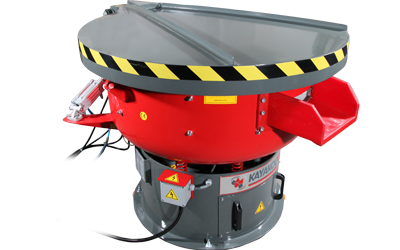
Circular vibratory finishing machines use an unbalanced drive motor to generate three-dimensional vibratory motion in a toroidal bowl. Parts and media circulate continuously through this motion, producing uniform deburring and edge rounding. These machines are well suited for medium to high production volumes, mixed part batches, and parts where gentle-to-moderate finishing intensity is required. The KAYAKOCVIB KVM series operates on this principle and is widely used for steel, stainless steel, and aluminum CNC parts across automotive, general engineering, and industrial component applications.
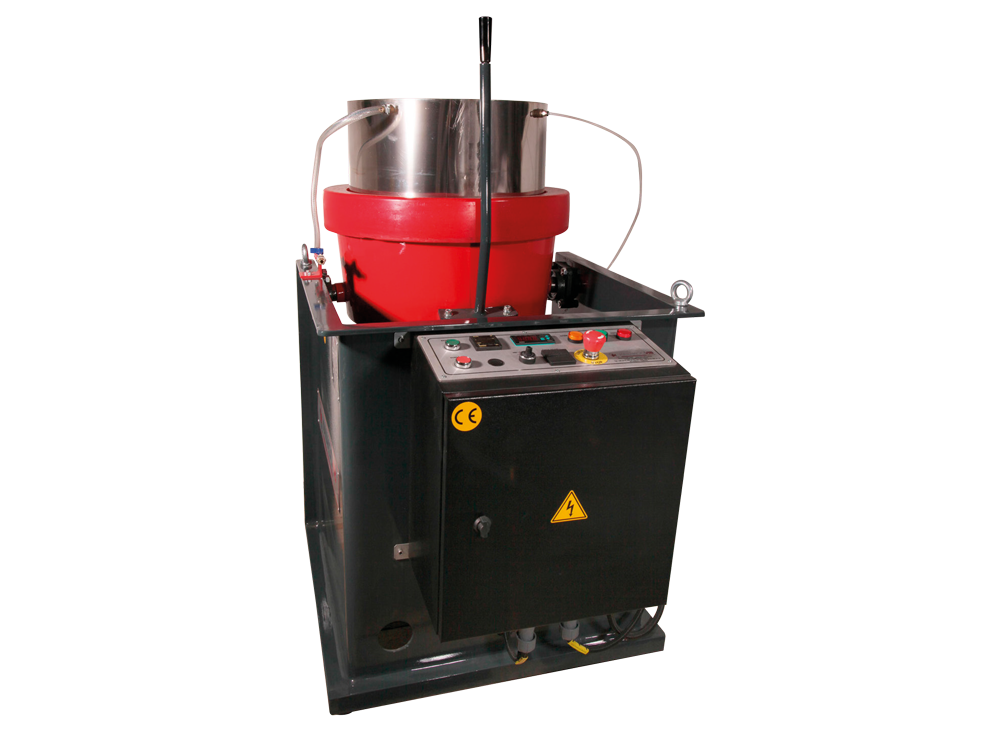
Centrifugal disc finishing machines use a high-speed rotating disc at the base of a stationary ring container. The disc drives a fast, dense media flow across the parts, producing significantly higher finishing intensity than vibratory machines within a shorter cycle time. The KAYAKOCVIB KSM series is suited for small high-precision CNC parts where short cycle times, controlled edge rounding, or fine surface refinement are required. Typical applications include small turned parts, precision connectors, hydraulic components, and medical-grade machined components where surface quality requirements are strict.
| Machine Type | Working Principle | Suitable Part Size | Finishing Intensity | Typical CNC Application |
|---|---|---|---|---|
| KVM Circular Vibratory | Vibratory toroidal flow | Small to medium | Gentle to moderate | General CNC parts, mixed batches, steel and aluminum |
| KSM Centrifugal Disc | High-speed disc drive | Small to medium precision | High intensity, short cycle | Precision turned parts, tight tolerances, high surface quality |
Media and Compound Selection
Media and compound selection directly determines the finishing result. For surface finishing CNC machined parts, the media choice must be matched to the base material, burr hardness, and target surface condition.
For steel and stainless steel CNC parts, ceramic media is the standard choice. Ceramic media provides the cutting action needed to remove hard machining burrs and refine the surface texture. Typical process chemicals for steel parts include a deburring and polishing compound such as a formulation equivalent to 943 series liquid, combined with a degreasing agent to manage machining oil and coolant residue.
For aluminum CNC parts, plastic media is generally preferred. Plastic media is softer and less aggressive, which reduces the risk of surface damage, bruising, or smearing on aluminum surfaces. Typical compounds for aluminum include a mild deburring and polishing liquid and a dedicated degreasing compound. Using ceramic media on aluminum is generally not recommended unless very aggressive cutting is specifically required and has been validated through sample testing.
Media shape selection also affects finishing results. Angle-cut cylinders and tristar shapes are commonly used for general deburring because their geometry creates contact across flat surfaces and edge intersections. Cones and pyramids are preferred when thread deburring or access to complex internal geometries is required. Media size must be selected to prevent lodging in holes, slots, or recesses on the part.
Process Parameters That Influence Surface Quality
Several process parameters directly control the surface quality outcome in mass finishing of CNC machined parts. These include machine amplitude and frequency, media-to-part load ratio, compound concentration, water flow rate, and cycle time.
In circular vibratory machines, the amplitude setting controls the intensity of the media-part interaction. Higher amplitude increases cutting action and reduces cycle time but may increase the risk of part-on-part contact damage in mixed batches. For delicate or thin-walled CNC parts, reduced amplitude combined with a protective media charge is often necessary.
The media-to-part ratio affects both finishing uniformity and part protection. A higher proportion of media relative to parts reduces part-on-part contact and produces more consistent surface results. Typical ratios in vibratory finishing range from approximately 3:1 to 6:1 by volume, depending on part geometry and sensitivity, but the correct ratio for a specific application requires validation through process testing.
Compound concentration and water flow rate control the chemical environment inside the machine. Insufficient compound can lead to surface staining, media glazing, or inadequate degreasing. Excessive compound concentration may reduce media cutting action by over-lubricating the media surface. Consistent compound dosing through a metered pump system is recommended in production environments to maintain process stability.
Cycle time must be validated empirically. For CNC parts with moderate machining burrs and a target surface Ra improvement, typical vibratory finishing cycles range from 20 to 90 minutes depending on media type, part material, burr severity, and machine settings. Centrifugal disc machines achieve comparable results in significantly shorter cycles due to higher finishing intensity. These figures are application-dependent and must be confirmed through sample finishing trials before production release.
Washing and Drying After Finishing
After the finishing cycle and part-media separation, CNC parts typically require washing to remove compound residue, media fines, and any remaining machining contamination. Depending on the cleanliness requirement, this may be accomplished through a rinsing stage integrated into the separator, a dedicated pressure washing system, or an ultrasonic cleaning system for parts with complex internal channels or precision surfaces.
Drying is required to prevent flash corrosion on steel parts and water spotting on aluminum or polished surfaces. Vibratory drying machines, such as the KAYAKOCVIB DVM series circular dryers, use heated dry media to absorb surface moisture from parts after washing. Trough-type dryers are available for longer components. Parts must reach a fully dry condition before coating, storage, or assembly.
Production Line Integration and Automation
In high-volume CNC machining environments, surface finishing is typically integrated into a semi-automated or fully automated production line. Automated systems can include vibratory finishing machines with timed process controllers, automatic compound dosing units, integrated separator screens, conveyor or bucket elevator systems for part handling, washing stations, and dryers connected in a continuous flow.
Wastewater generated by the wet finishing and washing stages must be managed in compliance with local discharge regulations. Continuous compound dosing and water flow generate wastewater containing oils, metallic fines, and chemical residues. Wastewater treatment and recycling systems allow compound water to be partially recirculated, reducing water consumption and waste disposal costs. The specific system requirements depend on production volume, compound chemistry, and local environmental regulations.
Automation level selection depends on production volume, part variety, and available floor space. For high-mix low-volume CNC shops, semi-automated batch finishing with manual loading is often the practical choice. For high-volume dedicated part families, fully automated lines with robotic loading, automatic separation, and inline washing and drying deliver consistent cycle repeatability.
Quality Control and Inspection Points
Surface quality after finishing should be validated against the part specification before production release. Key inspection points for CNC machined parts include visual burr inspection under appropriate lighting, edge condition assessment using magnification where tolerances are tight, surface roughness measurement using a contact profilometer, and dimensional checks on critical features to confirm that material removal has remained within tolerance.
For medical and aerospace CNC components, additional inspection steps may include particle counting, cleanliness verification, and documentation of finishing parameters as part of process traceability requirements. These requirements must be defined at the design and process planning stage, not after finishing has already been completed.
Process validation through initial sample finishing is strongly recommended before committing to production parameters. Media type, compound, cycle time, and machine settings should be fixed after a validated sample trial, and any subsequent production changes should trigger re-validation.
Frequently Asked Questions
What finishing process is most suitable for small precision CNC turned parts?
For small high-precision CNC turned parts requiring short cycle times and controlled edge rounding, centrifugal disc finishing is generally more suitable than vibratory finishing. The higher finishing intensity produces consistent results faster and is well suited to tight tolerance components where media-to-part contact must be carefully controlled.
Can aluminum and steel CNC parts be finished in the same batch?
Mixing aluminum and steel CNC parts in the same finishing batch is generally not recommended. Steel and aluminum require different media and compound combinations, and the harder steel parts may damage softer aluminum surfaces during processing. Separate batches with dedicated process parameters are the standard industrial practice.
How is the correct media size selected for CNC machined parts with holes and slots?
Media size must be selected so that the smallest media dimension is larger than the smallest hole, slot, or recess on the part. If media can enter a feature, it will lodge during processing and may be difficult or impossible to remove. For parts with small internal features, angular or high-aspect-ratio media shapes that cannot enter the feature are preferred over equidimensional shapes.
What cycle time should be expected for deburring steel CNC parts in a vibratory machine?
Cycle time depends on burr severity, media type, compound concentration, machine amplitude, and the target surface condition. In many industrial applications, deburring cycles for steel CNC parts in circular vibratory machines range from 30 to 60 minutes. Actual cycle time must be determined through sample finishing trials and cannot be guaranteed without process testing.
Related Process Equipment
Related Video Demonstration
Conclusion
Selecting and optimizing the right process for surface finishing CNC machined parts requires a structured approach that begins with understanding the incoming part condition and ends with validated production parameters. Machine type, media selection, compound chemistry, and process settings must be matched to the specific part material, geometry, burr profile, and surface quality target. Circular vibratory finishing is well suited for medium-volume general CNC applications across steel and aluminum, while centrifugal disc finishing offers higher intensity and shorter cycles for small precision components. Both approaches require process validation through sample testing before production release, and integration with washing, drying, and wastewater management stages is essential for a complete and repeatable production line.
Sorry, the comment form is closed at this time.