



23 Jun Vibratory Finishing Sheet Metal
Vibratory finishing sheet metal parts is a well-established mass finishing process used across laser cutting, metal stamping, and general fabrication to remove burrs, round edges, and improve surface condition before downstream operations such as coating, welding, or assembly. Unlike manual deburring, vibratory finishing processes large batches simultaneously with consistent and repeatable results, making it a practical choice for medium to high production volumes where edge quality and surface uniformity are required across every part.
In This Article
Typical Sheet Metal Parts and Their Finishing Requirements
Sheet metal parts processed through vibratory finishing typically include laser cut blanks, stamped brackets, pressed enclosures, formed panels, and punched components. These parts arrive from the cutting or stamping operation with characteristic defects including sharp edges, micro-burrs along cut profiles, heat-affected zones on laser cut edges, and surface contamination such as oils, stamping lubricants, or laser scale.
The finishing objective varies depending on the downstream process. Parts intended for powder coating or painting require a clean, slightly textured surface that promotes adhesion. Parts going into assemblies with human contact require safe, rounded edges. Parts used in precision assemblies may require a specific Ra surface roughness range to control fit and function. In each case, the vibratory process must be configured to address the specific defect condition and target surface quality of the part family.
Material type significantly influences process design. Steel and carbon steel sheet parts typically carry harder burrs and may have oxide or scale on laser-cut edges. Stainless steel parts present work-hardened edges and resist media cutting more than mild steel. Aluminum sheet parts are softer and more sensitive to surface marking or over-processing. Mixed metal batches, for example aluminum panels alongside steel brackets, should generally be avoided in a single finishing cycle because different materials respond differently to the same media and process intensity.
How Vibratory Finishing Works for Sheet Profiles
In a vibratory finishing machine, parts and media are loaded together into a processing bowl or trough. An eccentric vibrating motor creates controlled multi-directional motion that causes the entire mass of parts and media to rotate and circulate continuously. This relative motion between media and part surfaces produces the cutting, burnishing, or polishing action depending on media type, compound chemistry, and process parameters.
For sheet metal parts, the process generates consistent sliding contact between media faces and part edges. This contact progressively removes the burr material and radially rounds the edge profile. The degree of edge rounding depends on process duration, media aggressiveness, vibration amplitude, and part-to-media ratio. Surface finishing action also occurs across flat faces, though the intensity on flat areas is typically lower than on exposed edges and profiles.
One important consideration for thin sheet parts is part-on-part contact. If the part-to-media ratio is too high, or if parts are loaded without adequate media separation, flat sheet parts can nest together and receive no finishing action on contact faces. Proper loading ratios, typically with media occupying the majority of bowl volume, are essential to maintain separation and consistent process results.
Machine Selection for Sheet Metal Applications
The two main machine types used for vibratory finishing sheet metal components are circular vibratory finishing machines and trough vibratory finishing machines. Machine selection depends on part geometry, part size, batch volume, and production integration requirements.
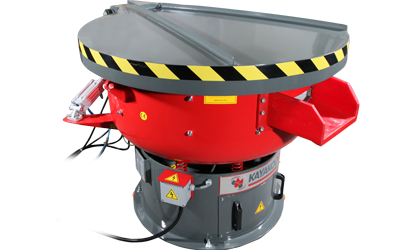
Circular vibratory machines, such as the KAYAKOCVIB KVM series, are well suited to small and medium sheet metal parts such as stamped brackets, laser cut blanks, and punched components where part length does not exceed approximately one-third of the bowl diameter. These machines provide good media circulation and consistent part movement across the full bowl volume. They are available in a wide range of bowl capacities and are commonly used in batch production environments.
Trough vibratory machines are preferred when parts are longer, larger, or when flat panels require careful processing to avoid part collision damage. The elongated processing channel of a trough machine allows long parts to travel through the media mass with reduced risk of end-to-end collisions. For very large sheet metal components, trough machines also allow easier loading and unloading.
| Part Type | Typical Size Range | Recommended Machine | Notes |
|---|---|---|---|
| Stamped brackets and washers | Small to medium | KVM circular vibratory | High batch volume, consistent results |
| Laser cut blanks | Small to medium | KVM circular vibratory | Monitor loading ratio carefully |
| Formed panels and enclosures | Medium to large | TVM trough vibratory | Reduce collision risk on formed surfaces |
| Long cut profiles or strips | Large or elongated | TVM trough vibratory | Prevents end impact damage |
Media Selection for Steel, Stainless Steel, and Aluminum Sheet Parts
Media selection is one of the most influential process decisions in vibratory finishing sheet metal applications. The base material, burr condition, and target surface finish all determine which media type and geometry are appropriate.
For steel and carbon steel sheet parts, ceramic media is the standard choice. Ceramic media provides sufficient cutting action to remove stamping and laser cut burrs efficiently. Ceramic media is available in multiple shapes including triangles, cylinders, stars, and cones. Shape selection is guided by part geometry: angular shapes provide access to internal corners and profiles, while cylindrical or spherical shapes are preferred when surface scratch direction needs to be controlled.
For stainless steel sheet parts, ceramic media with higher alumina content or harder bonding is sometimes selected to overcome the work-hardened edge condition. Process cycle times for stainless steel are typically longer than for mild steel under the same media and machine settings.
For aluminum sheet parts, plastic media is generally preferred. Plastic media is lighter and less aggressive, reducing the risk of surface indentation, micro-scratching, or over-processing on softer aluminum surfaces. Plastic media in conical or star shapes provides effective edge contact without the cutting force of ceramic media.
Media size must also be matched to part geometry. Media that is too large cannot access tight internal profiles. Media that is too small creates lodging risk in holes, slots, and narrow cutouts, which is a common problem with sheet metal parts that have punched apertures. A media size audit against the smallest part feature should be conducted before finalizing media selection for any new part family.
Compound Selection and Process Chemistry
Liquid compounds are used in wet vibratory finishing to provide lubrication, cleaning, and controlled chemical action during the process. Compound selection follows the base material being processed.
For steel and carbon steel sheet parts, a deburring and polishing compound such as a 943-type formulation is typically used alongside a degreasing agent such as 028-S. This combination supports burr removal, surface cleaning, and prevents rust formation during the wet process. Continuous dosing through a metered pump system maintains consistent compound concentration throughout the cycle.
For aluminum sheet parts, an 085-type deburring and polishing compound combined with 028-S degreasing liquid is more appropriate. Aluminum-compatible chemistry prevents surface staining and discoloration that can occur when aggressive alkaline compounds contact aluminum surfaces.
Water flow rate and compound dosing rate should be set according to machine volume and part load. Insufficient compound flow leads to media glazing and reduced cutting performance. Excess compound may cause surface contamination or foaming. Process chemistry should be validated during initial machine trials before committing to production settings.
Process Route for Vibratory Finishing Sheet Metal Parts
A typical production process route for vibratory finishing sheet metal parts follows a defined sequence from part preparation through to post-process handling.
- Pre-inspection: Verify incoming parts for burr condition, surface contamination level, and geometry. Parts with heavy flash, large weld spatter, or significant deformation should be identified and separated before loading.
- Loading: Load parts and media into the vibratory machine at the correct part-to-media ratio. For sheet metal parts, a media fill level of 60 to 80 percent of bowl volume is typical before part addition. Avoid loading parts dry without media buffer.
- Wet processing: Run the vibratory machine with continuous compound and water dosing. Set vibration amplitude and motor eccentric weight to achieve the required media circulation speed. Monitor the process for part separation and media coverage.
- Cycle completion: At cycle end, open the separation gate or tilt the machine to discharge parts and media onto a separator screen. The SM separator divides media from finished parts using screen apertures sized between media and part dimensions.
- Washing: After separation, parts may require rinsing to remove compound residue, media fines, and loose contamination. A pressure washing or spray rinsing stage is commonly integrated after separation for parts with tight cleanliness requirements.
- Drying: Wet parts must be dried before storage or coating operations. Centrifugal dryers or vibratory dryers with drying media or heated air can be used depending on part geometry and production volume.
- Post-inspection: Inspect finished parts for edge condition, surface texture, and absence of media lodging. Sample Ra measurements may be taken for controlled surface finish requirements.
Key Factors Affecting Edge Rounding and Surface Quality
The degree of edge rounding achieved in vibratory finishing sheet metal parts is controlled by several interacting variables. Understanding these variables allows process engineers to adjust results systematically rather than through trial and error.
Vibration amplitude and motor speed determine the energy input to the media mass. Higher amplitude increases media cutting intensity and accelerates material removal, but can also increase the risk of part-on-part contact for thin sheet parts. Lower amplitude produces gentler processing but requires longer cycle times to achieve the same edge condition.
Cycle duration directly controls the cumulative material removal and edge radius development. Longer cycles produce larger edge radii. The required cycle time depends on initial burr height, material hardness, media type, and machine energy level. Target edge radius values should be defined before process development begins, and cycle time should be validated empirically through sample testing.
Part geometry affects media access. Internal corners, narrow slots, and small punched holes receive less media contact than external edges and open profiles. For sheet metal parts with complex internal cutouts, media shape selection becomes critical to ensure consistent finishing action across the full edge profile.
Surface Ra achieved on flat faces of sheet metal parts in vibratory finishing is typically modest compared to the edge improvement. Flat surfaces receive less aggressive media contact than edges and corners. When a significant Ra improvement on flat surfaces is required in addition to edge rounding, a two-stage process using a coarser deburring stage followed by a finer polishing stage may be considered, though actual results depend on material, media, and machine conditions and require process validation.
Production Line Integration and Automation
For medium to high production volumes, vibratory finishing sheet metal operations are commonly integrated into semi-automated or fully automated finishing lines. Automation reduces manual handling, improves process consistency, and eliminates process timing errors that can occur in manual batch operations.
In a typical automated line, parts are loaded into the vibratory machine either manually or via a conveyor or robot feed system. At cycle completion, the machine automatically discharges parts to a separator. The separator divides media and parts, directing parts to a rinsing or washing station and returning media to the machine for the next batch. Drying follows washing, and finished parts exit to a conveyor or collection system for downstream operations.
Compound dosing, water flow, and cycle timing are controlled through a programmable control system, ensuring consistent process parameters across every production batch. Recipe management allows different part families to be processed on the same machine with stored parameter sets, reducing changeover time and setup errors.
For facilities processing multiple sheet metal part families with different materials or finishing requirements, flexible line layouts with recipe-based controls offer significant productivity advantages. However, automation investment should be justified against production volume, part variety, and the cost of manual deburring operations that the line replaces. Actual return on investment depends on application-specific conditions and requires detailed production analysis before investment decisions.
Practical Limitations and Validation Requirements
Vibratory finishing is effective for the majority of sheet metal deburring and edge rounding applications, but has defined limitations that process engineers should account for during process development.
Very thin sheet metal parts, typically below 0.5 mm, require careful process design to prevent deformation from media pressure or part-on-part contact. Plastic media, reduced amplitude, and controlled load ratios are important mitigation measures for thin sheet applications.
Parts with very small punched holes or narrow internal features carry a media lodging risk that must be managed through correct media sizing. A thorough media-to-feature size analysis is mandatory before production release of any new part with internal apertures.
Heavy laser cut dross or large stamping burrs above approximately 0.3 mm may require extended cycle times or a two-stage process to achieve the target edge condition within practical cycle durations. In some cases, preliminary mechanical deburring may be necessary before vibratory finishing.
Mixed metal batches should be avoided. Processing aluminum and steel parts together risks galvanic contamination of aluminum surfaces and inconsistent results due to different material removal rates. Dedicated batches or machine assignments per material type are recommended in production environments handling multiple base materials.
All process parameters including cycle time, amplitude, compound dosing, media type, and loading ratio must be validated through representative sample testing before production release. Documented process validation records support quality assurance requirements in regulated industries.
Frequently Asked Questions
What media should be used for vibratory finishing laser cut steel parts?
Ceramic media is generally recommended for laser cut steel parts because it provides sufficient cutting action to remove hardened edge burrs and laser scale. Media shape should be selected based on part profile complexity, with angular shapes preferred for parts with internal corners or narrow cutouts.
Can aluminum and steel sheet parts be processed together in the same vibratory machine?
Processing aluminum and steel parts in the same batch is not recommended. Ceramic media suitable for steel is too aggressive for aluminum surfaces, and galvanic contamination of aluminum can occur when contact with steel parts or steel fines is present during wet processing. Separate batches or dedicated machines per material type are the standard approach.
How is media lodging prevented in sheet metal parts with punched holes?
Media lodging is prevented by selecting media with a minimum dimension larger than the smallest hole or slot in the part. A conservative media-to-feature size ratio, typically with media at least 1.5 times larger than the critical aperture dimension, is recommended. Media size selection should be verified against part drawings before production trials.
What is the typical cycle time for vibratory finishing sheet metal parts?
Cycle time depends on material type, burr condition, target edge radius, media type, and machine energy level. For mild steel stamped parts with standard burrs, cycle times commonly range from 20 to 60 minutes as an approximate industrial reference. Stainless steel and harder materials typically require longer cycles. Actual cycle times must be confirmed through sample testing and process validation for each specific application.
Related Process Equipment
Related Video Demonstration
Conclusion
Vibratory finishing sheet metal parts provides a reliable and scalable solution for deburring, edge rounding, and surface preparation across laser cut, stamped, and punched components. Process performance depends on a systematic combination of machine selection, media type and geometry, compound chemistry matched to base material, correct loading ratios, and validated process parameters. Circular vibratory machines are well suited to small and medium sheet metal batch production, while trough machines address larger or longer part geometries. Media lodging risk, thin part handling, mixed metal batches, and heavy burr conditions are the primary limitations that require careful process engineering before production release. For any new sheet metal part family, representative sample testing and documented process validation remain the essential steps before committing to production process parameters.
Sorry, the comment form is closed at this time.