



22 Jun Deburring After Thread Rolling
Deburring after thread rolling is a finishing step applied to threaded fasteners to remove the fine burrs, sharp edges, and surface irregularities that remain after the thread rolling operation. Although thread rolling is a cold-forming process that generally produces cleaner thread profiles than thread cutting, residual burrs at part ends, chamfers, and runout zones are common and must be addressed before fasteners enter assembly, coating, or final inspection. This article explains the engineering rationale for post-rolling deburring, the recommended process route, machine and media selection, and practical factory implementation considerations.
In This Article
Why Thread-Rolled Fasteners Still Require Deburring
Thread rolling displaces metal rather than cutting it, which produces stronger threads with better surface integrity compared to tapping or die-cutting. However, the rolling process generates localized deformation at thread run-out zones, part chamfers, and head-to-shank transitions. Flash burrs can form where the rolling dies release the part, and surface smearing or micro-roughness can appear along the shank. In high-volume fastener production using steel, stainless steel, or aluminum blanks, these surface conditions are consistent enough to justify a dedicated deburring step before zinc plating, hot-dip galvanizing, phosphating, anodizing, or polymer coating.
Beyond coating adhesion, burr removal also affects functional performance. A sharp edge or raised burr on a thread run-out can damage sealing surfaces during torque-down, cause galling in stainless steel assemblies, or create stress concentration points in fatigue-sensitive applications such as automotive powertrain fasteners. Deburring after thread rolling is therefore both a surface preparation step and a functional quality requirement.
Typical Parts, Materials, and Surface Conditions
The fastener families most commonly processed after thread rolling include hex bolts, socket head cap screws, flange bolts, studs, threaded rods, and specialty automotive fasteners. The base materials are typically carbon steel, alloy steel, stainless steel grades 304 and 316, and in some cases aluminum alloys for lightweight applications.
The burr profile after thread rolling is generally fine to medium in scale. Unlike stamped or machined parts where burrs can be heavy and directional, thread-rolled fasteners typically present thin flash burrs at thread termination points, slight edge sharpness at chamfers, and surface contamination from rolling lubricants. The deburring process must address edge condition without damaging the thread profile, which means process intensity must be controlled carefully.
Recommended Process Route for Post-Rolling Deburring
The standard industrial process route for deburring after thread rolling in mass production follows this sequence:
- Load threaded fasteners into the vibratory finishing machine together with the selected finishing media and compound solution.
- Run a wet deburring cycle using ceramic media appropriate for the fastener material, with a liquid compound to support cutting action, prevent rust, and keep the machine clean.
- Separate finished parts from media using a screening separator after the deburring cycle is complete.
- Wash parts to remove compound residue, oil, and fine media particles, especially if downstream processes include plating or coating.
- Dry parts using a vibratory dryer loaded with dry hardwood chips or drying granules to prevent surface rust on steel fasteners and ensure parts are clean before storage or further processing.
Each step in this sequence has a direct influence on the final surface condition. Skipping the washing or drying stage can introduce contamination that causes coating adhesion failures or surface staining in downstream processes.
Machine Selection for Fastener Deburring
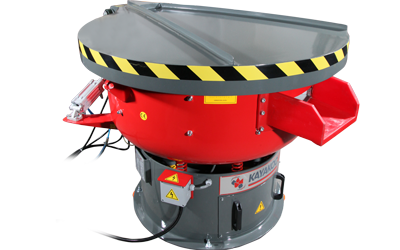
Circular vibratory finishing machines are the standard equipment choice for batch deburring of fasteners. Their toroidal media motion provides uniform part-to-media contact across the entire part surface, including thread flanks, chamfer zones, and head geometry. The circular bowl design also handles high part volumes efficiently, which suits the batch sizes typical in fastener manufacturing.
A circular vibratory machine such as the KAYAKOCVIB KVM series is well suited for this application. The KVM machines operate with adjustable vibration amplitude and frequency, allowing the process engineer to tune cutting intensity based on fastener size, material hardness, and the required edge condition. For smaller fasteners such as M6 to M12 hex bolts, a lower amplitude setting is typically sufficient to achieve clean edge rounding without risk of thread damage. For larger or more heavily burred parts such as M20 to M36 structural bolts, a higher amplitude and longer cycle time may be needed.
The KVM series can also be integrated with separation screens, washing units, and drying systems to create a continuous or semi-automated finishing line, which is relevant for high-volume fastener plants where manual handling between process stages is not practical.
Media and Compound Selection
For steel and alloy steel fasteners, ceramic media is the appropriate choice. Ceramic media provides sufficient cutting action to remove thread run-out burrs and chamfer flash while being dense enough to reach into tight spaces around thread geometry. Typical media shapes for fastener deburring include triangles, cylinders, and cones in sizes ranging from 10 mm to 20 mm, selected to avoid lodging in thread runout zones or hex socket recesses.
For stainless steel fasteners, ceramic media with a medium-cut formulation is preferred. Stainless steel work-hardens under mechanical contact, so process intensity should be monitored to avoid over-processing, which can cause micro-peening or surface smearing rather than clean deburring.
For aluminum fasteners or mixed batches that include softer alloy parts, plastic media with a mild abrasive formulation is more appropriate. Plastic media reduces the risk of surface damage and unwanted material removal on softer materials.
Compound selection follows material logic. For steel fasteners, a deburring and polishing liquid such as a 943-type compound is typically used to support cutting action, prevent surface rust during the wet cycle, and maintain clean machine conditions. For aluminum fasteners, a compound formulated for non-ferrous metals, such as an 085-type deburring liquid, is preferred. A degreasing compound such as 028-S is used when fasteners carry residual thread rolling oil that must be removed before the main deburring stage or before downstream processing.
| Material | Media Type | Compound Type | Notes |
|---|---|---|---|
| Carbon Steel / Alloy Steel | Ceramic, medium cut | 943 deburring liquid + 028-S degreaser | Standard choice for most fastener deburring |
| Stainless Steel | Ceramic, medium cut | 943 deburring liquid | Monitor cycle time to prevent over-processing |
| Aluminum Alloys | Plastic media | 085 deburring liquid + 028-S degreaser | Use lower intensity to protect soft surfaces |
| Mixed Metal Batches | Not recommended | N/A | Separate batches by material to avoid contamination |
Process Parameters and Cycle Control
Process parameters for deburring after thread rolling must be set based on part size, material, burr condition, and required surface quality. The following ranges represent typical starting points for vibratory finishing of fasteners, but actual settings require validation through sample testing before production release.
Vibration amplitude typically ranges from 2 mm to 6 mm depending on part mass and media density. Frequency is generally set between 25 Hz and 50 Hz. Cycle time for standard steel fasteners commonly falls between 20 and 60 minutes for fine to medium burr removal. Water and compound flow rate is adjusted to maintain a wet but not flooded media bed, typically 0.5 to 2 liters per hour depending on machine size and batch weight. Media-to-part ratio by volume is usually set between 3:1 and 6:1, with higher ratios used for complex or delicate part geometries.
Overlong cycle times do not improve results proportionally and can cause thread profile wear on smaller fasteners or surface over-processing on stainless steel. The finishing engineer should establish the minimum effective cycle time through sample validation and surface inspection.
Quality Control and Inspection After Deburring
After the deburring and drying cycle, fasteners must be inspected to confirm that burrs have been removed, thread geometry is undamaged, and surface condition meets downstream process requirements. Visual inspection under directional lighting is the primary method for detecting residual burrs at thread run-out zones and chamfer edges.
Thread gauge inspection using go/no-go gauges should be performed on sample parts from each batch to confirm that vibratory finishing has not altered the effective thread diameter or pitch beyond tolerance. This is particularly relevant for high-precision fasteners such as fine-pitch metric threads or inch series fasteners used in automotive torque-sensitive applications.
Surface roughness measurement is applicable when fasteners are destined for high-performance coating or when the specification requires a defined Ra value on the shank or bearing surface. In most standard fastener applications, visual and thread gauge inspection is sufficient for production release.
Integration into Automated Fastener Finishing Lines
In high-volume fastener plants, deburring after thread rolling is typically integrated into a semi-automated or fully automated finishing line. Parts exit the thread rolling machine, accumulate in a buffer hopper, and are batch-loaded into the vibratory finishing machine at timed intervals. After the deburring cycle, a separator screen or vibratory separator automatically divides parts from media, and parts are transferred by conveyor or chute to the washing unit.
Washing units remove compound residue and fine media particles from part surfaces before parts proceed to plating, phosphating, or coating lines. For plants with environmental compliance requirements, a wastewater treatment and recycling system handles the spent compound water from the washing stage, reducing water consumption and chemical discharge.
Following washing, a vibratory dryer loaded with dry hardwood chips removes surface moisture and provides a final light polishing effect. Dry, clean fasteners exit the dryer ready for coating or packaging inspection. This type of integrated line eliminates manual handling between process stages and supports consistent surface quality across large production volumes.
Limitations and Validation Requirements
Vibratory mass finishing is highly effective for fine to medium burrs on standard fastener geometries, but it has process boundaries that must be acknowledged. Very long threaded rods or specialty fasteners with deep recesses may require a trough-type vibratory machine rather than a circular bowl machine to achieve uniform finishing across the full part length. Parts with very small cross-holes, blind holes, or internal features present a media lodging risk and require careful media size selection and post-process inspection to confirm no media fragments are retained.
Thread rolling burrs that are unusually heavy due to tooling wear or process deviation may not be fully removed within a standard vibratory cycle time. In these cases, the root cause is typically in the thread rolling process itself, and corrective action should focus on tooling maintenance rather than extending the finishing cycle time indefinitely.
All process parameters, media selections, and cycle times stated in this article are indicative. Actual results depend on part geometry, material condition, batch weight, machine configuration, and compound concentration. Process validation through sample testing is required before committing to production parameters.
Frequently Asked Questions
Does vibratory finishing damage thread geometry on fine-pitch fasteners?
When media size, amplitude, and cycle time are correctly set, vibratory finishing does not damage thread geometry on standard or fine-pitch fasteners. Thread gauge inspection on sample parts after initial process validation is recommended to confirm dimensional compliance before full production runs.
Can steel and stainless steel fasteners be finished in the same batch?
Mixing carbon steel and stainless steel fasteners in the same batch is not recommended. Carbon steel particles can embed into stainless steel surfaces during vibratory contact, causing corrosion after finishing. Separate batches by material to maintain surface quality.
Is washing required after vibratory deburring before plating?
Yes. Compound residue, media fines, and residual oils on the fastener surface will interfere with plating adhesion and coating uniformity. Washing with clean water and a neutral rinsing compound is a necessary step between deburring and any electrochemical or chemical surface treatment.
What is the typical cycle time for deburring M10 hex bolts after thread rolling?
Cycle time depends on burr condition, media type, and machine amplitude settings. For fine residual burrs on M10 carbon steel hex bolts, cycle times commonly range from 20 to 40 minutes using ceramic media at medium amplitude. Final cycle time must be confirmed through sample testing for the specific production condition.
Related Machine and Process Resources
Related Video Demonstration
Conclusion
Deburring after thread rolling is an engineering-driven finishing step that directly affects fastener coating adhesion, functional performance, and assembly reliability. The correct process route combines circular vibratory finishing with material-matched ceramic or plastic media, appropriate compound chemistry, and controlled process parameters validated through sample testing. Machine selection, media-to-part ratio, cycle time, and downstream washing and drying stages all contribute to the final surface condition. For high-volume fastener production, integrating deburring, separation, washing, and drying into a semi-automated line provides consistent results and reduces handling-related process variation. Process parameters should always be validated against the specific fastener geometry, material, and downstream coating requirement before production release.
Sorry, the comment form is closed at this time.