



17 Jun Vibratory Dryer Machine
A vibratory dryer machine is a purpose-built industrial unit that removes residual moisture from parts immediately after wet vibratory finishing operations such as deburring, edge rounding, or polishing. In production environments where finished parts must be clean, dry, and ready for downstream operations including inspection, coating, packaging, or assembly, a dedicated drying stage is not optional. Skipping or under-specifying the drying step often results in water staining, flash corrosion on steel parts, or surface contamination that negates the quality achieved during the finishing stage.
In This Article
Why Drying Is a Required Process Stage
Wet vibratory finishing uses water-soluble compounds that clean, lubricate, and chemically assist the deburring or polishing action. When the finishing cycle ends and parts are separated from media, they carry moisture on their surfaces and in recessed areas such as holes, threads, slots, and pockets. This residual moisture contains dissolved compound chemistry, fine abrasive particles, and metallic fines from the finishing process itself.
If parts are left to air dry without a controlled process, evaporation is slow and uneven. Water marks and compound residues deposit on the surface. On steel and stainless steel parts, flash rust can form within minutes in humid shop conditions. On aluminum parts, water spots from compound chemistry can etch the surface and reduce the surface quality achieved during polishing. A vibratory dryer machine controls the drying environment to prevent these outcomes.
How a Vibratory Dryer Machine Works
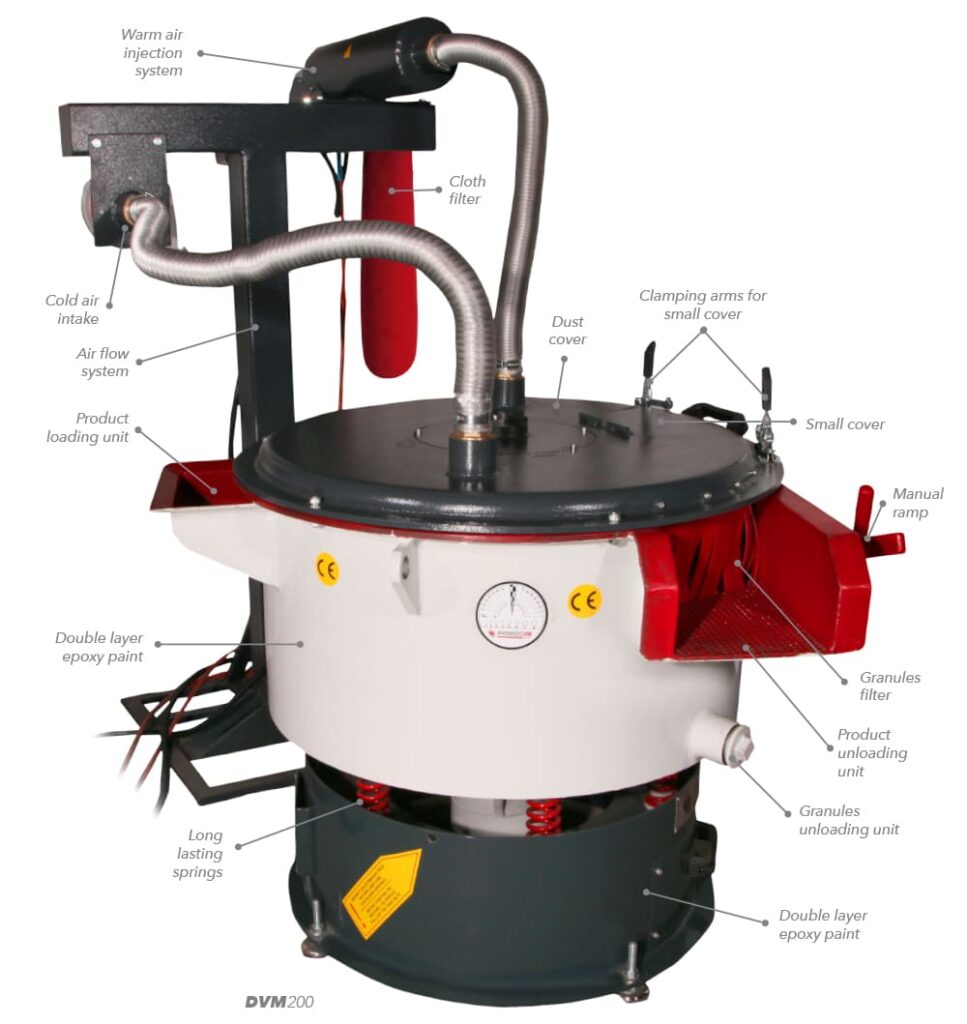
The working principle of a vibratory dryer machine is similar to a vibratory finishing machine but optimized for drying rather than material removal. The machine consists of a bowl or trough made from polyurethane-lined steel, mounted on a spring-mass vibration system driven by an eccentric-weight vibratory motor. Parts and dry drying media, typically corn cob granules or walnut shell granules, are loaded into the bowl together.
The vibratory motion causes the drying media to tumble continuously against the wet part surfaces. The media absorbs moisture mechanically through contact and also promotes air circulation around the parts. In many industrial configurations, heated air is introduced into the bowl from below to accelerate evaporation. The combination of mechanical contact, heat, and airflow dries parts efficiently without mechanical damage.
The corn cob or walnut shell media also performs a light buffing action during drying. This is beneficial for polished parts because it maintains surface brightness and removes any remaining compound film. The media itself must be kept dry between production cycles. Saturated drying media loses its moisture-absorption capacity and must be replaced or dried before reuse.
Process Sequence From Finishing to Dry Output
Understanding where the vibratory dryer machine sits in the production sequence helps engineers design a complete finishing line. The typical process route for wet vibratory finishing followed by drying follows this sequence:
- Parts are loaded into a vibratory finishing machine such as a circular bowl or trough machine together with wet finishing media and process compound diluted in water.
- The finishing cycle runs for the required duration. Deburring, edge rounding, polishing, or surface smoothing is completed during this stage.
- At the end of the finishing cycle, the machine discharges the mix of parts and media onto a separator. The separator screen allows media to pass through and retains parts.
- Separated parts, still wet from the compound solution, are transferred into the vibratory dryer machine. Dry drying media is already loaded in the dryer bowl or is added simultaneously.
- The dryer runs for a defined cycle time, typically ranging from 20 to 60 minutes depending on part geometry, material, and moisture level. Heated air may be applied throughout the cycle.
- After the drying cycle, parts are discharged and separated from the drying media using a second separator or a discharge screen integrated into the dryer.
- Dry, clean parts proceed to inspection, coating, packaging, or assembly as required.
This sequence represents the standard configuration for batch-mode wet finishing with centralized drying. Automated finishing lines may use conveyor-fed separators and continuous-feed dryers to reduce manual handling between stages.
Machine Types and Selection Criteria
Two vibratory dryer machine configurations are commonly used in industrial surface finishing. The selection depends on part geometry and production volume.
Circular bowl dryers are suitable for small to medium parts with compact geometries such as CNC machined components, fasteners, stamped parts, and small castings. The circular motion ensures uniform media contact across all parts in the load. The KAYAKOCVIB DVM series circular vibratory dryer follows this configuration and is designed for integration with vibratory finishing lines processing mixed small to medium part families.
Trough-type dryers are preferred when parts are long, flat, or have geometries that do not tumble well in a circular bowl. Long shafts, rails, extrusions, or large flat stampings benefit from the linear motion pattern of a trough dryer. The KAYAKOCVIB D-TVM trough vibratory dryer addresses this requirement and can be paired with TVM trough finishing machines for consistent line matching.
| Dryer Type | Suitable Parts | Typical Media | Heat Option |
|---|---|---|---|
| Circular bowl dryer | Small to medium compact parts, fasteners, CNC parts, castings | Corn cob, walnut shell | Yes, typically heated air from below |
| Trough dryer | Long parts, flat parts, large components | Corn cob, walnut shell | Yes, heated air distribution along trough length |
Drying Media Selection
The two most common drying media types in industrial vibratory drying are corn cob granules and walnut shell granules. Each has different absorption characteristics and surface interaction properties.
Corn cob granules are highly absorbent and provide gentle surface contact. They are the standard choice for most metal parts including steel, stainless steel, aluminum, and mixed metal batches. Corn cob media is available in different granule sizes. Coarser granules are used when faster drainage is needed. Finer granules provide more surface contact and a lighter buffing effect.
Walnut shell granules are harder and more abrasive than corn cob. They provide a stronger burnishing effect during drying and are used when the part surface requires additional brightness after finishing, particularly for brass, copper, or decorative steel components. Walnut shell media removes surface oxides more aggressively than corn cob, which can be beneficial or detrimental depending on the part requirement.
Media granule size must be selected to prevent lodging in part features such as small holes, internal threads, or narrow slots. If drying media lodges inside a part, it creates a contamination problem downstream. For parts with fine internal features, a coarser granule size or a sieve validation step should be included in the process design.
Process Parameters That Affect Drying Quality
Several parameters control the effectiveness of the vibratory dryer machine and the quality of the dry output. These parameters should be established during process validation and monitored during production.
Drying cycle time depends on the moisture load entering the dryer, the part geometry, the media-to-part ratio, and whether heated air is applied. Compact solid parts with smooth surfaces dry faster than hollow parts, threaded parts, or parts with blind holes that trap water. Cycle time requires validation through testing rather than estimation.
The media-to-part ratio affects drying efficiency. An insufficient media volume reduces the mechanical moisture absorption action and extends drying time. An excessive media volume is wasteful and may not improve performance proportionally. A media-to-part ratio by volume in the range of 2:1 to 4:1 is typical for most industrial applications, but the exact ratio depends on part size and geometry.
Heated air temperature should be controlled carefully. Excessively high drying temperatures can cause thermal oxidation on aluminum surfaces, discoloration on polished stainless steel, or dimensional issues with very thin parts. Moderate heat in the range of 60 to 90 degrees Celsius is typical in heated drying systems, but the appropriate temperature must be confirmed for each material and surface condition.
Media moisture content is a parameter that is sometimes overlooked in production. Drying media absorbs moisture from parts over successive cycles. If media is not periodically dried or replaced, its absorption capacity decreases, drying cycle time increases, and output quality deteriorates. Monitoring media condition is part of routine process maintenance.
Integration With Automated Finishing Lines
In high-volume manufacturing environments, the vibratory dryer machine is integrated into an automated finishing line rather than operated as a standalone manual unit. Automated integration typically includes a part-media separator positioned between the finishing machine discharge and the dryer inlet, a transfer conveyor or chute, a timed dryer cycle controller, and an automatic discharge separator at the dryer outlet.
Automated lines reduce operator handling, improve cycle time consistency, and minimize the time parts spend wet between separation and drying. For materials sensitive to flash corrosion such as uncoated carbon steel or certain cast iron components, minimizing wet dwell time between finishing and drying is important for achieving consistent surface quality.
Washing systems may be inserted between the finishing machine and the dryer when parts require rinsing to remove compound residues before drying. A rinse stage reduces the chemistry load entering the dryer and extends drying media service life. In precision applications for medical or aerospace components, a dedicated rinsing step before drying is often specified as part of the process validation requirements.
Common Process Problems and Correction Logic
Several recurring problems occur in vibratory drying operations when process parameters are not correctly set or maintained.
Water marks on dried parts typically indicate that parts entered the dryer with excess compound solution rather than rinsed water. The compound chemistry deposits residue as moisture evaporates. Adding a rinse stage before drying, or reducing compound concentration in the finishing process, usually resolves this problem.
Incomplete drying after the full cycle often results from saturated drying media, an insufficient media-to-part ratio, or inadequate heat. Checking and replacing media, adjusting the ratio, and verifying the heating system are the standard corrective actions.
Surface scratching during drying can occur if the drying media granule size is too small relative to the part surface, causing sharp media particles to contact soft surfaces under vibratory pressure. Switching to a coarser or softer media grade usually eliminates this issue. For highly polished surfaces or soft aluminum parts, granule size and media hardness selection are especially important.
Media lodging in part features is a part geometry and media size mismatch problem. Using a larger granule size or adding a post-drying sieve or air blow-off step eliminates lodged media from production output.
Frequently Asked Questions
Do all vibratory finishing processes require a dedicated dryer?
Not all applications require a dedicated vibratory dryer machine. For parts that proceed directly to processes tolerant of moisture, such as certain painting or plating lines with integrated cleaning stages, external drying may not be specified. However, for parts going to inspection, assembly, packaging, or quality measurement, controlled drying is generally required to prevent surface contamination and corrosion.
Can the same vibratory machine be used for both finishing and drying?
Using the same vibratory bowl for finishing and drying is not a reliable industrial practice. Wet finishing media and dry drying media cannot be mixed. Finishing machines are designed for wet operation with liquid compound. Drying machines are designed for dry media drying with controlled heat and airflow. A separate dedicated vibratory dryer machine is the correct solution for integrated finishing lines.
How often should drying media be replaced?
Drying media service life depends on production volume, part cleanliness entering the dryer, and whether a rinsing stage precedes drying. Media should be inspected regularly for moisture saturation, odor, and loss of free-flowing granule condition. In high-volume production, media may require replacement or regenerative drying on a weekly or bi-weekly basis. Actual replacement intervals must be determined through process monitoring.
Is heated air always required in a vibratory dryer machine?
Heated air significantly accelerates moisture evaporation and is recommended for most industrial applications. Ambient-temperature drying is possible but slower and may not achieve consistent results for parts with complex geometries or for production environments with high humidity. For materials sensitive to temperature, the heat level must be controlled within a safe range confirmed during process validation.
Conclusion
A vibratory dryer machine is a functional process stage that determines whether the surface quality achieved during deburring or polishing is preserved through to the final output. The drying step controls residual moisture, prevents staining and flash corrosion, and prepares parts for downstream operations. Correct machine selection, appropriate drying media type and granule size, validated cycle parameters, and integration with washing and separation stages are all required to achieve consistent dry output across different part geometries and materials. Process performance depends on application conditions and must be confirmed through sample testing and cycle validation before production release.
Sorry, the comment form is closed at this time.