


17 Jun Plastic Finishing Media for Aluminum
Plastic finishing media for aluminum parts is the standard choice across CNC machining, automotive, aerospace, fastener production, and general manufacturing. Aluminum is a relatively soft and ductile metal, which makes it prone to scratching, smearing, and surface damage when processed with aggressive ceramic media. Plastic media, by contrast, delivers controlled cutting and polishing action suited to the mechanical properties of aluminum alloys, allowing manufacturers to achieve consistent deburring, edge conditioning, and surface improvement without introducing new surface defects.
Why Aluminum Requires a Different Media Approach
Aluminum alloys used in industrial production range from soft wrought alloys such as 6061 and 6063 to harder die-cast alloys such as A380. All of these materials share a common characteristic: they are significantly softer than ferrous metals and more susceptible to surface damage from hard abrasive contact. Ceramic media, which is the standard choice for carbon steel and stainless steel parts, applies a level of cutting force that can leave scratch marks, smearing, or excessive material removal on aluminum surfaces.
Plastic media is formulated with a softer polyester or urea resin base containing fine abrasive particles, typically aluminum oxide or silicon carbide at lower concentrations than ceramic bonded media. This combination provides enough cutting action to remove light burrs, machined witness lines, and tool marks from aluminum surfaces without altering part geometry or creating surface damage. For aluminum castings with heavier flash, plastic media may require longer cycle times than ceramic, and in some cases, pre-trimming of heavy flash is recommended before vibratory finishing.
Typical Aluminum Parts and Common Surface Conditions
The parts most commonly processed with plastic finishing media in aluminum applications include CNC-machined housings, brackets, and connectors; die-cast automotive and electronics components; extruded aluminum profiles with cut edges; stamped aluminum sheet metal parts; fasteners and threaded inserts; and medical device components with tight surface finish tolerances.
Common surface conditions that require attention before or during finishing include sharp machined edges requiring edge rounding, light to medium burrs from milling, drilling, or turning operations, tool marks and feed lines from CNC machining, parting line flash from die casting, and oxide layers or minor surface contamination. Each of these conditions can be addressed with the appropriate plastic media geometry, cut level, and compound selection.
Plastic Media Geometry and Cut Level Selection
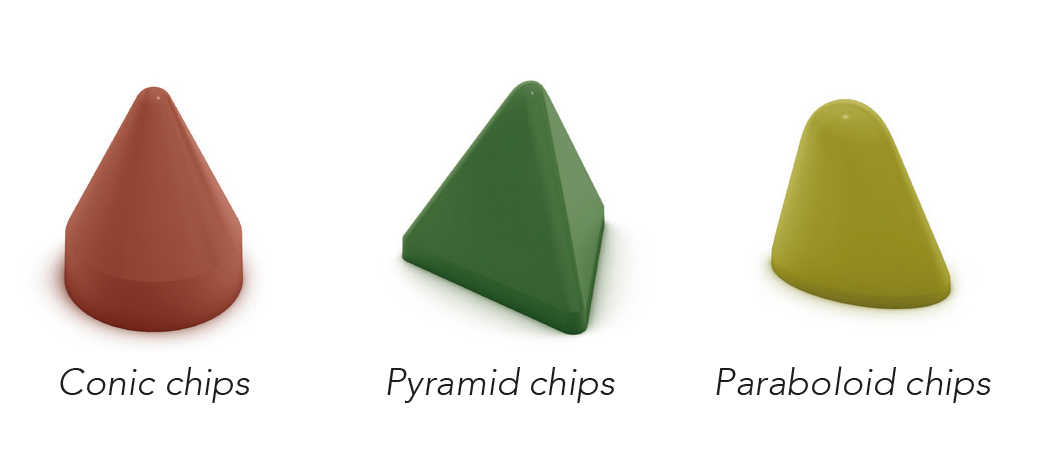
Plastic finishing media is manufactured in a range of geometries and abrasive concentrations to address different finishing requirements. The most common geometries used for aluminum parts include cones, wedges, triangles, cylinders, and angle-cut cylinders. Geometry selection depends primarily on part geometry rather than cut level.
Cones and triangles are widely used for parts with recesses, drilled holes, or complex internal features because the pointed geometry reduces media lodging risk in cavities. Cylinders and angle-cut cylinders are practical for parts with flat surfaces and simple external geometry. Wedge shapes are frequently used for threaded parts or components where access to recessed areas is needed without lodging risk.
Cut level refers to the abrasive concentration in the plastic bonding matrix. For aluminum parts requiring deburring and light edge rounding, a medium-cut plastic media is typically selected. For parts requiring a smoother final surface or pre-polish before anodizing or coating, a fine-cut or non-abrasive burnishing plastic media may be used as a second stage. The correct cut level must be confirmed through sample testing because cut levels vary by media manufacturer and aluminum alloy hardness.
| Application Requirement | Recommended Geometry | Cut Level |
|---|---|---|
| Light deburring, CNC parts | Triangle, Cone | Medium cut |
| Edge rounding, machined parts | Angle-cut cylinder, Wedge | Medium cut |
| Surface smoothing before anodizing | Cylinder, Triangle | Fine cut |
| Parts with holes and recesses | Cone, Triangle | Medium or fine cut |
| Burnishing or pre-polish stage | Cylinder, Cone | Non-abrasive or fine cut |
Compound Selection for Aluminum Finishing
Compound selection is as important as media geometry and cut level in aluminum vibratory finishing. The compound serves multiple functions simultaneously: it maintains the pH of the process water, suspends and flushes cut particles and swarf from the work bowl, keeps media surfaces clean and active, and contributes to the final surface condition of the part.
For aluminum parts processed with plastic finishing media, a neutral to mildly alkaline deburring and polishing liquid is the standard chemical selection. This type of compound supports controlled cutting action, prevents aluminum oxide buildup on both the media and the part surface, and produces a clean, consistent finish. In KAYAKOCVIB finishing practice, compounds such as 085 deburring and polishing liquid are typically paired with plastic media for aluminum applications. A degreasing liquid such as 028-S may be added when parts arrive with cutting oil, coolant contamination, or light grease from machining operations.
Compound dosage and water flow rate must be adjusted to maintain a stable working slurry. Insufficient compound causes media glazing, poor surface finish, and accelerated media wear. Excessive compound can reduce cutting efficiency and leave residues on part surfaces. Dosage rates should be calibrated during process development and monitored during production.
Machine Selection for Aluminum Parts with Plastic Media
The most widely used machine type for plastic finishing media aluminum applications is the circular vibratory finishing machine. Circular vibratory machines generate a toroidal flow motion in the work bowl, which causes media and parts to move in a consistent helical path. This motion produces uniform contact between media and part surfaces, making it suitable for deburring, edge rounding, and surface improvement of aluminum parts across a wide range of sizes and geometries.
For small to medium aluminum parts such as CNC-machined connectors, fasteners, die-cast housings, and stamped brackets, a circular vibratory machine such as the KAYAKOCVIB KVM series provides effective media coverage and part-to-media contact without excessive impact forces that could damage thin-wall features or soft aluminum surfaces. Bowl amplitude and frequency can be adjusted to control process intensity, which is an important capability when processing delicate aluminum parts.
For longer aluminum extrusion segments, large machined housings, or parts that cannot tumble freely in a circular bowl, a trough-type vibratory machine may be preferred. Trough machines orient parts more linearly during processing and reduce the risk of part-to-part impact for elongated components.
Centrifugal disc finishing machines can also process aluminum parts with plastic media when short cycle times and high surface quality are required. The centrifugal disc machine applies significantly higher process intensity than vibratory machines, which reduces cycle time but requires careful media selection, compound management, and load monitoring to avoid part damage on thin-wall or precision aluminum components.
Process Parameters and Cycle Development
Developing a reliable plastic finishing media process for aluminum parts requires systematic parameter control. The main process variables that influence finishing outcome are media fill level, part load ratio, compound dosage, water flow rate, machine amplitude and frequency, and cycle time.
Media fill level in circular vibratory machines is typically set at 80 to 90 percent of bowl volume as a starting point. Reducing the media fill level below this range can cause excessive part-to-part contact and surface damage, particularly for softer aluminum alloys. The part-to-media ratio by volume is an important control point; most aluminum part applications run with a part fraction of 10 to 25 percent of total bowl volume, depending on part size and geometry. Heavy or bulky parts may require a lower part fraction to ensure sufficient media coverage.
Cycle time for plastic media aluminum finishing typically ranges from 20 to 90 minutes for deburring and surface improvement, depending on burr size, required edge radius, and initial surface condition. Pre-polish or fine-finish stages may add an additional 20 to 40 minutes. Actual cycle times require validation through sample testing because they depend on the specific aluminum alloy, media cut level, and surface quality requirement. These ranges are indicative only and should not be used as guaranteed production parameters.
Machine amplitude should be set conservatively for thin-wall or delicate aluminum parts. Higher amplitude increases process intensity and cutting speed but also increases the risk of part-to-part impact damage. A lower amplitude combined with extended cycle time may produce better results for sensitive geometries than a high-intensity short cycle.
Post-Finishing Washing and Drying
After vibratory finishing, aluminum parts require thorough washing to remove finishing compound residues, aluminum swarf, and fine abrasive particles. Residual compound left on part surfaces can interfere with subsequent processes such as anodizing, chromate conversion coating, painting, or adhesive bonding. Parts should be rinsed with clean water immediately after the finishing cycle and washed with a suitable cleaning solution before downstream processing.
Drying is the final step before inspection or downstream processing. Aluminum parts must be dried quickly after washing to prevent water spotting or surface oxidation. Vibratory dryers using dry corncob or walnut shell media are commonly used for small to medium aluminum parts. For longer or larger parts, trough-format dryers may be required. In automated finishing lines, washing, separation, and drying units can be integrated directly with the vibratory finishing machine to reduce handling time and maintain surface quality.
Surface Quality Control and Inspection Points
Quality control after plastic finishing media aluminum processing should include visual inspection for remaining burrs, edge condition, surface uniformity, and any media lodging in holes or recesses. For parts with tight surface finish requirements, surface roughness measurement using a contact profilometer provides a quantitative basis for process validation. Typical Ra values achievable with plastic media on aluminum depend on the initial machined surface, media cut level, compound selection, and cycle time, and must be confirmed through application-specific testing.
Parts intended for anodizing or coating require particular attention to surface cleanliness and the absence of smearing or embedded media particles. If the finishing process introduces any surface contamination, additional cleaning steps may be necessary before surface treatment. Dimensional inspection should be included in the initial process validation to confirm that the finishing cycle does not remove more material than specified.
Media lodging in small holes, slots, or undercuts is a practical risk when processing aluminum parts with complex geometry. Choosing the correct media geometry with a minimum size larger than the smallest hole or slot in the part reduces lodging risk. If lodging occurs, the media geometry, part loading orientation, or machine motion parameters should be reviewed before production release.
Frequently Asked Questions
Can ceramic media be used on aluminum parts?
Ceramic media can be used on aluminum in specific cases, but it is generally not recommended as the standard choice. Ceramic media applies higher cutting force than plastic media and can cause scratching, smearing, or excessive material removal on soft aluminum alloys. If ceramic media is used on aluminum, it should be limited to applications requiring aggressive flash removal, and process validation must confirm that surface quality requirements are met.
What compound should be used with plastic media for aluminum?
A neutral to mildly alkaline deburring and polishing liquid is the standard compound for plastic media aluminum applications. This type of compound maintains media activity, suspends swarf, and produces a clean surface condition. A degreasing liquid such as 028-S may be added when parts arrive with oil or coolant contamination from machining.
How long does a typical plastic media finishing cycle take for aluminum parts?
Cycle times commonly range from 20 to 90 minutes for deburring and surface improvement, depending on burr size, initial surface condition, and required finish quality. These are indicative ranges only. Actual cycle time must be confirmed through sample testing and process validation for each specific part and application.
Is plastic finishing media suitable for anodizing preparation?
Yes, plastic finishing media is commonly used to prepare aluminum parts for anodizing by removing machined tool marks, light burrs, and surface irregularities. The finishing process must be followed by thorough washing to remove all compound and swarf residues before anodizing, as surface contamination can cause anodizing defects.
Conclusion
Plastic finishing media for aluminum parts is the technically correct and industrially validated choice for deburring, edge conditioning, and surface improvement of aluminum components across CNC machining, automotive, aerospace, fastener, and medical manufacturing applications. The softer abrasive action of plastic media matches the mechanical properties of aluminum alloys, reducing the risk of surface damage that would result from ceramic media. Successful implementation depends on selecting the right media geometry and cut level for the part, pairing it with an appropriate compound, controlling process parameters through systematic development, and validating the result through sample testing before production release. Post-finishing washing and drying are essential steps that protect surface quality and prepare aluminum parts for downstream coating, anodizing, or assembly operations.
Sorry, the comment form is closed at this time.