


16 Jun Steel Burnishing Media
Steel burnishing media is widely used in mass finishing operations where the objective is not aggressive material removal but rather surface densification, brightening, and smoothness improvement. Unlike ceramic or plastic abrasive media, steel media produces its effect through mechanical pressure and cold working of the part surface, making it the preferred choice for applications that demand a polished, reflective, or work-hardened finish on metal components. This article explains the engineering principles behind burnishing with steel media, the process variables that control the result, and the industrial contexts where this approach is technically justified.
In This Article
What Burnishing with Steel Media Actually Does
Burnishing is a non-abrasive or minimally abrasive finishing process. When steel media contacts a metal part surface, it applies compressive force that plastically deforms surface micro-asperities rather than cutting them away. The result is a smoother, denser, and often more reflective surface with improved mechanical properties at the surface layer.
This is fundamentally different from deburring or surface grinding. Burnishing does not remove material in the conventional sense. Instead, it redistributes and compresses the surface peaks into valleys, reducing surface roughness through plastic flow rather than abrasion. This distinction is important for engineers selecting a finishing process because burnishing improves surface finish without dimensional loss and can also introduce compressive residual stress, which has well-documented benefits for fatigue life.
Types of Steel Media Used in Burnishing
Steel burnishing media is produced in several geometric forms, and the selection of shape affects the contact dynamics and the resulting surface finish. The most common forms encountered in industrial mass finishing are as follows.
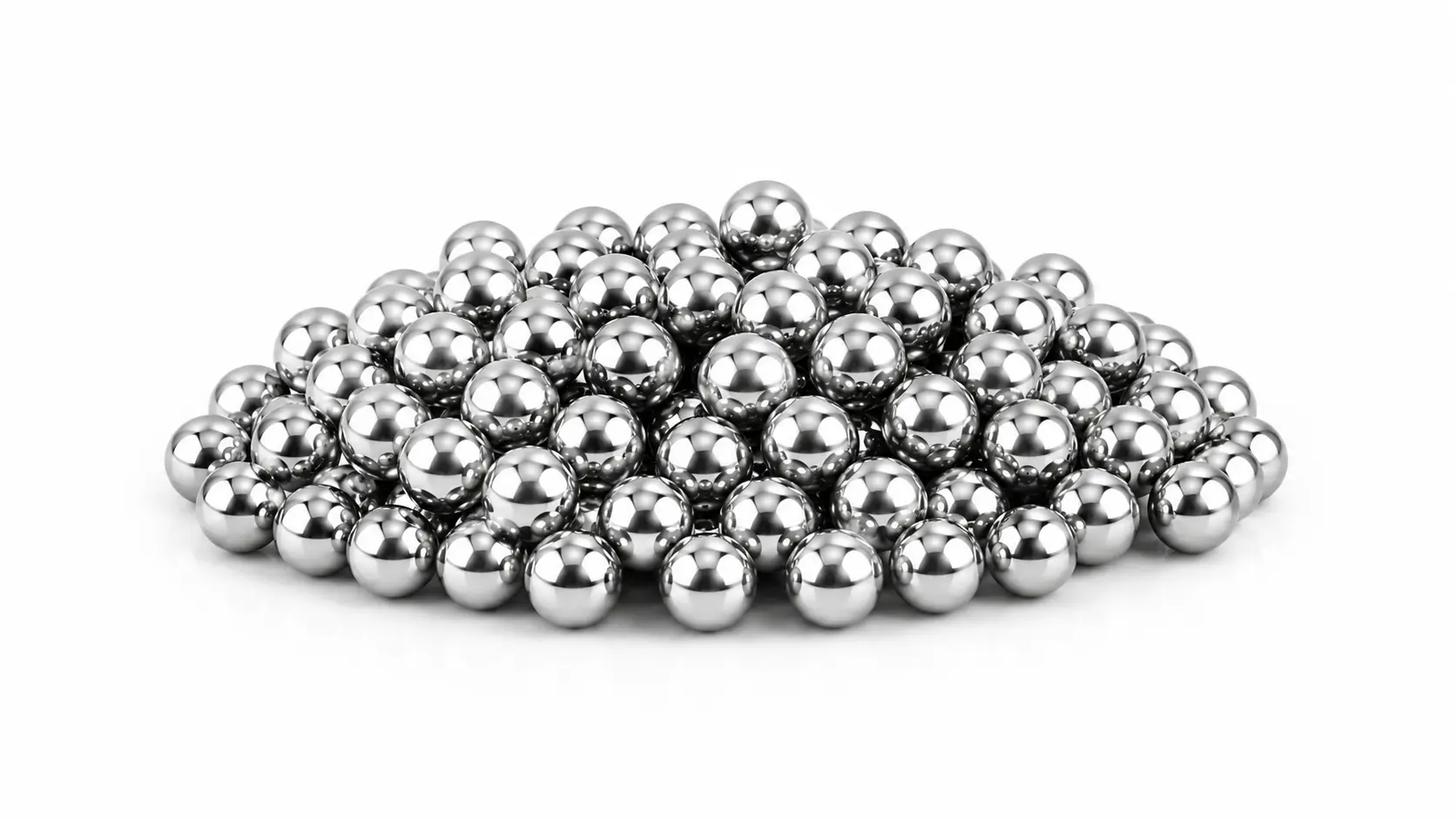
- Steel balls: The most common burnishing media shape. Balls produce uniform contact with curved and flat surfaces and are widely used for high-gloss finishing of small precision parts, fasteners, and bearing components.
- Steel pins and cylinders: These provide line contact rather than point contact and are effective for reaching into recessed areas, threaded features, and cross-holes. Pin media is frequently used for fasteners and small CNC-machined components.
- Steel satellites and cones: Less common, but used when specific contact geometry is required for part features such as chamfers or internal radii.
Media diameter and length are selected based on part geometry to prevent lodging in holes, channels, or recesses. A general engineering rule is that the smallest media dimension should be larger than the smallest feature opening on the part. Media sizing must be validated for each part before production runs begin.
How the Burnishing Process Works in a Vibratory Machine
In a circular vibratory finishing machine, the working bowl is driven by an imbalanced motor that creates three-dimensional vibratory motion. The media and parts move in a toroidal circulation pattern, continuously contacting each other at controlled energy levels. When steel burnishing media is loaded into the machine alongside the parts, the repeated sliding and rolling contact between media and part surface produces the burnishing effect.
The energy of each contact event is controlled by vibratory amplitude and frequency. For burnishing, lower-to-medium amplitude settings are typically more appropriate than the high-amplitude settings used for aggressive deburring. Excessive energy can cause surface marking or part-on-part contact, which may produce unwanted indentations rather than a smooth burnished surface.
A circular vibratory machine such as the KAYAKOCVIB KVM series is a common platform for steel media burnishing because it handles batch processing of small to medium parts efficiently, provides controlled media circulation, and allows precise adjustment of process intensity. The machine’s separation system allows parts to be discharged from the media at the end of the cycle, typically through a built-in separation screen or an external separator.
Process Parameters That Govern Surface Quality
The surface outcome from steel burnishing media depends on several interacting variables. Understanding and controlling these parameters is essential for process repeatability.
| Parameter | Typical Range or Condition | Engineering Note |
|---|---|---|
| Media type | Steel balls, pins, or mixed shapes | Selected based on part geometry and feature access |
| Media-to-part ratio | Commonly 3:1 to 6:1 by volume | Higher ratios improve surface contact frequency |
| Cycle time | Typically 20 to 90 minutes depending on application | Longer cycles improve finish but must be validated to avoid over-processing |
| Compound type | Burnishing liquid or mild polishing compound | Prevents oxidation, acts as lubricant, maintains media cleanliness |
| Water flow rate | Controlled continuous or batch addition | Affects compound concentration and lubrication level |
| Vibratory amplitude | Low to medium | High amplitude can cause surface marking with steel media |
| Part loading density | Moderate; avoid part-on-part contact | Especially important for soft metals or precision surfaces |
Actual process parameters must be established through sample testing because part geometry, material hardness, initial surface condition, and production throughput requirements all affect the optimal settings. The values shown above are indicative ranges used in many industrial applications and should not be applied without process validation.
Compound Selection for Steel Burnishing Media
Steel burnishing media requires a compatible process compound to function correctly. The compound serves several technical purposes: it prevents oxidation of both the steel media and the workpiece surface, provides lubrication that enhances the burnishing action, keeps the media clean and free of surface oxide contamination, and controls the pH environment in the machine.
For steel and iron workpieces, a dedicated burnishing liquid or polishing compound is appropriate. These compounds are typically alkaline to mildly alkaline formulations that prevent rust formation on steel media between contact cycles. A mild degreasing action may also be incorporated if the incoming parts carry machining oils or coolant residue that could interfere with contact quality.
For softer metals such as brass or copper being burnished with steel media, compound selection must account for the chemical sensitivity of the workpiece material. Compounds that are too acidic may cause surface staining or tarnishing on yellow metals even during short cycles. In these cases, a neutral or mildly alkaline burnishing compound is preferred. KAYAKOCVIB surface treatment compounds include formulations suitable for steel-on-steel burnishing as well as steel media use on non-ferrous metals, and compound selection should always be validated against the specific workpiece material and finish requirement.
Industrial Applications of Steel Burnishing Media
Steel burnishing media is used across several manufacturing industries where surface finish, reflectivity, or surface layer compression is a production requirement.
In the fastener industry, steel balls and pins are used to burnish bolt heads, nut faces, and shank surfaces to produce a uniform bright finish that also improves corrosion resistance and fatigue strength. High-volume fastener production lines frequently use continuous-flow vibratory machines with steel media to process large quantities per shift.
In CNC machining, burnishing with steel media is applied to precision components after turning or milling to reduce machined surface roughness and eliminate tool marks without removing dimensional material. This is particularly useful where tight tolerances must be preserved while improving the surface texture for functional or aesthetic reasons.
In the automotive sector, small transmission components, pump parts, and brackets are often burnished with steel media to improve surface consistency and reduce friction coefficients on contacting surfaces. In the medical and general precision manufacturing sectors, steel media burnishing is applied to components where a smooth, bright surface is required for cleanliness, inspection, or subsequent coating adhesion purposes.
Burnishing Versus Abrasive Finishing: When to Choose Steel Media
The decision to use steel burnishing media instead of ceramic or plastic abrasive media depends on the engineering objective of the finishing step. If the goal is to remove burrs, reduce Ra from a rough machined surface, or correct visible surface defects, abrasive media is generally required. Ceramic media with appropriate grit cuts the surface and removes material, which is necessary when incoming surface roughness is high or when burrs are present.
Steel burnishing media is appropriate when the incoming parts already have an acceptable surface condition and the remaining objective is to improve gloss, compress the surface, or achieve a bright metallic appearance without further material removal. Parts that have already been processed through an abrasive deburring step are often good candidates for a secondary burnishing cycle with steel media.
It is also worth noting that steel media is not suitable for all materials. Aluminum and softer non-ferrous alloys can be marked or indented if steel media is used at high energy levels or with excessive part loading. For these materials, burnishing is typically performed with plastic media or ceramic media of appropriate fine grit rather than steel. Steel burnishing media is best suited to carbon steel, hardened steel, stainless steel, and harder brass or bronze workpieces where the material can withstand the compressive contact without deformation damage.
Automation and Production Integration
In high-volume manufacturing, burnishing with steel media can be integrated into automated finishing lines where parts flow from a machining cell into the vibratory machine, are processed for a controlled cycle time, and are then separated, washed, and dried before moving to the next production stage. Separation of steel media from finished parts is typically straightforward because of the density difference and magnetic properties of steel media, which can be recovered using magnetic separation if needed.
Washing after burnishing is recommended to remove compound residue and any metallic fines from the part surface before inspection, coating, or assembly. A pressure washing system or inline rinsing unit may be integrated depending on cleanliness requirements. If the parts are to receive a corrosion protection coating, plating, or heat treatment after burnishing, consistent post-process cleaning is essential to ensure surface quality is maintained through the downstream process steps.
Frequently Asked Questions
What is the main purpose of steel burnishing media in mass finishing?
Steel burnishing media is used to produce a bright, smooth, and compressed surface on metal parts through mechanical contact and cold working rather than abrasive cutting. It improves surface reflectivity and surface layer properties without significant dimensional material removal.
Can steel burnishing media be used on aluminum parts?
Steel burnishing media is generally not recommended for aluminum parts at standard process intensities because the hardness difference can cause surface indentation or marking. For aluminum, plastic or fine ceramic media is typically preferred. If steel media is used on aluminum, very low energy settings and thorough process validation are required.
How long does a typical burnishing cycle take with steel media?
Cycle times in vibratory burnishing with steel media typically range from 20 to 90 minutes depending on the part material, initial surface condition, media-to-part ratio, and required finish level. Actual cycle time must be determined through sample testing for each application.
Does steel burnishing media require special compounds?
Yes. Steel burnishing media requires a compatible burnishing or polishing compound that prevents oxidation of both the media and the workpiece, provides lubrication, and maintains media cleanliness throughout the cycle. Compound selection depends on the workpiece material and the required finish.
What machines are used for steel media burnishing?
Circular vibratory finishing machines are the most common platform for steel burnishing media applications, particularly for small to medium parts in batch quantities. Trough vibratory machines may be used for longer or larger components. Machine selection depends on part geometry, batch size, and production volume requirements.
Conclusion
Steel burnishing media occupies a specific and technically well-defined role in mass finishing. It is not a deburring tool, and it is not a replacement for abrasive finishing processes. Its value lies in surface compression, brightening, and smoothness improvement on metal parts that are already in an acceptable dimensional and surface condition. Selecting steel burnishing media correctly requires understanding the workpiece material, the incoming surface state, the required surface outcome, the compatible compound chemistry, and the machine energy settings. For production environments where bright, dense, and consistent surfaces are required on steel, stainless steel, or harder non-ferrous parts, a properly configured burnishing process with steel media and appropriate compound delivers repeatable and technically justifiable results. All process parameters, cycle times, and media configurations should be validated through sample testing before committing to production settings.
Sorry, the comment form is closed at this time.