


04 Jun Drag Finishing
Drag finishing is a controlled high-precision surface finishing process designed for parts that cannot tolerate the random contact forces of conventional mass finishing. Unlike vibratory or centrifugal disc finishing, where parts move freely through the media, drag finishing holds each part in a dedicated fixture and rotates it through a stationary or slow-moving abrasive or polishing media bed. This fundamental difference makes the process suitable for precision components in cutting tool manufacturing, medical device production, aerospace, mold making, and additive manufacturing post-processing.
Technical Definition and Working Principle
In drag finishing, parts are individually clamped onto spindle arms mounted on a rotating carousel or turret. The carousel rotates the parts in a circular path through a media-filled working bowl. The parts are simultaneously rotated on their own axis while being dragged through the media, creating a defined and repeatable contact pattern between the part surface and the media granules.
This dual-axis motion — orbital carousel rotation combined with individual part rotation — produces consistent material removal across all exposed surfaces. The relative velocity between the part and the media can be adjusted by controlling the carousel speed and the individual spindle rotation speed independently. Higher relative velocity increases material removal rate and abrasive action, while lower velocity is used for fine polishing and surface refinement stages.
Stream finishing is a closely related variant where parts are clamped and driven through a flowing or recirculating media stream at higher relative velocities than standard drag configurations. Stream finishing is typically used when more aggressive surface conditioning or faster cycle times are required while still maintaining individual part control.
Part Types and Material Behavior
Drag finishing is most commonly applied to precision parts made from tool steel, hardened steel, carbide, and similar hard or wear-resistant materials. These materials are frequently used in cutting tools, indexable inserts, milling cutters, drill bits, punches, and mold components where edge geometry, surface roughness, and residual stress conditions directly affect functional performance.
Carbide cutting tools in particular benefit from drag finishing for edge preparation. A controlled radius on the cutting edge — typically referred to as a honed edge or K-land — reduces microchipping during interrupted cuts and improves coating adhesion when followed by PVD or CVD coating processes. The amount of edge rounding achieved depends on media type, abrasive grain size, process time, and relative velocity between the part and the media bed.
Hardened steel mold components often require smooth cavity surfaces combined with sharp or well-defined edge transitions. Drag finishing allows selective finishing of exposed surfaces while avoiding contact with areas protected by fixturing. This level of control is not achievable in free-tumbling mass finishing processes.
For additive manufacturing applications, drag finishing is increasingly used for post-processing metal parts produced by selective laser melting or direct metal laser sintering. These parts typically exhibit high surface roughness values from the layer-by-layer build process, and drag finishing provides a controlled method to reduce surface roughness and remove partially melted powder particles from accessible surfaces.
Industrial Applications by Sector
In cutting tool manufacturing, drag finishing is used for three primary objectives: edge preparation before coating, surface roughness reduction on flute surfaces to reduce chip adhesion, and polishing of rake and clearance faces to improve cutting performance. The consistency of the process across a full batch of fixtureable tools is a key production advantage.
In medical device manufacturing, drag finishing is applied to bone screws, surgical instruments, and implant components where surface finish quality, the absence of sharp edges, and contamination control are regulated requirements. The ability to process each part individually and track it through the finishing cycle supports process validation requirements in regulated production environments.
In aerospace manufacturing, drag finishing is used for turbine blade edge conditioning, small structural component surface preparation, and precision gear finishing. The process provides a documented, repeatable surface treatment that can be integrated into quality control workflows.
In mold and die manufacturing, drag finishing addresses the polishing of forming surfaces, ejector pin bores, and runner channels where surface roughness directly affects part release and mold life. Processing individual mold inserts in a drag finishing machine produces more consistent results than manual polishing, which varies with operator skill and fatigue.
Process Sequence and Setup
A typical drag finishing process sequence follows these stages:
- Part inspection and pre-cleaning to remove cutting oils, chips, or loose contamination that could affect media contact.
- Fixture loading — each part is clamped onto its designated spindle arm. Fixturing geometry must expose the target surfaces while protecting critical dimensions such as threads, precision bores, or ground reference faces.
- Media selection and bowl preparation — the working bowl is filled with the selected media type and compound to the required depth. Compound and water dosing rates are set for wet processing, or dry media is used for specific polishing stages.
- Process parameter setting — carousel speed, individual spindle rotation speed, immersion depth of parts into the media, and cycle time are programmed into the machine controller.
- Processing — the machine runs the programmed recipe. Compound is dosed continuously or at set intervals to maintain consistent chemical action and media flow properties.
- Unloading and inspection — parts are removed from fixtures and inspected for edge condition, surface roughness, and absence of media lodging in internal features.
- Post-process washing — parts are cleaned to remove compound residue and fine abrasive particles before coating or assembly.
Media and Compound Selection
Media selection is one of the most influential variables in drag finishing. The process typically uses plastic abrasive media, ceramic abrasive media, porcelain polishing media, or steel burnishing media depending on the application stage and material.
For cutting tool edge preparation on carbide tools, plastic bonded abrasive media in the range of mesh 120 to 600 is commonly used. Finer media produces smaller edge radii with better control. Ceramic media is used for more aggressive material removal on high-alloy steel components or for initial surface conditioning of rough additive manufacturing surfaces.
Porcelain or high-density polishing media is used in final polishing stages where the objective is to reduce surface roughness to low Ra values without additional material removal. Steel media is used for burnishing applications where surface compaction and brightness are required.
Finishing compounds serve to lubricate the media, carry away fine abrasive debris, control pH, and in some applications provide mild chemical activation of the part surface. Compound selection depends on material compatibility, environmental disposal requirements, and the final surface condition required. For carbide and tool steel parts, neutral or mildly alkaline compounds are typically used. For medical applications, compounds must be biocompatible and leave no harmful residue.
Process Parameters That Control Surface Quality
The key process variables in drag finishing that directly affect surface quality outcomes are:
- Carousel rotation speed — determines the relative velocity between the part and the media bed, affecting material removal rate and finish intensity.
- Individual spindle rotation speed and direction — controls how uniformly the media contacts the full part surface.
- Immersion depth — the depth to which the part is submerged into the media affects contact pressure and coverage.
- Media type and abrasive grain size — determines the aggressiveness of material removal and achievable final surface roughness.
- Compound concentration and dosing rate — affects media flow behavior, cleaning action, and surface chemistry.
- Cycle time per stage — longer cycles produce more material removal but also risk over-processing sensitive edge geometry.
- Media fill level and media age — worn or contaminated media produces less consistent results and must be replenished at defined intervals.
Because drag finishing processes sensitive precision parts, parameter development should be performed using sample parts before production runs. Actual surface roughness outcomes, edge radii, and material removal rates depend on the specific combination of part geometry, material hardness, media selection, and machine settings. Process validation through measurement and documentation is standard practice in medical and aerospace production environments.
Automation and Recipe Control
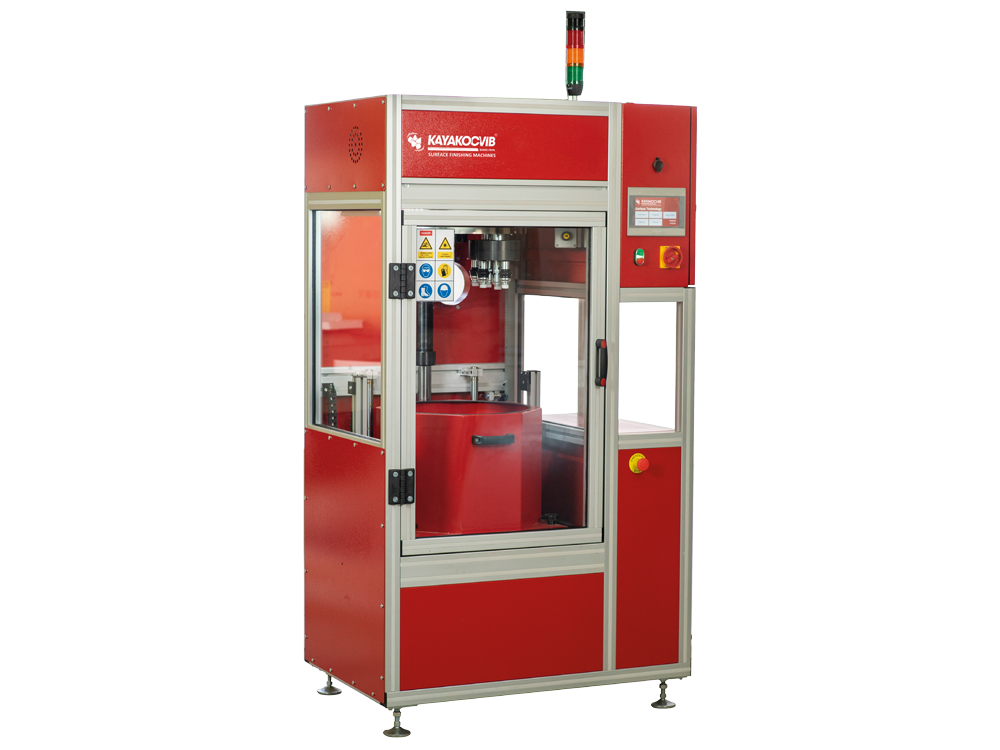
Modern drag finishing machines, including the KAYAKOCVIB DRG series, use Siemens PLC-based control systems that allow multi-stage recipes to be programmed and stored. A single finishing cycle may include an initial edge preparation stage with abrasive media, followed by a surface refinement stage with finer media, and a final polishing stage with non-abrasive polishing compound. Each stage has independently controlled speed, time, and compound dosing parameters.
Recipe storage and recall eliminate manual parameter setting between batches, which reduces operator error and improves process repeatability. In high-volume production of cutting tools or medical implants, PLC recipe control is essential for consistent quality across thousands of parts per shift. Integration with production MES systems for batch traceability is technically feasible on modern drag finishing platforms.
Automated loading and unloading arms can be integrated with drag finishing machines in higher-volume lines to reduce manual handling time and minimize part damage during fixturing. Downstream washing, using pressure washing or ultrasonic cleaning systems, can be incorporated into the line to complete the process sequence without manual transfer steps.
Comparison with Free-Tumbling Mass Finishing
| Characteristic | Drag Finishing | Vibratory Finishing | Centrifugal Disc Finishing |
|---|---|---|---|
| Part control | Individual fixturing | Free tumbling | Free tumbling |
| Edge geometry control | High — programmable | Low to moderate | Moderate |
| Risk of part-on-part damage | None — parts isolated | Present for delicate parts | Present at high loads |
| Typical cycle time | Minutes per stage | Hours typical | Minutes to 1 hour |
| Suitable part complexity | High — complex geometry | Simple to moderate | Small simple parts |
| Process repeatability | Very high with PLC recipes | Moderate | High for small parts |
| Throughput | Lower — fixtureable count | High batch volume | Medium batch volume |
Free-tumbling processes such as vibratory finishing and centrifugal disc finishing are well suited for high-volume batches of robust parts where part-on-part contact does not cause damage. Drag finishing is the preferred choice when individual part geometry control, edge radius precision, or the risk of part damage makes free-tumbling unsuitable. The two approaches are not competitive alternatives for the same application — they address fundamentally different finishing requirements.
Practical Limitations and Implementation Considerations
Drag finishing is not suitable for all part types. Parts with very complex internal geometry, deep blind holes, or internal channels that must be finished may not benefit from drag finishing because the media cannot enter those features. Vibratory finishing with smaller media or targeted flow-through configurations may be more appropriate for such geometries.
Fixturing design is a significant engineering investment for each new part type. The fixture must hold the part securely, expose the correct surfaces, and protect sensitive features. For small production volumes of a single part type, the fixturing cost per part may not justify drag finishing over manual polishing. However, for recurring production of precision tools or implants in thousands of units, the investment in fixturing and recipe development is typically recovered through consistency and labor savings.
Media wear management is important in drag finishing because worn media produces inconsistent results. Establishing media replenishment intervals based on part count or measured surface quality outcomes is part of a controlled finishing process.
Frequently Asked Questions
What is the difference between drag finishing and stream finishing?
In drag finishing, parts are rotated through a stationary or slowly moving media bed at moderate relative velocities. In stream finishing, the media is driven at higher velocity and parts are processed at greater relative speed, which increases material removal rate. Both methods use individual part fixturing and share the same fundamental principle of controlled part-to-media contact.
Can drag finishing replace manual polishing for cutting tools?
For most cutting tool edge preparation and surface roughness reduction applications, drag finishing produces more consistent and repeatable results than manual polishing. Manual polishing is highly operator-dependent and difficult to validate in a regulated production environment. Drag finishing with PLC recipe control allows full documentation of process parameters and is preferred for production volumes where consistency and traceability are required.
What surface roughness values can drag finishing achieve?
Achievable surface roughness depends on the starting condition of the part, the media sequence used, and the number of processing stages. In many industrial cutting tool applications, drag finishing with sequential media stages can reduce surface roughness significantly from the as-ground or as-coated condition. Specific Ra targets require validation through sample testing because actual results depend on material, geometry, media selection, and machine parameters.
How many parts can be processed per cycle in a drag finishing machine?
The number of parts per cycle depends on the machine size and the number of spindle arms. Typical drag finishing machines have between 4 and 24 spindle positions. Larger carousel configurations allow higher throughput while maintaining individual part control. Cycle time per batch is typically shorter than vibratory finishing, and multiple recipe stages can be executed sequentially in a single setup.
Conclusion
Drag finishing occupies a technically distinct position in the surface finishing spectrum. It is the process of choice when part geometry sensitivity, edge radius control, part-on-part damage risk, or regulatory traceability requirements rule out free-tumbling alternatives. The combination of individual part fixturing, programmable motion parameters, and multi-stage recipe control using Siemens PLC systems makes drag finishing a production-capable, validatable process for cutting tools, precision implants, molds, and aerospace components. Engineers evaluating this technology should focus on fixturing design, media sequence development, and process validation as the core implementation tasks, and confirm final surface quality outcomes through sample testing before committing to production parameters.
Sorry, the comment form is closed at this time.