


15 Jul Industrial Polishing Process
The industrial polishing process in serial production is not a single operation but a structured sequence of steps that must be engineered to deliver consistent surface quality across high volumes of parts. Unlike bench polishing or manual finishing, production polishing requires repeatable results with defined process parameters, controlled media and compound inputs, and integration into the broader manufacturing line. Getting this sequence right from the start reduces rework, prevents surface defects, and supports downstream operations such as coating, plating, or inspection.
In This Article
Defining the Process Scope Before Design Begins
Before selecting any machine or media, the process engineer must define the starting condition and target condition of the part. The starting condition includes the material type, part geometry, surface roughness after machining or forming, and the nature of defects present such as sharp edges, burrs, machining marks, or oxide layers. The target condition defines the required surface finish, edge condition, dimensional tolerance after finishing, and any downstream process requirements such as electroplating adhesion or anodizing uniformity.
Without this baseline, it is impossible to design a reliable industrial polishing sequence. Parts made from aluminum, stainless steel, carbon steel, or mixed metals each require different media hardness, compound chemistry, and machine agitation levels. A process designed for CNC-machined steel fasteners will not transfer directly to aluminum die casting components, even if both parts look similar in size.
Process Sequence for Serial Production Polishing
A well-designed industrial polishing process typically follows a defined sequence from pre-treatment through finishing and post-process handling. The exact number of stages depends on the initial surface condition and the required finish level.
- Pre-cleaning or degreasing to remove cutting fluids, chips, and contamination before finishing media contact
- Coarse deburring or edge conditioning stage using appropriate media and compound to remove burrs and machining marks
- Intermediate smoothing stage if required to reduce surface roughness before final polishing
- Final polishing stage using fine media and burnishing or polishing compound to achieve target surface finish
- Part-media separation using a separator machine
- Washing or rinsing to remove compound residue, media fines, and process water contamination
- Drying to prevent oxidation and prepare parts for downstream operations
- Visual or instrumental quality inspection before parts are released
Not every production application requires all eight stages. Light polishing of pre-finished CNC parts may require only steps three through seven. Heavy deburring followed by mirror-like polishing requires the full sequence. The process engineer must decide which stages add value and which can be eliminated without compromising the output.
Machine Selection for the Production Requirement
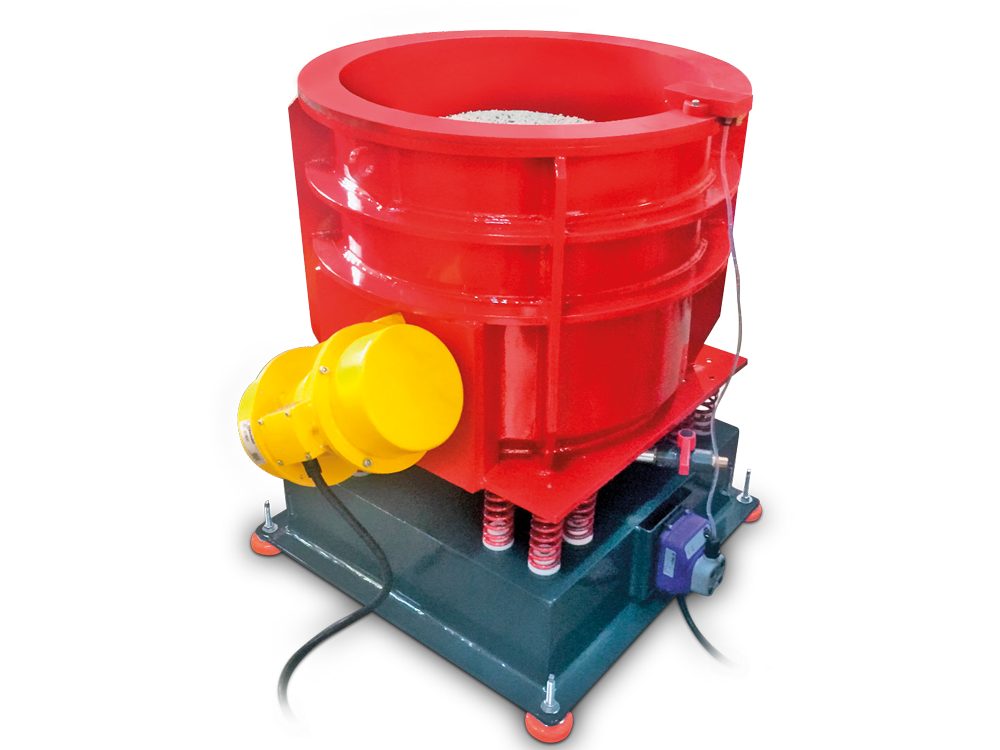
Machine type determines the agitation energy, part-to-media contact pattern, and the physical handling constraints of the process. For most small to medium parts in serial production, circular vibratory finishing machines provide a practical balance between throughput, process control, and part safety. Machines such as the KAYAKOCVIB KVM series are commonly used in automotive, fastener, and CNC part finishing lines where batch sizes are large and part geometry is compact.
For long or delicate parts that cannot tumble freely in a circular machine, trough vibratory machines are preferred because they allow parts to align lengthwise and travel through the process mass with lower collision risk. When cycle time is a limiting factor in high-output production, centrifugal disc finishing machines deliver significantly higher finishing energy per unit time, making them suitable for precision parts where short cycles and tight surface finish tolerances are both required.
The production volume also affects machine sizing. A single machine may be sufficient for low-to-medium volume applications, while automated continuous-flow finishing lines with multiple machines running in parallel may be required for high-volume serial production. The machine selection decision must account for part handling before and after the finishing machine, not only the finishing operation itself.
Media and Compound Selection Logic
Media and compound selection is the most direct lever the process engineer has over surface quality outcome. The wrong media type will either leave insufficient finishing action or damage part surfaces. The wrong compound will cause discoloration, staining, or inadequate cleaning.
For steel and stainless steel parts, ceramic media is the standard choice because the higher density and cutting action of ceramic media matches the hardness and burr structure of ferrous materials. Common process chemicals for steel finishing include deburring and polishing liquids formulated for ferrous metals, combined with a degreasing compound to control foam and remove oils. For aluminum and zinc alloy parts, plastic media is generally preferred because it is lighter and less aggressive, reducing the risk of surface denting or excessive material removal on softer substrates.
Media shape also matters significantly. Angle-cut cylinder and triangle shapes provide aggressive edge access and are used in deburring stages. Sphere and ellipse shapes provide gentler, more uniform surface contact and are preferred in polishing and burnishing stages. Media size must be selected to avoid lodging inside part holes, slots, or undercuts. Parts with small internal features require careful media size validation before production release.
| Part Material | Recommended Media Type | Typical Process Chemical | Primary Application |
|---|---|---|---|
| Carbon Steel | Ceramic | Deburring and polishing liquid for ferrous metals | Deburring, edge rounding, surface smoothing |
| Stainless Steel | Ceramic or stainless steel burnishing pins | Polishing liquid, degreaser | Surface brightening, light deburring |
| Aluminum | Plastic | Polishing liquid for non-ferrous metals, degreaser | Deburring, surface smoothing, anodizing prep |
| Brass and Copper | Plastic or ceramic (fine grade) | Acidic degreasing liquid | Surface brightening, oxide removal |
| Mixed Metal Batches | Not recommended without segregation | Material-specific compound required | Segregate by material before finishing |
Compound concentration and water flow rate must be controlled precisely in production. Too little compound causes inadequate lubrication and poor surface quality. Too much compound increases cost and can leave residue that is difficult to remove in the washing stage. In automated finishing lines, compound dosing systems are used to maintain consistent concentration throughout the production shift.
Process Parameters and Their Adjustment Logic
The industrial polishing process is controlled by a set of interdependent parameters that the process engineer must balance to achieve the target surface condition within acceptable cycle time.
Amplitude and frequency of the vibratory machine determine the agitation energy applied to parts. Higher amplitude increases cutting action and edge rounding speed but also increases the risk of part-on-part collision damage for thin or delicate components. Frequency is generally fixed by machine design, while amplitude is adjustable through counterweight position on the eccentric motor.
Cycle time is the most visible process parameter. Typical vibratory polishing cycles for machined metal parts range from 20 minutes to several hours depending on the initial surface condition, media cutting rate, and target finish level. Short cycles with aggressive media are appropriate for heavy deburring. Longer cycles with fine media and polishing compound are used when surface roughness reduction is the primary objective. Actual cycle times must be validated through sample testing because no universal standard applies across all part and media combinations.
Media-to-part loading ratio affects how freely parts move through the finishing mass. A typical ratio by volume is approximately 3:1 to 5:1 media to parts, but this depends on part density, geometry, and the risk of part-on-part contact. Overloading reduces finishing effectiveness. Underloading increases collision risk between parts.
Water flow rate controls compound dilution and process temperature. In continuous compound addition systems, the water and compound flow must be balanced to maintain the target concentration throughout the cycle. Stagnant water with degraded compound reduces finishing performance over time and can cause staining, particularly on non-ferrous metals.
Washing and Drying Integration
After the polishing stage, parts carry compound residue, media fines, and contaminated process water. If parts proceed directly to coating, plating, inspection, or assembly without proper washing, surface contamination will cause adhesion failures, visual defects, or corrosion. Washing is therefore a mandatory step in any production finishing line, not an optional add-on.
Pressure washing systems remove bulk contamination efficiently for robust parts. For parts with complex internal geometry, blind holes, or precision surfaces, ultrasonic cleaning provides more thorough cleaning action by generating cavitation energy that reaches inaccessible areas. The washing system must use water or chemistry compatible with the part material to avoid secondary surface attack or discoloration.
After washing, parts must be dried quickly to prevent flash rust on carbon steel parts or water spotting on polished aluminum or stainless steel surfaces. Industrial drying units such as the KAYAKOCVIB DVM circular dryer use heated air circulation to dry batches rapidly without surface damage. For long parts, trough dryers provide the appropriate geometry. Drying time and temperature must be validated for the part material and the surface condition after washing.
Automation and Line Integration for High-Volume Production
In serial production, manual handling between finishing stages introduces variability, increases labor cost, and limits throughput. Automated finishing lines connect the finishing machine, separator, washer, and dryer into a continuous sequence controlled by timing or sensor logic. Parts move from one stage to the next without manual intervention, maintaining consistent exposure time at each station.
Automated compound dosing systems maintain consistent chemistry throughout the shift. Automated separator discharge controls part-media separation timing. Automated conveyor or elevator systems move parts between machines without operator contact. For high-volume applications, these automation elements are not luxury additions but functional requirements for consistent industrial polishing process output at scale.
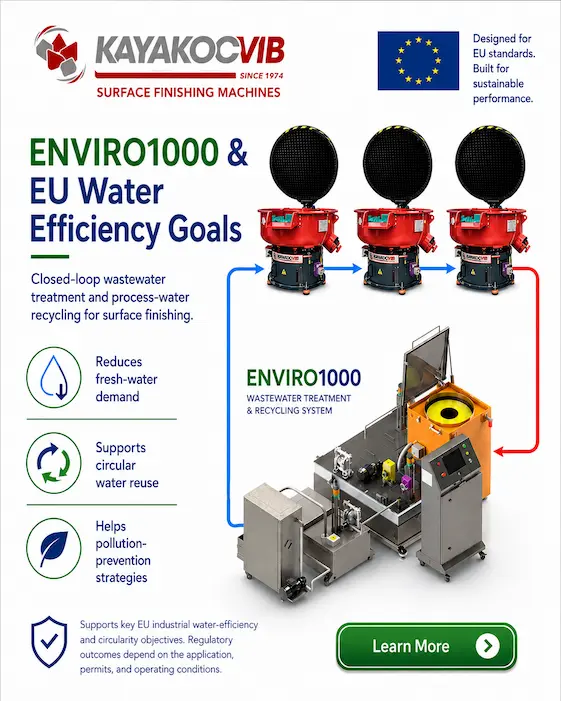
Wastewater generated during the polishing and washing stages contains oils, metal fines, compound chemistry, and suspended solids that cannot be discharged without treatment. Wastewater treatment and recycling systems allow production facilities to reuse process water, reduce chemical consumption, and comply with effluent regulations. In integrated finishing lines, wastewater management is part of the process design, not an afterthought.
Quality Control and Process Validation Points
Quality control in an industrial polishing process must be built into the process sequence rather than applied only at the end. The key validation points are the condition of parts entering each stage, the process parameters at each machine, and the surface condition of parts leaving the final stage.
Surface roughness measurement using profilometers or contact instruments provides objective data on whether the target Ra value has been achieved. Visual inspection under controlled lighting identifies staining, pitting, media lodging, or part-on-part collision marks. Dimensional checks confirm that the finishing process has not removed material beyond the tolerance allowed by the part drawing.
Before releasing any new part to serial production, sample runs should be performed with process parameters documented and results measured against the target specification. Process parameter records, media batch data, compound lot numbers, and part inspection results should be maintained as part of the production quality record. Any change in part material, media type, compound brand, or machine settings requires re-validation because the surface finishing result depends on all variables simultaneously.
Common Design Mistakes to Avoid
The most frequent mistake in industrial polishing process design is selecting media and compound based on cost or availability without reference to the part material and surface condition. This leads to inconsistent results, excessive cycle times, or surface damage that requires additional rework.
A second common error is skipping the pre-cleaning stage. Parts entering the finishing machine with heavy cutting fluid, chips, or oxide contamination will contaminate the process water rapidly, degrading compound performance and leaving surface residue that is difficult to remove in washing.
Running aluminum and steel parts in the same batch is a frequently observed mistake in mixed-part production environments. The galvanic interaction between dissimilar metals in the presence of acidic or alkaline process water can cause discoloration or accelerated surface attack on the softer material. Parts should always be segregated by material before finishing unless specific testing has confirmed compatibility.
Finally, not accounting for media wear over time leads to gradual process drift. As media wears down, cutting action decreases, cycle time must increase to achieve the same result, or surface quality begins to fall below specification. Regular media top-up and periodic full media replacement are required maintenance activities in any production finishing line.
Frequently Asked Questions
How do I determine the correct cycle time for a new part?
Cycle time must be determined through sample testing. Start with a baseline cycle appropriate for the media and machine type, measure the surface condition at intervals, and identify the minimum time that achieves the target finish. There is no standard formula that applies across all part and media combinations.
Can the same finishing machine handle both deburring and polishing stages?
Yes, but only if different media and compound combinations are used sequentially or if the machine is large enough to run separate batches. In practice, many production lines use dedicated machines for each stage to avoid cross-contamination and to allow independent process optimization.
What causes surface staining after vibratory polishing?
Staining is typically caused by degraded compound chemistry, insufficient water flow, contaminated process water, or inadequate washing after finishing. Staining on aluminum is often caused by water with high mineral content or by compound residue left on the surface after drying. Adjusting compound concentration, increasing rinse water flow, and verifying washing system chemistry usually resolves the issue.
When should centrifugal disc finishing be used instead of vibratory finishing?
Centrifugal disc finishing is preferred when cycle time reduction is a priority, when parts require a high-quality surface finish in a short process time, or when part geometry is compact and compatible with the disc machine bowl. It is commonly used for medical components, precision aerospace parts, and small CNC parts with tight surface finish requirements.
Related Process Equipment
Related Video Demonstration
Conclusion
Designing a reliable industrial polishing process for serial production requires systematic engineering decisions at every stage, from initial surface condition assessment through media and compound selection, machine configuration, washing and drying integration, and final quality validation. The process cannot be treated as a single-step operation, nor can parameters be transferred from one part family to another without re-validation. When the process sequence is correctly engineered, the industrial polishing process delivers consistent surface quality at production volume, supports downstream operations, and reduces the total cost of finishing over the production lifecycle. All process parameters and results should be validated through sample testing before release to full production.
Sorry, the comment form is closed at this time.