


09 Jul Automated Coin Polishing Line
An automated coin polishing line is a purpose-engineered production system that sequentially processes coin blanks or struck coins through polishing, separation, washing, and drying stages without manual handling between steps. In coin minting and medal manufacturing, surface quality directly affects both aesthetic value and rejection rates, making process automation and parameter control central engineering priorities. This article explains the working principles, machine logic, media and compound selection, key process variables, and practical implementation considerations for automated polishing lines in minting environments.
In This Article
Engineering Principle Behind Coin Surface Polishing
Coin polishing is fundamentally an abrasive mass finishing process. Coins or blanks are loaded into a machine bowl or trough along with shaped abrasive or polishing media and a process liquid compound. The relative motion between the media mass and the coin surfaces generates controlled micro-abrasion, progressively reducing surface roughness, removing oxide layers, and producing the bright or satin finish required before or after striking.
The energy input, media geometry, media hardness, compound chemistry, and processing time together determine the surface outcome. Unlike manual buffing, which introduces operator variability, an automated coin polishing line applies consistent mechanical energy across every part in the batch, enabling repeatable surface quality at production scale.
For coin blanks processed before striking, the polishing goal is typically to achieve a uniform, scratch-free surface that will transfer cleanly into die detail during coining. For struck coins processed after the press, polishing removes handling marks, lubricant residue, and minor surface irregularities while preserving struck relief detail.
Machine Working Logic
Most automated coin polishing lines are built around one of two machine types: circular vibratory finishing machines or centrifugal disc finishing machines. The selection depends on production volume, coin size, required surface quality, and cycle time constraints.
In a circular vibratory machine, an eccentric motor assembly generates three-dimensional vibration in the machine bowl. This motion causes the media and coin mass to circulate in a toroidal path, creating continuous sliding contact between media surfaces and coin faces. The amplitude and frequency of vibration, typically adjustable through motor eccentric weight settings, control the intensity of abrasive action.
In a centrifugal disc finishing machine, a rotating disc at the base of a stationary ring generates high centrifugal force. This produces significantly faster relative motion between media and parts, reducing cycle times substantially compared to vibratory machines. Centrifugal disc machines are commonly selected when high throughput, short cycle times, and consistent high-gloss results are required. The KAYAKOCVIB BCP-10 coin polishing system is an example of a machine engineered specifically for coin and medal surface treatment, designed to handle coin blanks and struck coins with controlled process intensity and separation capability.
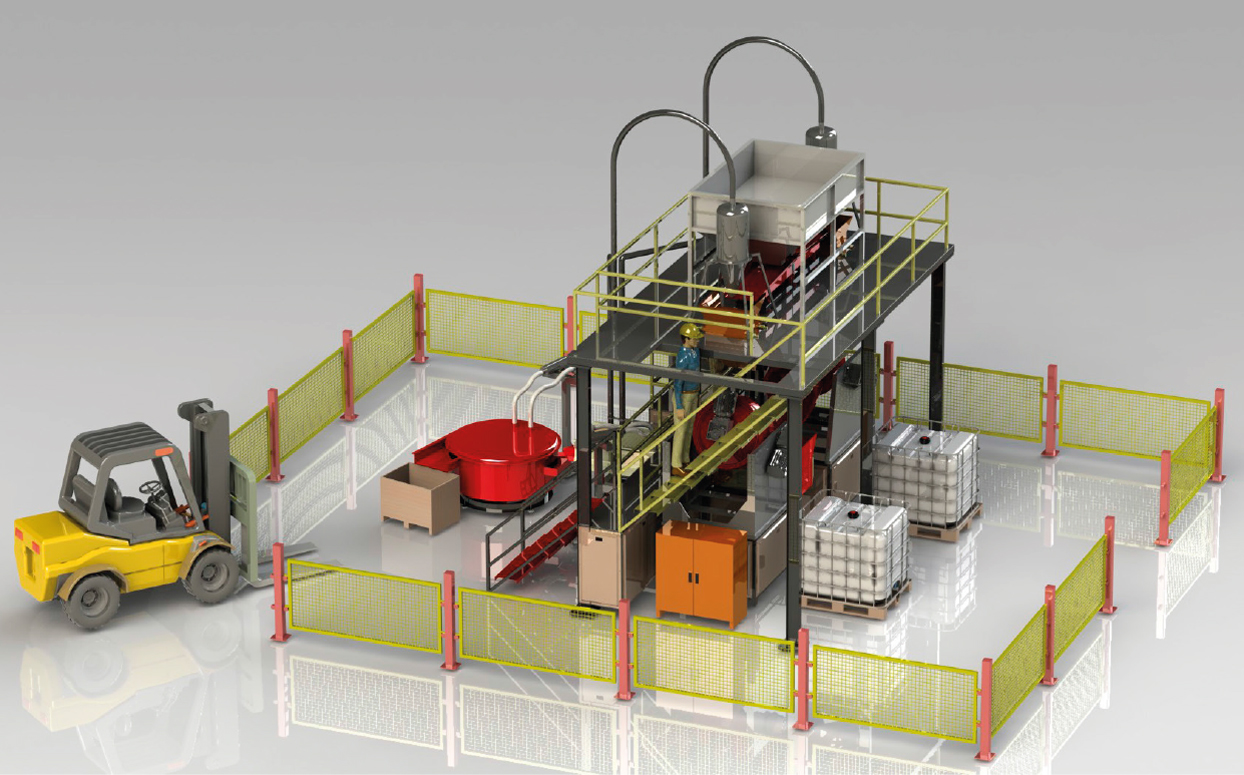
Both machine types can be integrated into continuous automated lines where coins are fed in, processed for a defined cycle, automatically separated from media, washed, dried, and discharged without manual intervention between stages.
Process Stages in an Automated Line
A complete automated coin polishing line typically consists of the following sequential stages:
- Blank or coin loading, either manually batched or via conveyor and vibratory feeder from the upstream press or annealing furnace
- Polishing stage in the primary finishing machine, where coins and media process together for a defined cycle time
- Media separation, where a separator screen or discharge system divides finished coins from polishing media
- Washing stage to remove compound residue, polishing debris, and surface contamination from coin surfaces
- Drying stage using a vibratory dryer loaded with dry corn cob or walnut shell drying media, or using hot air drying systems
- Final inspection and discharge to packaging or next process stage
The automation system coordinates conveyors, vibratory feeders, machine discharge gates, washing systems, and dryer infeed to maintain continuous flow without manual handling. Programmable logic controllers manage cycle timing, discharge sequencing, water flow, compound dosing, and dryer temperature when applicable.
Media and Compound Selection for Coin Applications
Media selection is one of the most consequential engineering decisions in coin surface finishing. Coins are typically made from steel, stainless steel, aluminum, copper alloys, nickel, or bi-metallic combinations. The media must be matched to the base metal to achieve the required surface finish without causing unwanted material removal, edge rounding, or surface scratching.
For steel and stainless steel coin blanks, ceramic media is generally preferred because harder metals require stronger cutting and polishing action to produce a bright surface within acceptable cycle times. Ceramic media in small cylindrical, spherical, or triangular geometries provides effective coverage across flat coin faces and edges.
For aluminum and softer alloy coins, plastic media is typically more appropriate. Plastic media applies lower cutting force, reducing the risk of surface scratching or edge deformation on softer substrates. Lighter plastic media also reduces the risk of impact damage on thin or relief-detailed struck coins.
Burnishing media, typically made from stainless steel pins or balls, is used in the final polishing stage when a high-gloss mirror-like finish is required. Burnishing is a non-abrasive process that plastically deforms the surface micro-peaks, producing brightness through surface densification rather than material removal. Burnishing is commonly applied to proof coin blanks or commemorative medals.
Process liquid compounds must be matched to both the metal type and the polishing objective. For steel and stainless steel, a deburring and polishing liquid such as KAYAKOCVIB 943 compound provides effective cleaning, surface activation, and polishing support. For aluminum or copper-based coins, a compound such as 085 polishing liquid is more appropriate, since it is formulated for non-ferrous metals and softer substrates. Degreasing compounds such as 028-S are used when coin blanks carry lubricant contamination from the pressing or annealing process.
Key Process Parameters and Their Effect on Surface Quality
Controlling surface quality in an automated coin polishing line requires understanding which process parameters govern the finishing outcome. The following table summarizes the main variables and their engineering significance:
| Parameter | Typical Range | Effect on Surface Quality |
|---|---|---|
| Machine amplitude | 1 to 4 mm | Higher amplitude increases cutting intensity; lower amplitude suits delicate struck coins |
| Cycle time | 15 to 90 minutes | Longer cycles improve surface uniformity; excessive time risks over-polishing or edge rounding |
| Media-to-coin ratio | 5:1 to 10:1 by volume | Insufficient media reduces coverage; excessive media increases part impact risk |
| Compound concentration | 1 to 3% dilution | Controls lubrication, cleaning action, and surface brightness; affects foam and drainage |
| Water flow rate | Application dependent | Continuous flow maintains clean media and removes debris; insufficient flow causes compound buildup |
| Machine load volume | 60 to 80% of bowl capacity | Correct load ensures proper media circulation; overloading reduces part motion and coverage uniformity |
All parameter values in the table above are approximate industrial references. Actual settings must be validated through sample testing because coin geometry, material, strike detail, and required surface specification vary significantly across applications. Parameter optimization should be conducted with production-representative coin samples before committing to full-scale line operation.
Separation, Washing, and Drying Integration
After the polishing cycle, reliable separation of coins from polishing media is essential to line continuity. For coin applications, a vibratory separator with a screen aperture sized between the coin diameter and the media size is typically used. The separator discharges coins to the next stage while returning media to the polishing machine or media storage.
Washing removes compound residue and polishing debris from coin surfaces before drying. Pressure washing or spray rinsing systems are commonly integrated into automated lines. For coins with fine relief detail or tight tolerances on surface cleanliness, ultrasonic cleaning systems provide more thorough removal of residue from recessed areas. Effective washing prevents compound staining or discoloration during the drying stage.
Drying is typically performed in a vibratory dryer loaded with dry corn cob granules. The warm, absorbent corn cob media picks up moisture from coin surfaces during vibratory tumbling, producing a dry, bright finish without water spotting. For high-speed lines or when heat is acceptable, hot air drying may replace or supplement corn cob drying. In an automated coin polishing line, the dryer is integrated inline so dried coins discharge directly to inspection and packaging without accumulation or manual transfer.
Automation and Production Line Integration
The degree of automation in an automated coin polishing line can range from semi-automated batch systems to fully continuous lines with zero manual coin handling. In a fully integrated line, vibratory feeders control coin input rate, programmable discharge gates manage batch timing, and conveyor systems transfer coins between polishing, separation, washing, and drying stages without operator intervention.
PLC-based control systems allow operators to store and recall process recipes for different coin types or surface specifications, reducing changeover time and ensuring repeatability between production runs. Sensors monitoring water flow, compound dosing, machine vibration, and dryer temperature allow real-time process monitoring and alarm-based intervention before surface quality deviates from specification.
For minting facilities with multiple coin denominations or materials, modular line designs allow the same polishing and drying equipment to be reconfigured for different products by adjusting media type, compound selection, and process parameters stored in the control system. This flexibility reduces capital investment while maintaining engineering control over surface outcomes.
Surface Quality Factors and Practical Validation
Surface quality in coin polishing is evaluated by visual inspection under controlled lighting, surface roughness measurement using profilometry, and gloss measurement in high-specification applications. The primary surface defects to monitor in an automated polishing line include:
- Incomplete polishing coverage on coin faces or edges, typically caused by insufficient media-to-coin ratio or low cycle time
- Media lodging in coin design detail, which can occur when media geometry is poorly matched to the coin relief depth
- Over-polishing or edge rounding, resulting from excessive cycle time or amplitude that removes metal from design edges
- Water spotting or compound staining, caused by insufficient washing or premature dryer discharge before coins are fully dry
- Mixed-metal contamination, which occurs when coins of different materials are processed together and metal transfer marks one surface type onto another
Each defect type has a specific engineering root cause that can be addressed through parameter adjustment, media selection review, or line sequencing changes. Process validation before production release requires running a representative sample batch, measuring surface quality against specification, and adjusting parameters iteratively until the required surface condition is consistently achieved.
Frequently Asked Questions
What is the difference between polishing and burnishing in coin finishing?
Polishing uses abrasive media to remove surface material and reduce roughness. Burnishing uses non-abrasive stainless steel media to plastically deform surface peaks, producing high gloss without significant material removal. Burnishing is typically used for proof blanks or final-stage bright finishing after initial polishing.
Can steel and aluminum coins be processed together in the same polishing machine?
Processing steel and aluminum coins together in the same batch is generally not recommended. Steel media and steel coins can cause metal transfer marks or scratching on softer aluminum surfaces. Separate process runs or dedicated machines are preferred when processing different base metals.
How is media selected for bi-metallic coins?
Bi-metallic coins typically contain an outer ring and inner core of different metals. Media selection must account for the softer of the two metals to avoid surface damage. Plastic media or fine ceramic media at low amplitude settings is often used, with process validation required to confirm that neither metal component is adversely affected.
What drives the cycle time in an automated coin polishing line?
Cycle time is primarily driven by the required surface finish specification, the initial surface condition of the coin blanks, the media type and cutting rate, and the machine energy level. Centrifugal disc machines typically achieve comparable results in significantly shorter cycle times than vibratory machines, making them suitable for high-volume minting lines where throughput is a priority.
Related Process Equipment
Conclusion
An automated coin polishing line combines mechanical finishing, media and compound science, separation, washing, and drying into a controlled production system that delivers repeatable surface quality at minting production volumes. Engineering the line correctly requires matching machine type to production throughput and coin geometry, selecting media based on base metal and required surface specification, calibrating process parameters through sample validation, and integrating reliable washing and drying stages to prevent post-process contamination. Systems such as the KAYAKOCVIB BCP-10 coin polishing system illustrate how dedicated coin finishing equipment can be configured into complete automated lines where parameter control and process repeatability are central design requirements. The specific settings for any production application must be confirmed through process testing with representative coin samples before full-scale line commissioning.
Sorry, the comment form is closed at this time.