



09 Jul Hot Air Drying vs Vibratory Drying
The choice between hot air drying vs vibratory drying is a frequent engineering decision in industrial surface finishing lines, particularly after wet vibratory finishing, mass finishing, or aqueous washing operations. Both methods remove residual moisture from metal parts, but they differ significantly in mechanism, part suitability, throughput characteristics, and surface quality outcomes. Understanding these differences allows process engineers to select the right drying method for their specific part material, geometry, production volume, and quality requirements.
In This Article
How Hot Air Drying Works
Hot air drying uses forced convective heat to evaporate moisture from part surfaces. Parts are conveyed or placed inside an insulated chamber or tunnel where heated air is circulated at controlled temperature and flow velocity. The thermal energy transferred to the part surface drives water evaporation without mechanical contact.
In industrial mass finishing lines, hot air drying is commonly implemented as a tunnel dryer configuration. Parts exit the separator or washing stage on a conveyor belt and pass continuously through the drying tunnel. Temperature settings typically range from 60°C to 120°C depending on part material, part thickness, moisture level, and required drying speed. Aluminum parts generally require lower temperatures than steel parts due to oxidation and discoloration sensitivity.
Hot air drying is a non-contact process, which makes it suitable for delicate or precision-finished surfaces where mechanical action could introduce micro-scratches or disturb surface texture. However, it depends entirely on thermal penetration and airflow access. Parts with deep blind holes, internal threads, undercuts, or stacked geometries may retain moisture in inaccessible areas even after extended drying cycles.
How Vibratory Drying Works
Vibratory drying combines mechanical motion with drying media and heat to remove moisture from part surfaces. Parts and dry drying media, typically corncob granules or walnut shell granules, are loaded together into a vibratory machine bowl or trough. The vibrating motion causes continuous contact between the media and the parts, while the absorbent media draws moisture away from the part surface through both mechanical wiping and capillary absorption.
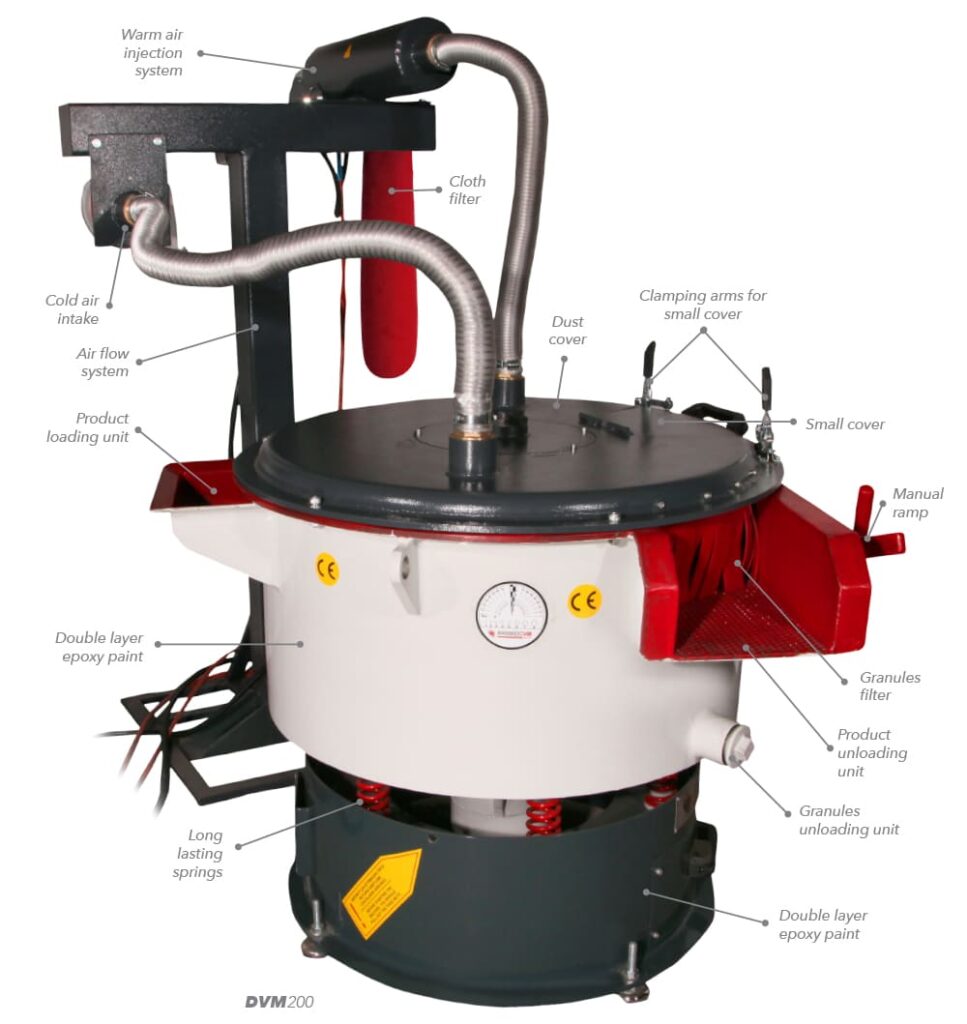
Many vibratory dryers include an integrated heating element or warm air injection to accelerate moisture absorption by the media. The KAYAKOCVIB DVM circular vibratory dryer, for example, operates on this combined principle, using vibratory motion and media contact to achieve efficient drying across a wide range of part geometries and sizes.
The mechanical action in vibratory drying also provides a secondary benefit: light burnishing of the part surface during the drying cycle. For parts that have completed a wet finishing process, this burnishing effect can slightly improve surface brightness and remove any residual loose compound or media fines. This effect is not always desired and should be evaluated against part geometry and surface specification before selecting vibratory drying as the primary drying method.
Comparison of Process Characteristics
The two methods serve similar functional purposes but differ substantially in how they interact with part surfaces, part geometries, and production line configurations.
| Parameter | Hot Air Drying | Vibratory Drying |
|---|---|---|
| Drying Mechanism | Convective heat and airflow | Absorbent media contact and vibration |
| Part Contact | Non-contact | Media-to-part contact |
| Suitable Part Geometry | Simple, open geometries | Complex, irregular geometries |
| Blind Holes and Recesses | May retain moisture | Media can access some recesses |
| Surface Effect | No additional finishing | Light burnishing possible |
| Cycle Time | Depends on airflow and temperature | Depends on media type and load ratio |
| Part Material Sensitivity | Aluminum needs lower temperature | Soft metals may show media marks |
| Automation Integration | Well-suited for tunnel conveyor lines | Batch or continuous operation possible |
Material and Part Geometry Considerations
Part material plays a significant role in selecting the correct drying method. Steel and stainless steel parts with standard geometries typically tolerate both methods well. For steel components, hot air drying at moderate temperatures is efficient and introduces no additional mechanical risk. Vibratory drying with corncob media is also effective and can provide a light brightening effect on steel surfaces.
Aluminum parts require more careful evaluation. Hot air drying at elevated temperatures can cause surface oxidation or slight discoloration if temperature control is not precise. Vibratory drying with corncob or walnut shell media is generally gentler thermally, but the mechanical contact needs to be evaluated if the aluminum part has a polished or anodized finish.
For mixed metal batches, neither drying method should combine different metal types in the same vibratory load. Galvanic contact between dissimilar metals in a vibratory dryer can cause surface staining or microcontact marks. Separate drying runs by material group are recommended for quality-sensitive applications.
Part geometry is equally important. Parts with deep threads, blind holes, complex internal channels, or densely packed cross-sections are better candidates for vibratory drying because the media can mechanically displace moisture from surface features that airflow alone cannot reliably access. Flat, thin stamped parts or simple turned components with no internal features can be dried efficiently with hot air.
Process Variables That Control Drying Quality
For hot air drying, the key variables are air temperature, air velocity, residence time inside the drying zone, and conveyor belt load density. If parts are stacked or touching on the conveyor belt, drying efficiency drops significantly in contact areas. Proper part distribution across the conveyor belt width is essential for consistent results.
For vibratory drying, the controlling variables are media type, media-to-part volume ratio, vibratory amplitude and frequency, heating temperature if used, and cycle duration. Corncob granule media absorbs moisture progressively and must be replaced or refreshed periodically when saturation reduces drying efficiency. A general rule in industrial practice is that damp or saturated corncob media should not be reused without drying the media itself between production batches.
The media-to-part volume ratio in vibratory drying directly affects contact frequency and moisture extraction rate. A higher media ratio means more surface contact per unit time but also increases the risk of part-on-part impingement if the machine is overloaded. Typical ratios range from 3:1 to 5:1 media to parts by volume, though this should be validated for each specific part geometry and batch size.
Automation and Line Integration
Both drying methods can be integrated into fully automated surface finishing lines. In a typical automated line, parts exit the vibratory finishing machine, pass through a separator to remove finishing media, enter a washing or rinsing stage, and then proceed to drying.
Hot air tunnel drying is particularly well-suited for high-volume continuous production lines where parts move on conveyor systems. The tunnel dryer can be sized to match the throughput of the upstream separator and washing units, creating a seamless flow without batch interruptions. For automotive fasteners, stamped brackets, or CNC machined components produced in large volumes, tunnel drying offers consistent cycle control with minimal manual intervention.
Vibratory drying in batch mode requires loading and unloading steps, which can be automated with conveyor transfers, vibratory feeders, or robotic handling depending on part size and production volume. The KAYAKOCVIB DVM series circular vibratory dryers are designed for integration into batch-based finishing lines where parts transition from wet finishing to the drying stage with media separation handled upstream by a dedicated separator.
For larger or longer parts that do not fit standard circular dryer bowls, trough-type vibratory dryers provide an alternative configuration. Both machine types operate on the same combined vibration and absorbent media principle, with the trough geometry accommodating longer component profiles.
Surface Quality After Drying
Drying is not a passive process step from a surface quality perspective. The selected drying method and process parameters directly affect the final appearance and cleanliness of the part surface.
Hot air drying, when operated at the correct temperature and with proper part distribution, produces a clean, dry surface with no additional mechanical modification. This is the preferred method when the part has been finished to a tight surface roughness specification and no further surface interaction is acceptable.
Vibratory drying introduces mechanical contact and may produce a very light additional polishing or burnishing effect depending on media grade and cycle time. For parts that benefit from a slightly brighter or more uniform surface, this effect can be a positive outcome. For precision-ground, lapped, or finely polished parts, the additional contact must be evaluated carefully to ensure it does not alter the surface specification.
In both cases, flash rust is a risk for unprotected steel and iron parts if drying is incomplete or if humidity is high in the production environment. After drying, parts should be conveyed to rust protection, packaging, or coating stages promptly to prevent moisture reabsorption from the ambient environment.
Frequently Asked Questions
Which drying method is better for parts with blind holes?
Vibratory drying with absorbent corncob or walnut shell media is generally more effective for parts with blind holes, threads, or recessed features because the media mechanically contacts and absorbs moisture from surface details that airflow cannot reliably reach. Hot air drying may leave residual moisture in deep blind holes even with extended drying times.
Can vibratory drying add a polishing effect?
Yes, vibratory drying can produce a light burnishing or brightening effect depending on the media type, cycle time, and part material. This effect is most noticeable on steel and brass parts. For parts with tight surface finish specifications, this secondary effect should be evaluated and validated before selecting vibratory drying as the final process step.
What media is used in vibratory dryers?
Corncob granule media and walnut shell granule media are the most common absorbent drying media in industrial vibratory dryers. Corncob media offers higher absorption capacity and is widely used for general metal parts. Walnut shell media is denser and provides a slightly more aggressive surface contact, which can be beneficial for light surface brightening on harder metals.
How does temperature affect drying performance in hot air systems?
Higher air temperature accelerates moisture evaporation and reduces drying cycle time. However, temperature must be kept within safe limits for the part material. Aluminum and zinc alloy parts are sensitive to surface oxidation at elevated temperatures and typically require lower drying temperatures than steel components. Actual temperature settings should be validated based on part material, surface finish specification, and required cycle time.
Related Process Equipment
Related Video Demonstration
Conclusion
The decision between hot air drying vs vibratory drying depends on part geometry, material, surface finish requirements, production volume, and line configuration. Hot air drying is the preferred choice for high-volume continuous lines with simple part geometries, tight surface specifications, and non-contact drying requirements. Vibratory drying is more effective for complex geometries, parts with recessed features, and applications where a light secondary burnishing effect is acceptable or beneficial. In practice, many finishing lines use vibratory drying as the primary method for batch operations and hot air tunnel drying for high-volume continuous production. Both methods can be integrated into automated finishing lines with appropriate upstream separation and washing stages. Final drying method selection should always be validated through sample testing under actual production conditions to confirm surface quality, cycle time, and throughput requirements.
Sorry, the comment form is closed at this time.