



25 Jun Deburring Medical Precision Parts
Deburring medical precision parts is one of the most technically demanding surface finishing applications in industrial manufacturing. Unlike general industrial deburring, medical part finishing must remove burrs and sharp edges without measurably altering dimensions, surface texture, or geometric tolerances. The materials involved — primarily titanium alloys and medical-grade stainless steel — add further constraints because both are sensitive to contamination, surface stress, and aggressive material removal. Getting this process right requires a deliberate selection of machine type, media, compound, and process parameters validated through controlled testing before production release.
In This Article
What Makes Medical Part Deburring Different
Most industrial deburring applications allow for some tolerance in edge condition, surface roughness variation, or minor dimensional change. Medical precision parts operate under a completely different set of requirements. Implants, surgical instruments, bone screws, cannulas, and catheter components must meet tight dimensional tolerances while presenting burr-free, smooth, and in many cases highly polished surfaces. Any residual burr on an implant edge creates a stress riser, a contamination trap, or a tissue-damage risk. Any unintended geometry change — even rounding a functional edge that should remain sharp — becomes a quality failure.
The challenge is not simply removing burrs. The challenge is removing only the burrs while leaving all functional geometry intact. This requires low-intensity, highly controlled finishing action with media and compounds selected specifically for the base material, part geometry, and required surface condition.
Typical Parts, Materials, and Defect Types
Medical precision components that commonly require deburring and edge finishing include orthopedic implants, spinal fixation hardware, dental implant bodies and abutments, surgical instrument tips and shafts, bone screws, endoscopic components, and catheter fittings. These parts are typically produced by CNC turning, CNC milling, Swiss-type machining, or EDM, and may arrive at the finishing stage with light machining burrs, micro-burrs at intersecting hole exits, sharp edge transitions, or mild tool marks.
Titanium alloys such as Ti-6Al-4V and commercially pure titanium grades are widely used for implants because of their biocompatibility and mechanical strength. Medical-grade stainless steel, primarily 316L austenitic stainless, is standard for instruments, connectors, and fixation hardware. Both materials require care during finishing because titanium is prone to surface smearing under high contact pressure and stainless steel can develop free iron contamination if ferrous media contact is not controlled.
Defect types that the finishing process must address typically include light burrs at drilled or milled edges, sharp intersections at feature transitions, mild surface roughness from machining, and occasional micro-cracks or tool marks that may require light surface refinement. Heavy material removal is rarely the objective. The primary goal is controlled edge rounding and surface improvement at low stock removal rates.
Machine Selection for Precision Medical Deburring
Machine selection is the first and most consequential decision in setting up a deburring process for medical precision parts. Three machine types are most relevant for this application: centrifugal disc finishing machines, drag finishing machines, and circular vibratory finishing machines. Each produces a different finishing action with different levels of intensity and control.
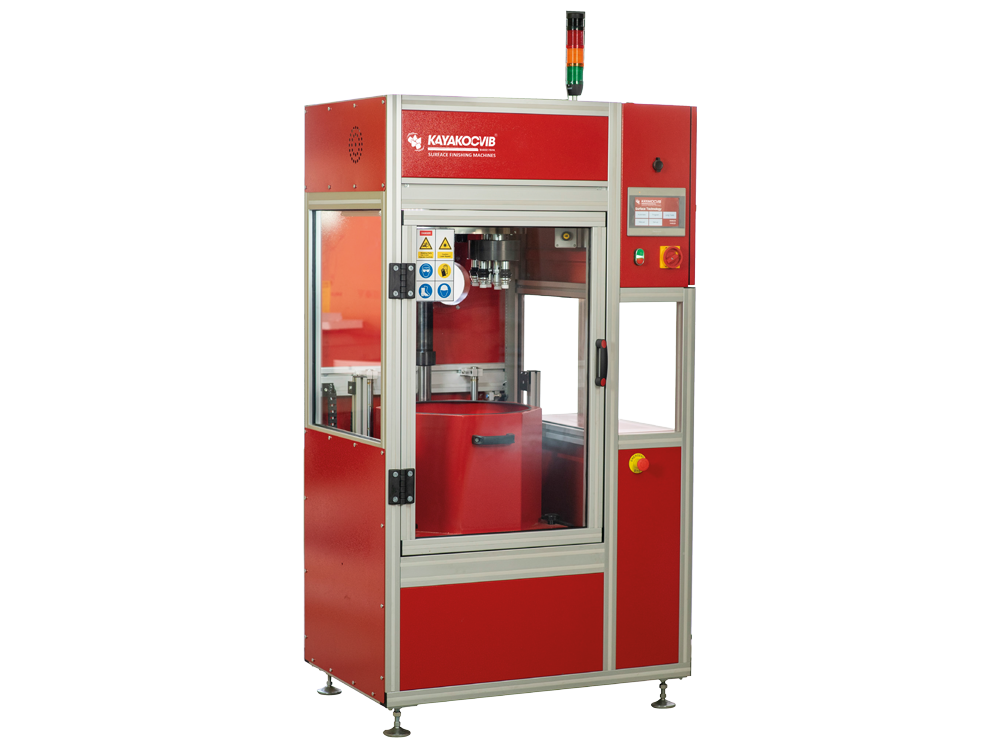
Centrifugal disc finishing machines, such as the KAYAKOCVIB KSM series, generate a high-energy toroidal media flow that produces fast, consistent cutting action on small and medium precision parts. The centrifugal disc at the base of the working bowl accelerates the media mass, which flows upward along the bowl wall and returns over the parts. This produces significantly higher finishing intensity than standard vibratory machines, often reducing cycle times by a factor of five to ten compared to conventional vibratory equipment. For medical parts where burr removal must be fast and repeatable across large batches, centrifugal disc machines provide a strong combination of speed and surface consistency. However, because the process intensity is higher, media selection and cycle time control are more critical to avoid over-processing thin features or delicate edges.
Drag finishing machines, such as the KAYAKOCVIB DRG series, take a fundamentally different approach. Parts are mounted individually on spindles or fixtures and dragged through a stationary media bed at controlled speed and depth. This produces a highly defined, gentle finishing action that is particularly suited to complex-geometry implants, cutting tools, dental abutments, and precision components where part-to-part contact must be completely avoided. Because each part is processed separately and the contact angle and depth are programmable, drag finishing offers the highest level of geometry preservation among available mass finishing methods. The limitation is throughput — drag finishing processes one part or a small number of parts per cycle, which makes it less suitable for very high-volume commodity medical hardware.
Circular vibratory finishing machines, such as the KAYAKOCVIB KVM series, are suitable for lower-intensity finishing requirements on parts that can tolerate part-to-part contact at low energy levels. For very small and lightweight medical fasteners or simple connectors, vibratory finishing with a carefully selected plastic or ceramic media can provide adequate burr removal and edge rounding. However, for tight-tolerance implants or instruments with complex geometries, the uncontrolled nature of vibratory media flow introduces more variability than centrifugal or drag finishing.
| Machine Type | Finishing Intensity | Geometry Control | Part Contact | Best For |
|---|---|---|---|---|
| Centrifugal Disc (KSM) | High | Good | Part-to-part possible | Small precision parts, high volume, short cycle |
| Drag Finishing (DRG) | Controlled / Low to Medium | Highest | None (fixture mounted) | Implants, dental, complex geometry, no contact allowed |
| Circular Vibratory (KVM) | Low to Medium | Moderate | Part-to-part contact | Simple geometry, lower precision requirements, high volume |
Media Selection for Titanium and Medical Stainless Steel
Media selection for deburring medical precision parts must account for the base material hardness, the required surface finish, the burr size, and the contamination risk. The wrong media type can cause surface smearing on titanium, free iron contamination on stainless steel, or lodging in small holes and cavities.
For titanium medical components, plastic media is generally preferred. Plastic media produces lower contact pressure and cutting force than ceramic, which reduces the risk of surface smearing or mechanical embedding of media particles into the titanium surface. Fine-cut or ultra-fine plastic media shapes, such as triangles, cones, or wedges sized appropriately for the part geometry, are commonly used for light burr removal and edge rounding on titanium implants. For final polishing stages, burnishing media or fine polishing plastic media with low-abrasive or non-abrasive compound may be used.
For medical-grade stainless steel components, ceramic media or fine-cut plastic media may both be appropriate depending on the burr size. Heavier burrs on stainless steel instruments may require ceramic media with a cutting compound in the first stage, followed by plastic media in a polishing or refinement stage. It is important to ensure that the ceramic media used does not contain iron-bearing abrasives that could contaminate the stainless surface. Dedicated stainless-grade ceramic media is preferred in controlled production environments.
In all cases, media size and shape must be selected so that media cannot lodge inside holes, slots, or internal channels of the part. A pre-process media entrapment risk assessment is standard practice for precision medical parts. Undersized media relative to the smallest hole diameter on the part is a production risk that can cause costly inspection failures.
Process Parameters That Control Edge Rounding Quality
Process parameters directly determine whether the deburring medical precision parts outcome meets engineering requirements. The key variables include machine speed or frequency, cycle time, media-to-part ratio, compound concentration, water flow rate, and part loading density.
For centrifugal disc machines, disc rotational speed controls the intensity of the media flow. Higher speeds produce faster cutting action but also increase the risk of part collision damage on fragile features. For medical parts, disc speed is typically set below the maximum rated value and fine-tuned through test cycles. Cycle time is short — often between five and twenty minutes for light deburring — and must be validated to prevent over-processing. Media-to-part volume ratio is important; a higher ratio reduces part-to-part contact probability and improves surface consistency.
For drag finishing, spindle speed, immersion depth, and orbital path determine the rate of material removal and edge rounding. Slower spindle speeds and shallower immersion reduce the finishing intensity for delicate parts. The compound flow rate and type also influence surface brightness and lubricating action during the process. Process parameters for drag finishing are more deterministic than for mass finishing because each part follows the same path through the media bed.
Compound selection should match the base material. For titanium, a neutral or slightly alkaline finishing liquid is typically used to maintain cleanliness and prevent surface contamination. For stainless steel, a deburring and polishing liquid compatible with stainless grades should be selected. Compound concentration is set to maintain consistent lubrication and media self-cleaning throughout the cycle. Excessive compound concentration can cause media glazing, which reduces cutting efficiency and extends required cycle time.
Post-Process Cleaning and Passivation Considerations
After deburring and finishing, medical precision parts require thorough cleaning to remove all media residue, compound film, metallic fines, and abrasive particles before any subsequent process steps such as passivation, coating, or sterilization. Residual compound or fine abrasive particles trapped in threads, holes, or surface features are a known contamination risk in medical device production.
Ultrasonic cleaning is widely used as the post-finishing cleaning method for medical precision parts because it effectively removes contamination from complex geometry surfaces and internal features. Pressure washing with deionized or purified water may be used for simpler geometries. The cleaning process specification should address solvent compatibility with the base material, rinse water quality, and drying method to prevent water spotting or oxidation before downstream processes.
Passivation of stainless steel medical parts is typically required after finishing to restore the passive oxide layer and remove any free iron introduced during manufacturing or finishing. The finishing process itself can affect the surface condition that determines passivation effectiveness, which is one reason why media cleanliness and contamination control during the finishing stage are treated as process-critical factors.
Quality Control and Inspection After Finishing
Quality validation for deburring medical precision parts should include dimensional inspection to confirm that part geometry has not changed beyond tolerance, surface roughness measurement to confirm the achieved Ra value falls within specification, and visual or microscopic inspection for residual burrs, surface defects, edge condition, and media contamination.
Dimensional inspection using coordinate measuring equipment before and after finishing is the standard approach for confirming geometry preservation. Surface roughness measurement using profilometry confirms that the finishing process achieved the required texture without over-cutting. For implant-grade parts, additional inspection for micro-crack propagation, surface smearing, or embedded abrasive particles may be required depending on the regulatory and quality system requirements of the manufacturer.
Because the exact Ra values achievable through any finishing process depend on the starting surface condition, media selection, machine settings, compound, and cycle time, no numerical surface roughness guarantee should be assumed without validation testing. Process capability must be established through sample testing and documented in a process validation report before production release.
Frequently Asked Questions
Can centrifugal disc finishing remove burrs from titanium implants without geometry damage?
Yes, provided that the correct plastic media, appropriate disc speed, and validated cycle time are used. Centrifugal disc machines offer fast and repeatable finishing action for small medical precision parts, but process parameters must be tested and validated for each specific part geometry before production. Over-processing or incorrect media selection can cause geometry change on thin features.
What is the difference between drag finishing and centrifugal disc finishing for medical parts?
Drag finishing mounts each part individually on a fixture and controls its path through the media bed, which eliminates part-to-part contact and provides the highest level of geometry control. Centrifugal disc finishing processes a batch of loose parts together at high media flow intensity. Drag finishing is preferred for complex-geometry implants or single high-value parts where contact damage is unacceptable. Centrifugal disc finishing is better suited to high-volume small parts where batch consistency is the priority.
Should plastic or ceramic media be used for medical-grade stainless steel deburring?
For light to medium burrs on medical-grade stainless steel, fine ceramic media or fine plastic media can both be appropriate depending on burr size and required surface finish. Ceramic media provides stronger cutting action for heavier burrs. Plastic media is preferred for final refinement stages or when the part surface is already close to final specification. In all cases, media contamination risk must be evaluated, and iron-free or stainless-compatible media should be selected.
Is media lodging a risk in medical part finishing?
Yes. Media lodging inside holes, slots, internal channels, or undercut features is a real production risk in medical part finishing. Media size and shape must be selected so that no media particle can enter and become trapped in any feature of the part. A media entrapment risk assessment should be completed before running any new part in a mass finishing or centrifugal disc process.
Related Process Equipment
Related Video Demonstration
Conclusion
Achieving reliable deburring medical precision parts results requires matching the machine type, media, compound, and process parameters specifically to the part material, geometry, and surface quality requirements. For complex implants and high-value components where zero part contact and maximum geometry preservation are required, drag finishing provides the most controlled processing environment. For small, high-volume precision parts where short cycle time and batch consistency are the priorities, centrifugal disc finishing with validated plastic media and compound offers an effective solution. Circular vibratory finishing remains relevant for simpler geometries and lower-precision requirements within the medical device segment. In all cases, post-process cleaning, contamination control, and documented process validation are as important as the finishing process itself in meeting the quality standards that medical device manufacturing demands.
Sorry, the comment form is closed at this time.