



24 Jun Drag Finishing
Drag finishing is a high-precision surface finishing method in which individual parts are clamped into dedicated fixtures and dragged through a stationary or slowly rotating bed of finishing media. Unlike conventional mass finishing processes where parts move freely with the media, drag finishing gives the process engineer direct control over part orientation, immersion depth, and relative velocity between the part surface and the media bed. This makes the process particularly well-suited for applications where part geometry, edge condition, and surface roughness must be controlled within tight tolerances.
In This Article
Application Context and Typical Parts
The primary application domain for drag finishing includes cutting tools such as end mills, drills, and inserts, where controlled edge preparation is required before coating. In tool manufacturing, the cutting edge radius must be generated with high repeatability to improve coating adhesion and reduce chipping under load. Mold manufacturing uses the process to achieve mirror-quality surface finishes on complex cavities without hand polishing. Medical device manufacturing relies on drag finishing for implants and surgical instruments where surface topography, cleanliness, and biocompatibility requirements are strict. Additive manufactured parts, especially those made from titanium or tool steel via selective laser melting, often require aggressive surface roughness reduction combined with fine polishing, and drag finishing can handle both stages in sequence.
Typical materials processed include hardened tool steel, carbide, high-speed steel, titanium alloys, and stainless steel. These are dense, hard materials that tolerate the relatively high contact forces generated between the part surface and the media bed during drag motion.
How Drag Finishing Works
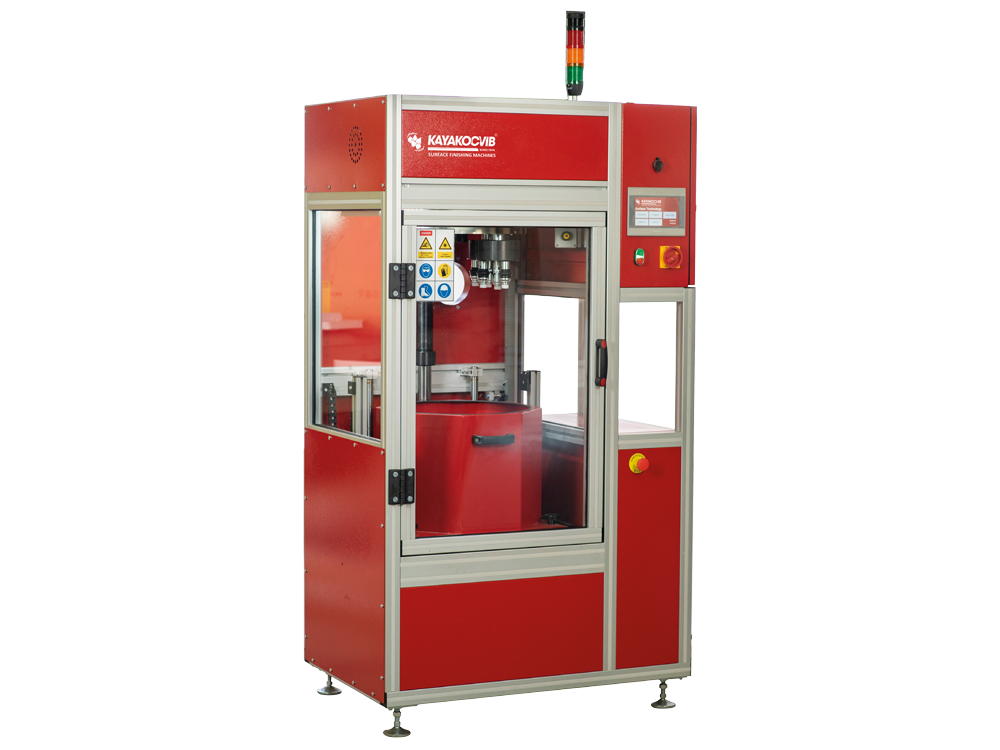
In a drag finishing machine, parts are mounted on spindles or fixture arms arranged around a rotating carousel or linear carriage above the media working bowl. The carousel rotates the parts horizontally while simultaneously lowering the fixture arms so that each part is immersed into the media bed to a controlled depth. The parts are dragged through the media at a controlled speed, creating a high relative velocity between the part surface and the media. Because the parts are clamped rather than tumbling freely, the finishing action is consistent across the entire exposed surface area, and delicate features such as cutting edges, chamfers, and thin walls are not subjected to random impact forces.
Some machine configurations also rotate the individual part spindles about their own axis while the carousel is in motion. This secondary rotation ensures that all surfaces of a round tool or complex part are equally exposed to the media, providing uniform edge rounding and surface conditioning. The immersion depth controls how aggressively the media contacts the part, and the carousel speed controls the relative velocity, which directly affects material removal rate and final surface roughness.
Stream Finishing as a Related Process
Stream finishing operates on a closely related principle. In stream finishing, the media bowl itself rotates at high speed while the parts are held stationary or slowly rotated in fixed spindles positioned above the bowl center. The rotating media creates a strong centrifugal stream that flows outward and upward against the immersed parts with high velocity and pressure. This produces a more intense finishing action than standard drag configurations, making stream finishing useful when faster cycle times or higher material removal rates are required before transitioning to fine polishing stages. KAYAKOCVIB DRG series machines support both drag finishing and stream finishing operating modes, allowing the same machine platform to cover a range of applications from gentle polishing to aggressive edge preparation.
Media and Compound Selection for Precision Parts
Media selection in drag finishing follows the same base logic as other mass finishing processes but is further constrained by part geometry and the required surface result. For hardened steel and carbide cutting tools, small ceramic media in triangular, cylindrical, or satellite geometries is commonly used because ceramic cutting action is strong enough to condition the hard surface and generate consistent edge radii. The media size must be selected so that it cannot lodge in flutes, pockets, or bores of the workpiece. For fine polishing stages, plastic media with embedded abrasive or porcelain burnishing media may follow the cutting stage.
For titanium implants or medical-grade stainless steel parts, plastic media or ceramic media with fine grit is used depending on the starting surface condition. Additive manufactured titanium parts typically arrive with Ra values in the range of 10 to 25 micrometers depending on build orientation and parameters. Aggressive cutting stages with ceramic media reduce the surface roughness significantly before transitioning to finer stages. Actual final Ra values achievable depend on the number of process stages, media type and grit, compound selection, carousel speed, and immersion depth, and must be validated through sample testing for each specific part and material combination.
Compounds used during drag finishing control lubrication, pH buffering, surface brightening, and chip flushing. For steel and hardened tool steel, an acidic or neutral deburring compound such as KAYAKOCVIB 943 is commonly used in combination with a degreasing liquid. For medical or aerospace parts requiring a clean, bright surface, compound selection must also account for post-process cleaning requirements, as residues from finishing compounds must be fully removed before inspection or coating.
Process Parameters That Control Surface Quality
The following parameters directly affect the surface result in a drag finishing operation. Each parameter must be defined and validated for the specific part, material, and target surface condition before production release.
| Parameter | Effect on Process | Typical Adjustment Range |
|---|---|---|
| Carousel speed | Controls relative velocity between part and media; higher speed increases material removal and edge rounding rate | Application dependent; validated by sample testing |
| Immersion depth | Controls contact pressure between media and part surface; deeper immersion increases intensity | Typically 30 to 80 percent of media bed depth |
| Spindle rotation speed | Controls surface exposure uniformity for round or complex parts | Low to moderate; must not centrifugally sling media |
| Cycle time per stage | Controls total material removal and surface refinement level | Minutes to tens of minutes per stage depending on application |
| Media type and grit | Determines cutting aggressiveness and achievable Ra floor | Coarse ceramic to fine plastic or porcelain |
| Compound concentration | Controls lubrication, chip flushing, and surface chemistry | Diluted per manufacturer specification |
| Number of stages | Multi-stage sequences allow coarse-to-fine progression for tight Ra targets | Typically 2 to 5 stages for precision applications |
Siemens PLC Recipe Control and Process Repeatability
One of the engineering advantages of drag finishing machines designed for precision manufacturing is the integration of programmable recipe control systems. KAYAKOCVIB DRG machines use Siemens PLC-based control platforms that allow operators to store and recall complete process recipes for each part number. A recipe defines carousel speed, spindle rotation speed, immersion depth, cycle time per stage, compound dosing, and the number of stages in sequence. Once a recipe is validated through sample testing and approved by quality control, it can be locked and executed with operator-independent repeatability.
This level of process control is important in tool manufacturing and medical device production where process validation is a formal quality requirement. Recipe-based control reduces operator influence, enables production traceability, and supports process qualification documentation. It also simplifies the transition between different part numbers on the same machine by loading a different recipe rather than manually adjusting machine parameters.
Production Line Integration and Washing Requirements
After drag finishing, parts typically require thorough cleaning to remove media fragments, compound residues, and metallic fines from the surface. For cutting tools destined for PVD or CVD coating, surface cleanliness is a direct factor in coating adhesion quality. Residual oils or compound films can cause coating delamination or adhesion failure. Ultrasonic cleaning or high-pressure washing systems are commonly used after drag finishing to achieve the required cleanliness level before inspection and coating.
In automated production lines, the drag finishing machine can be integrated with automated part loading and unloading systems, ultrasonic cleaning cells, drying units, and inspection stations. The Siemens PLC interface on the finishing machine can communicate with line-level automation controllers to synchronize part flow and recipe selection based on part identification data. For high-volume tool manufacturing, this integration reduces manual handling, maintains process consistency, and shortens total cycle time between raw part and coated finished tool.
Comparison with Alternative Precision Finishing Methods
Drag finishing is not the only process capable of achieving fine surface roughness on precision parts. Centrifugal disc finishing, vibratory finishing, and manual or CNC polishing are also used depending on the application. The table below compares these approaches for typical precision part scenarios.
| Method | Part Control | Edge Rounding Control | Ra Achievement Potential | Suitable Part Types |
|---|---|---|---|---|
| Drag finishing | Individual clamped parts | High; orientation controlled | Very fine with multi-stage process | Cutting tools, implants, molds, AM parts |
| Centrifugal disc finishing | Free-moving batch | Moderate; not part-specific | Fine for small parts | Small precision components, medical parts |
| Vibratory finishing | Free-moving batch | Low to moderate | Moderate to fine depending on media | General deburring, medium complexity parts |
| Manual or CNC polishing | Full operator or program control | High but variable by operator | Very fine | Molds, dies, single complex parts |
Drag finishing offers the specific combination of individual part control, automated recipe repeatability, and scalable production capacity that manual polishing cannot match at volume. Compared to free-media processes such as vibratory or centrifugal disc finishing, it provides controlled orientation and selective finishing that is necessary for cutting tool edge preparation where only the cutting edge geometry must be modified without damaging relief faces or coating areas.
Quality Control and Inspection Points
Process validation for drag finishing applications typically involves measuring edge radius before and after finishing using scanning electron microscopy or optical profilometry, measuring surface roughness Ra at defined locations on the part, and performing visual inspection for media contact marks, non-uniform finishing, or surface damage. For cutting tools, edge rounding consistency across all cutting edges of the same tool is a key quality parameter.
For medical implants, surface cleanliness testing and Ra measurement at multiple surface zones are standard inspection steps before sterilization or packaging. For additive manufactured parts, cross-section inspection may be used to confirm that internal channels or thin walls were not compromised during the finishing process.
Process validation must be completed for each new part number, material, and surface specification before releasing the drag finishing recipe to production. Changes to media type, compound, or machine parameters require revalidation. Actual results depend on starting surface condition, part geometry, and material properties, and no finishing process can guarantee a specific Ra value without sample testing and controlled process conditions.
Frequently Asked Questions
What types of parts are best suited for drag finishing?
Parts that require controlled edge preparation, precise surface roughness reduction, or selective surface finishing without random tumbling are best suited for drag finishing. Typical examples include solid carbide cutting tools, hardened steel molds, titanium medical implants, and additive manufactured aerospace components.
How does drag finishing differ from vibratory finishing?
In vibratory finishing, parts move freely with the media and the finishing action is less controlled. In drag finishing, each part is clamped and moved through the media in a defined orientation at a controlled speed, allowing much tighter control over edge geometry and surface uniformity. This makes drag finishing suitable for precision applications where free-tumbling would produce inconsistent results or damage delicate features.
How many process stages does drag finishing typically require?
The number of stages depends on the starting surface condition and the target surface quality. Additive manufactured parts with high initial roughness may require three to five stages progressing from coarse cutting media to fine polishing media. Cutting tools with a machined surface may require two to three stages. Each stage must be defined and validated for the specific application.
Can drag finishing replace manual polishing for mold manufacturing?
Drag finishing can significantly reduce or replace manual polishing for many mold cavity surfaces, particularly when consistent Ra targets and repeatable production are required. However, very complex internal geometries or areas inaccessible to the media may still require supplementary manual finishing. Process capability must be confirmed through sample testing for each mold geometry.
Related Machine and Process Resources
Related Video Demonstration
Conclusion
Drag finishing occupies a specific and technically justified position in precision surface finishing. Its ability to process individual clamped parts through a controlled media environment, combined with recipe-based PLC automation, makes it the preferred method when edge geometry, surface roughness, and process repeatability are simultaneously critical requirements. For cutting tool manufacturers, medical device producers, mold makers, and additive manufacturing post-processing operations, the process offers a level of control that free-media finishing methods cannot reliably provide. Selecting the correct machine configuration, media type, compound, and process sequence requires engineering analysis and sample validation, but once established, a drag finishing process can deliver consistent surface quality at production volume with minimal operator influence.
Sorry, the comment form is closed at this time.