


01 Jun Cleaning Aerospace Parts After Surface Finishing
Cleaning aerospace parts after surface finishing is a technically distinct process step that directly affects final part quality, coating adhesion, and downstream inspection reliability. In aerospace manufacturing, finishing operations such as centrifugal disc finishing, vibratory deburring, and polishing leave compound residue, metallic fines, abrasive dust, and surface moisture on parts. If these residues are not removed completely and consistently, they can interfere with anodizing, conversion coating, NDT inspection, adhesive bonding, and functional assembly. This article explains the engineering logic behind post-finishing cleaning for aerospace components, including process design, washing technology selection, and key variables that affect cleaning effectiveness.
Why Post-Finishing Cleaning Matters in Aerospace Production
Aerospace components are typically manufactured from aluminum alloys, titanium, and high-strength steel. These materials are finished to tight surface quality requirements, with surface roughness, edge condition, and contamination levels all subject to engineering specifications. After a finishing operation, parts carry several types of contamination that must be removed before any downstream process can proceed reliably.
Compound residues from wet finishing operations contain surfactants, abrasives, and corrosion inhibitors that leave a chemical film on the part surface. Metallic fines generated during deburring or edge radiusing settle in recesses, threaded holes, and internal channels. Abrasive media dust and polishing paste residue can embed lightly in soft aluminum surfaces. Each of these contaminant types requires a targeted cleaning approach.
Failures in post-finishing cleaning can produce defects that are not always visible to the naked eye but cause serious problems in production. Incomplete removal of compound film on aluminum can cause anodizing inconsistencies or adhesion failure in primer coatings. Retained metallic particles in blind holes can cause functional failures after assembly. Titanium parts with residual compound may not meet the cleanliness requirements specified for critical structural applications.
Types of Contamination Generated by Finishing Operations
Understanding what must be removed is the starting point for selecting the correct cleaning process. The contamination profile depends on the finishing technology used, the part material, and the type of compound applied during finishing.
Wet vibratory or centrifugal disc finishing with liquid compound produces a mixture of fine metallic swarf, worn media particles, and diluted compound solution that adheres to part surfaces. This combination requires effective rinsing, followed by drying to prevent water marks or surface oxidation, particularly on aluminum and titanium. Dry finishing with corn cob or walnut shell media produces dust and loose organic particles that can be removed mechanically or by air cleaning, but fine dust in recesses may still require rinsing. Polishing operations using paste compounds produce a greasy residue that may require alkaline cleaning or ultrasonic washing to remove from complex geometries.
Cleaning Process Design for Aerospace Components
Post-finishing cleaning for aerospace parts is not a single universal process. It must be designed around the part geometry, material, finishing method, and downstream requirements. A cleaning process that works adequately for a simple flat bracket may not be sufficient for a machined housing with deep cavities, cross-drilled passages, or tight internal threads.
The basic sequence for cleaning aerospace parts after wet mass finishing consists of separation from media, rinsing under clean water, washing with a controlled cleaning compound if required, final rinsing, and drying. Each step must be controlled to avoid recontaminating the part or introducing new surface defects such as water staining, chemical etching, or thermal discoloration on titanium.
For aluminum aerospace parts, cleaning compound concentration and temperature must be carefully controlled. Alkaline cleaners that are suitable for steel may cause etching or surface attack on thin-walled aluminum aerospace structures. Neutral or mildly alkaline compounds formulated for aluminum are preferred. For titanium components, cleaning agents must be free of chlorine or fluoride-bearing chemicals, which can cause stress corrosion cracking in certain alloy conditions.
Centrifugal Disc Finishing and the Cleaning Requirement
Centrifugal disc finishing is widely used for small to medium precision aerospace parts, including connector bodies, hydraulic fittings, bracket components, and machined housings. The KAYAKOCVIB KSM series centrifugal disc finishing machine produces high-energy finishing action that achieves edge radiusing, surface smoothing, and light polishing in short cycle times. This process typically runs with wet compound, which means that post-finishing cleaning is always required.
After centrifugal disc finishing, aerospace parts carry a consistent layer of diluted compound mixed with metallic fines. The high process energy of centrifugal disc finishing also creates a finer swarf compared to standard vibratory machines, which means that fine particles may penetrate more deeply into surface features. Effective cleaning after centrifugal finishing requires adequate water pressure and flow rate to flush recesses, combined with a final rinse in clean water to remove all compound traces before drying.
For parts with complex internal channels, supplementary ultrasonic cleaning may be required after the initial rinse stage to ensure that fine metallic particles are removed from inaccessible areas. This combination of centrifugal disc finishing followed by ultrasonic washing and controlled drying represents a common process sequence for high-specification aerospace components.
Washing Technology Options and Selection Criteria
Several industrial washing technologies are available for cleaning aerospace parts after finishing. The correct selection depends on part geometry, material sensitivity, contamination type, required cleanliness level, and production volume.
| Washing Technology | Suitable For | Cleaning Mechanism | Typical Application |
|---|---|---|---|
| Pressure washing | Medium to large parts, open geometries | High-pressure water jets with compound | Structural aluminum components, machined housings |
| Ultrasonic cleaning | Small precision parts, complex geometry | Cavitation in liquid bath | Connector bodies, hydraulic fittings, titanium parts |
| Spray rinse tunnel | High-volume production, simple geometry | Cascaded spray rinse stages | Small brackets, fasteners, simple stampings |
| Immersion washing | Parts with recesses and blind holes | Agitated bath with cleaning compound | Machined aerospace parts, castings |
Pressure washing systems are effective for removing compound residue from flat or moderately complex parts at reasonable throughput. Ultrasonic cleaning systems use acoustic cavitation in a liquid bath to dislodge particles from recesses, blind holes, and fine surface features where mechanical jet cleaning cannot reach effectively. For the highest cleanliness requirements on small precision aerospace parts, ultrasonic cleaning followed by a clean water rinse and hot air or warm air drying is a well-established process sequence.
Drying After Washing and the Risk of Water Marks
Drying is a technically important step that is often underestimated in post-finishing cleaning design. Aluminum aerospace parts are sensitive to water marks and surface staining caused by mineral deposits from uncontrolled water quality. If parts exit the washing stage wet and are dried slowly in ambient air, water spots from dissolved calcium and magnesium salts can form on the surface and may be visible after anodizing.
Controlled drying in a warm air dryer eliminates this risk when water quality is managed. Industrial dryers designed for aerospace part production use filtered warm air circulation to evaporate moisture quickly and uniformly. Deionized or demineralized rinse water in the final rinse stage is commonly used for high-specification parts to prevent mineral deposits entirely. The combination of clean final rinse water and controlled drying temperature produces a dry, clean, deposit-free surface ready for coating or inspection.
For titanium components, drying temperature must be controlled to avoid surface discoloration. Titanium oxidizes at elevated temperatures and can show interference colors above certain temperature thresholds. This limits drying temperature to ranges typically used in controlled warm air drying systems rather than high-temperature ovens.
Process Parameters That Affect Cleaning Effectiveness
Effective cleaning of aerospace parts requires control of several interdependent process variables. These parameters must be established through process development and validated for each part family before production release.
- Washing compound type and concentration: must be compatible with part material and finishing compound residue type
- Wash water temperature: higher temperatures improve compound dissolution and rinsing speed but must stay within material limits
- Rinse water quality: conductivity or total dissolved solids should be monitored to prevent mineral deposit formation
- Washing time and mechanical action: adequate dwell time and agitation or spray pressure are needed to reach recesses
- Drying temperature and airflow: must be sufficient for complete moisture removal without thermal damage to part or surface
- Number of rinse stages: multi-stage rinsing reduces compound carry-over more effectively than single-stage rinsing
Process validation for cleaning aerospace parts typically involves visual inspection, white glove or white cloth wipe tests, and in some cases UV fluorescence inspection or gravimetric cleanliness testing depending on the part application and specification. Cleanliness requirements for flight-critical structural parts are more stringent than for non-structural components, and this difference must be reflected in the cleaning process design.
Integration of Cleaning Into the Finishing Line
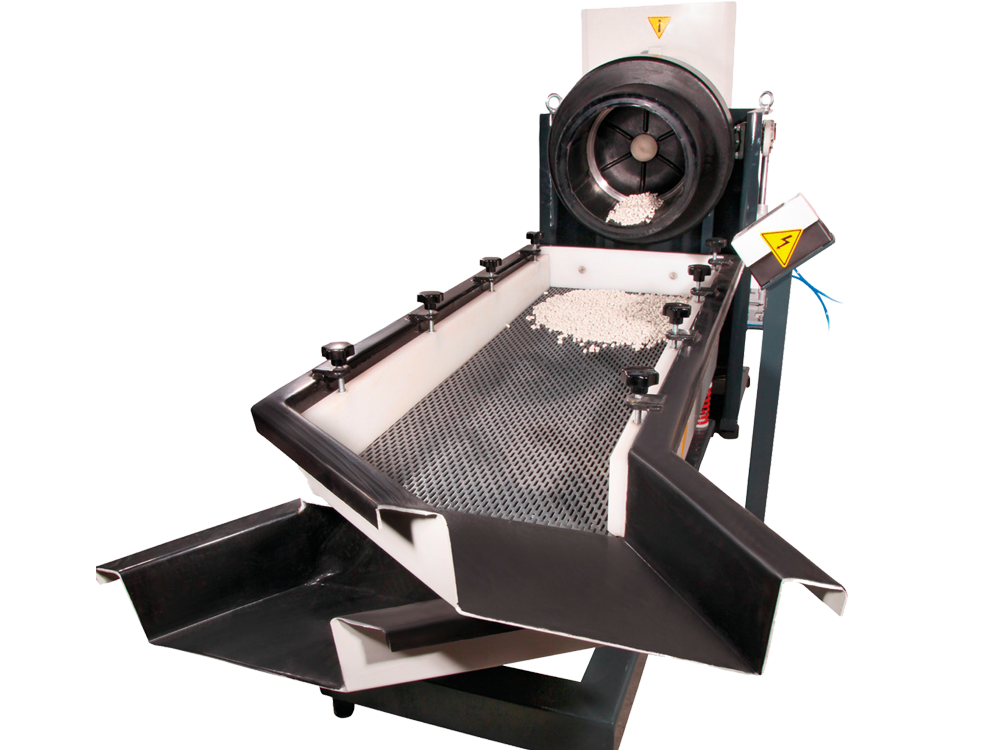
In production environments where cleaning aerospace parts follows directly after finishing, integrating washing and drying into a continuous or semi-continuous finishing line reduces handling time, contamination risk from manual transfer, and operator labor. A typical automated finishing line for aerospace components may include a centrifugal disc finishing machine or vibratory finishing machine, a separator to remove parts from media, an in-line pressure rinse or spray wash station, an ultrasonic cleaning tank if required by the part specification, a final rinse station with controlled water quality, and a warm air dryer.
PLC-controlled finishing lines allow recipe-based process control, where washing time, temperature, compound dosing, and drying cycle are set per part number. This approach improves repeatability compared to manual batch washing and reduces the risk of process deviations that could affect downstream quality. For aerospace production where process traceability is required, automated lines with data logging provide documentation of cleaning cycle parameters for each batch.
KAYAKOCVIB offers integrated washing and drying systems that can be configured alongside KSM centrifugal disc finishing machines or KVM vibratory finishing machines to form complete finishing lines. The specific configuration depends on part size, geometry, production volume, and the cleanliness level required by the part specification.
Frequently Asked Questions
Why is cleaning aerospace parts after surface finishing treated as a separate process step?
Finishing operations introduce compound residue, metallic fines, and abrasive dust onto part surfaces. These contaminants must be removed before downstream processes such as anodizing, conversion coating, adhesive bonding, or NDT inspection can proceed reliably. Cleaning is a controlled process step with defined parameters, not simply a rinse.
What cleaning method is most suitable for small titanium aerospace parts with complex geometry?
Ultrasonic cleaning in a bath formulated for titanium, followed by a clean water rinse and controlled warm air drying, is commonly used for small titanium parts with recesses or fine features. Cleaning agents must be free of chlorine and fluoride to avoid chemical attack on titanium alloys.
How does water quality affect cleaning results for aluminum aerospace parts?
Hard water with high mineral content leaves calcium and magnesium deposits on aluminum surfaces during drying. These deposits can appear as white marks and may affect the uniformity of anodizing or other surface treatments. Using demineralized or deionized water in the final rinse stage prevents this problem.
Can the cleaning step be integrated into a centrifugal disc finishing line?
Yes. After the centrifugal disc finishing cycle and media separation, parts can pass directly through an in-line wash station and dryer within an automated finishing line. This integration reduces handling, improves repeatability, and supports process traceability requirements in aerospace production.
Conclusion
Cleaning aerospace parts after surface finishing is an engineering process step that requires the same level of specification and control as the finishing operation itself. The contamination profile, part material, geometry, and downstream process requirements all drive decisions about washing technology, compound selection, rinse water quality, and drying method. For small precision parts processed through centrifugal disc finishing, the combination of spray or ultrasonic washing, multi-stage rinsing with controlled water quality, and warm air drying represents a technically sound process sequence. Process parameters must be validated through testing and confirmed against the cleanliness requirements defined by the part application. Integrating cleaning into an automated finishing line improves consistency and supports the traceability requirements common in aerospace and defense manufacturing environments.
Related KAYAKOCVIB Technical Resources
Related Video Demonstration
KSM centrifugal disc finishing machine demonstration for high energy deburring, polishing, and edge rounding applications.
Sorry, the comment form is closed at this time.