


24 May Coin Polishing System
A coin polishing system is a specialized mass finishing solution used in minting facilities and metal processing operations to refine the surface condition of coin blanks, finished coins, or medallion discs to a defined surface quality standard. Unlike general-purpose deburring equipment, a coin polishing system must achieve consistent, repeatable surface results across very high batch volumes while protecting part geometry and preventing surface damage between individual pieces. The process combines controlled mechanical motion, precisely selected finishing media, and liquid compound chemistry to produce surfaces ranging from smooth satin finishes to mirror-level brightness depending on the application requirement.
Engineering Definition and Purpose
In coin minting, surface preparation before and after stamping directly affects the visual and functional quality of the final product. Coin blanks must be free of rolling marks, scratches, oxide layers, and edge irregularities before they enter the stamping press. After stamping, collector coins, commemorative medallions, and circulation coins may require additional polishing to remove press marks or refine surface brightness.
A coin polishing system performs this function through mass finishing principles. The machine generates controlled relative motion between the workpieces and the finishing media. This motion creates millions of micro-abrasive or burnishing contacts per cycle that progressively smooth, refine, and brighten the coin surface. The process is scalable, consistent, and suitable for high-volume production without manual handling of individual pieces.
Machine Working Principle
The core operating principle of a coin polishing system relies on the interaction between three elements: machine motion, finishing media, and compound solution. The machine creates a defined flow pattern inside the processing bowl or channel. Coins and media move together in this flow pattern, generating controlled surface contact. The type of media determines whether the action is primarily abrasive, cutting, burnishing, or a combination of these.
In circular bowl-type polishing machines, the drive system produces a vibratory or rotary motion that causes the media-coin mass to circulate in a toroidal flow path. This flow ensures all coin surfaces receive uniform contact with the media throughout the cycle. The compound solution acts as a lubricant, carrier, and chemical agent that supports the surface conditioning action, prevents recontamination, and removes material released during the process.
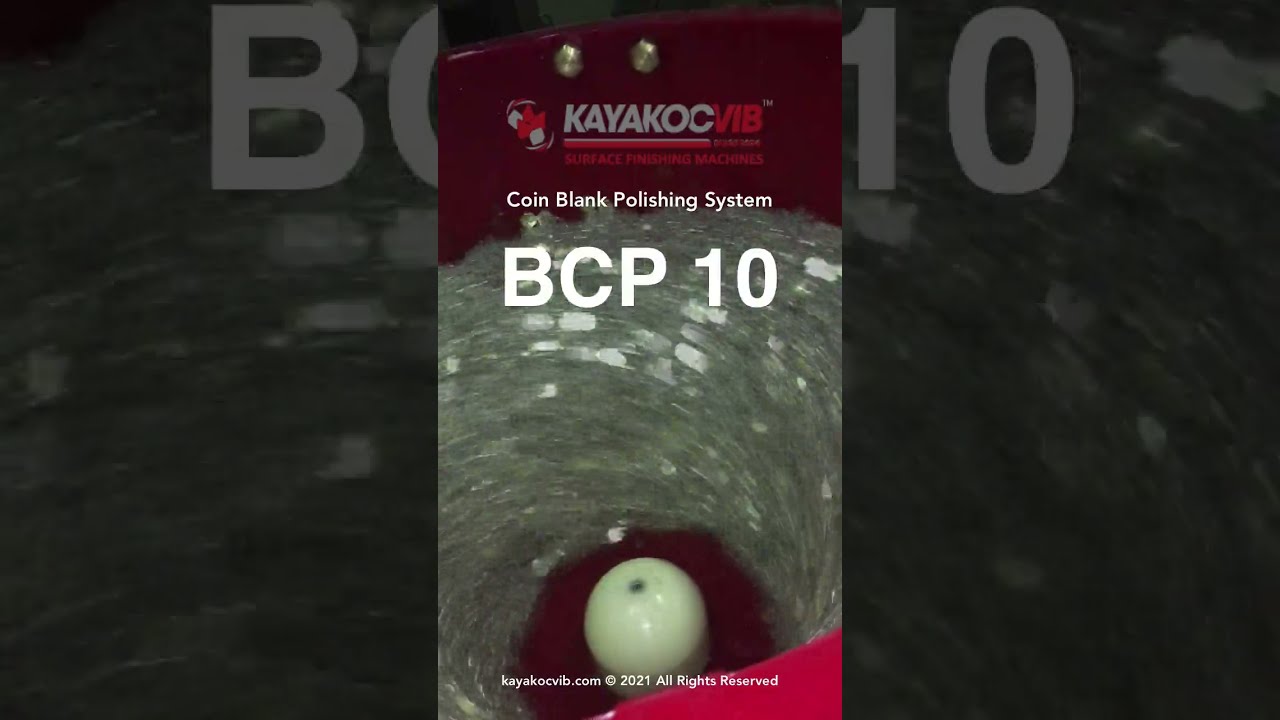
The KAYAKOCVIB BCP-10 coin polishing system uses this operating principle with a machine design optimized specifically for coin geometry. The bowl configuration, drive frequency, and amplitude settings are engineered to produce the surface flow conditions required for consistent coin polishing results across large batch volumes.
Process Steps in Coin Polishing
A complete coin polishing process typically follows a defined sequence from part loading to finished surface verification. Understanding each step helps process engineers control the output quality and identify variables that affect the result.
- Coin blanks or finished coins are loaded into the machine bowl together with the selected finishing media at the correct media-to-part ratio.
- The compound solution is introduced at a controlled flow rate. The compound type, concentration, and flow rate are set based on the required surface action and part material.
- The machine runs at the programmed operating parameters including frequency, amplitude, and cycle time. The coin-media mass circulates continuously through the bowl.
- As the cycle progresses, the media contacts the coin surfaces and progressively refines them. Heavier abrasive media removes more material in early stages, while lighter burnishing media in later stages improves brightness without removing significant material.
- At the end of the cycle, coins and media are separated using a separation screen. Coin geometry and media size are matched to allow clean separation without manual sorting.
- Coins are rinsed to remove compound residue, then dried using a drying system before quality inspection or further processing.
Media and Compound Selection for Coin Polishing
Media selection is one of the most influential variables in a coin polishing system. The wrong media type can cause surface damage, imprint texture patterns onto the coin, create part-on-part contact marks, or produce inconsistent brightness levels across the batch.
For coin blanks requiring pre-stamp surface preparation, steel burnishing media is commonly used. Steel balls or mixed-shape steel media generate a compressive burnishing action that smooths the surface, removes light oxidation, and increases surface brightness without removing significant material from the coin blank. Steel media is particularly effective for copper, brass, aluminum, and steel coin blanks.
For post-stamp polishing of collector coins or commemorative pieces, fine plastic media or organic media such as walnut shell or corn cob may be used in dry or wet process configurations. These softer media types refine the surface without affecting the struck design relief. Dry polishing with organic media and a small amount of polishing paste can achieve high brightness levels on sensitive surfaces.
Compound selection depends on the metal type, required surface chemistry, and process stage. Alkaline compounds are commonly used for degreasing and general polishing action. Acidic compounds may be used to support bright finishing on specific metals. Neutral compounds are preferred when surface chemistry must remain stable for downstream processes such as plating or coating.
Key Process Parameters
Controlling process parameters consistently is essential for achieving uniform coin surface quality across production batches. The following parameters directly influence the polishing result.
| Parameter | Effect on Surface Quality | Typical Control Method |
|---|---|---|
| Machine frequency and amplitude | Controls media flow speed and contact intensity | Drive unit settings, machine design |
| Media type and size | Determines abrasive or burnishing action character | Media selection based on material and target finish |
| Media-to-part ratio | Affects contact frequency and part-on-part risk | Loading volume control per batch |
| Compound flow rate and concentration | Controls lubrication, surface chemistry, and contamination removal | Dosing pump and concentration monitoring |
| Cycle time | Determines total surface refinement achieved | Timer or surface quality checkpoint |
| Water temperature | Affects compound activity and surface reaction rate | Temperature-controlled water supply |
Actual process outcomes depend on the specific coin material, alloy composition, initial surface condition, and required final quality level. All parameter settings should be validated through controlled sample testing before full production runs are established.
Industrial Applications Beyond Coin Minting
While the primary application of a coin polishing system is in coin minting facilities processing copper, brass, aluminum, and bimetallic coin blanks, the same machine configuration is applicable to other disc-shaped or flat metal parts with similar geometry and surface requirements. Medallion manufacturers, token producers, gaming chip manufacturers, and button-style fastener producers use comparable polishing systems to achieve defined surface conditions at high production volumes.
In decorative hardware production, flat stamped components such as badges, emblems, and identification plates may be processed using similar equipment and media configurations. The key requirement in all these applications is that the part geometry is compatible with the media separation step and that the part material is suitable for the selected media and compound combination.
Surface Quality Factors and Finishing Limitations
Several factors influence whether a coin polishing system achieves the target surface quality for a given application. Part material is a primary variable because different metals respond differently to abrasive and burnishing media. Copper and brass generally respond well to steel burnishing media. Aluminum requires careful media selection to avoid aluminum smearing or surface tearing. Mixed metal batches, such as bimetallic coins with different inner and outer materials, require media and compound combinations that are compatible with both metals simultaneously.
Initial surface condition of the coin blank also matters significantly. Blanks with deep rolling marks, heavy oxidation, or significant edge burrs from the blanking operation may require a preparatory deburring stage before the polishing cycle. Attempting to achieve a bright polish on a surface with heavy defects in a single process stage typically produces inconsistent results.
Part-on-part contact is a specific risk in coin polishing because coins are flat, smooth, and high-value surfaces. If the media-to-part ratio is too low or the media shape is incorrect, coins may contact each other during the process and create surface marks. Correct loading ratios and media selection are essential to prevent this defect mode.
Very high-gloss mirror finishes, particularly for proof-quality collector coins, may not be achievable through standard mass finishing processes. Proof coin finishing typically involves hand-polishing of individually prepared dies and controlled stamping rather than mass polishing of finished coins. A coin polishing system is most effective for achieving consistent satin, semi-bright, or bright commercial finishes across large batch volumes, rather than for proof-level surface conditions.
Separation, Washing, and Drying Integration
A complete coin polishing system installation includes separation, washing, and drying stages following the polishing cycle. After the polishing cycle is complete, coins and media are discharged onto a vibrating separation screen. The screen aperture is sized to allow media to pass through while retaining the coins. Correct sizing of the separation screen is critical to prevent coin damage during separation or media retention on coin surfaces.
After separation, coins carry residual compound and fine finishing debris on their surfaces. A rinsing or washing stage removes this contamination before drying. In higher-output facilities, pressure washing or cascade rinsing systems are integrated directly into the finishing line to ensure clean coin surfaces before drying.
Drying is performed using a vibratory dryer loaded with dry organic media such as corn cob granules. The dryer transfers residual moisture from the coin surface to the organic media while the vibratory motion prevents part-on-part contact and promotes uniform drying. For high-volume minting lines, continuous-feed drying systems maintain output flow without batch interruptions.
Automation and Production Line Integration
Modern coin polishing installations in high-volume minting facilities operate as integrated finishing lines rather than standalone machines. Automated part loading, timed polishing cycles, automatic media and compound dosing, controlled separation, and integrated drying are combined under a central control system. PLC-based recipe management allows operators to store and recall validated process parameters for different coin types, materials, and surface quality targets.
Automation reduces operator dependency, eliminates manual parameter adjustment between batches, and improves batch-to-batch consistency. For minting operations running multiple coin types or alloys, recipe control systems enable rapid changeover between process programs while maintaining validated settings for each product type. Wastewater from the wet polishing and washing stages should be managed through a wastewater treatment system to maintain compound concentration control and meet environmental discharge requirements.
Frequently Asked Questions
What type of media is used in a coin polishing system?
Steel burnishing media is most commonly used for coin blank surface preparation and general commercial bright finishing. Plastic media, walnut shell, and corn cob media are used for softer finishing actions on struck coins or sensitive alloys. Media selection depends on the coin material, required surface finish, and processing stage.
Can a coin polishing system process bimetallic coins?
Yes, but media and compound must be selected to be compatible with both the inner and outer ring materials simultaneously. Compound chemistry must not cause galvanic or selective etching effects between the two metals. Process validation through sample testing is required before production processing of bimetallic coin types.
How is surface quality verified after coin polishing?
Surface quality is typically verified through visual inspection under controlled lighting conditions and, in higher-specification applications, through surface roughness measurement using profilometry. Gloss meters may be used for brightness-critical applications. The acceptance criteria should be defined and documented before production begins.
What is the difference between coin polishing and coin burnishing?
Burnishing is a specific type of polishing action in which surface smoothing occurs through plastic deformation of surface asperities rather than abrasive material removal. Steel media in a coin polishing system creates a burnishing action. Abrasive media such as ceramic or plastic shapes creates a cutting and smoothing action with more material removal. Both actions may be used in sequence to achieve different surface stages.
Conclusion
A coin polishing system delivers controlled, repeatable surface finishing for coin blanks and finished coins through the combination of machine motion, media contact, and compound chemistry. Engineering the correct process requires selecting the appropriate machine configuration, matching media type and size to the coin material and target finish, controlling all process parameters within validated ranges, and integrating separation, washing, and drying stages into a complete production flow. The KAYAKOCVIB BCP-10 coin polishing system represents a purpose-built approach to this requirement. Process engineers should establish the target surface quality specification, validate parameters through controlled sample testing, and design the production line around confirmed process data rather than assumed results.
Related KAYAKOCVIB Technical Resources
Related Video Demonstration
BCP10 blank coin polishing system for controlled coin surface finishing and polishing operations.
Sorry, the comment form is closed at this time.